2025.12 KENDOJIDAI
Composition: Tuchiya Tomohiro
Photography: Nishiguchi Kunihiko
*Unauthorized reproduction or use of any images in this article is strictly prohibited.
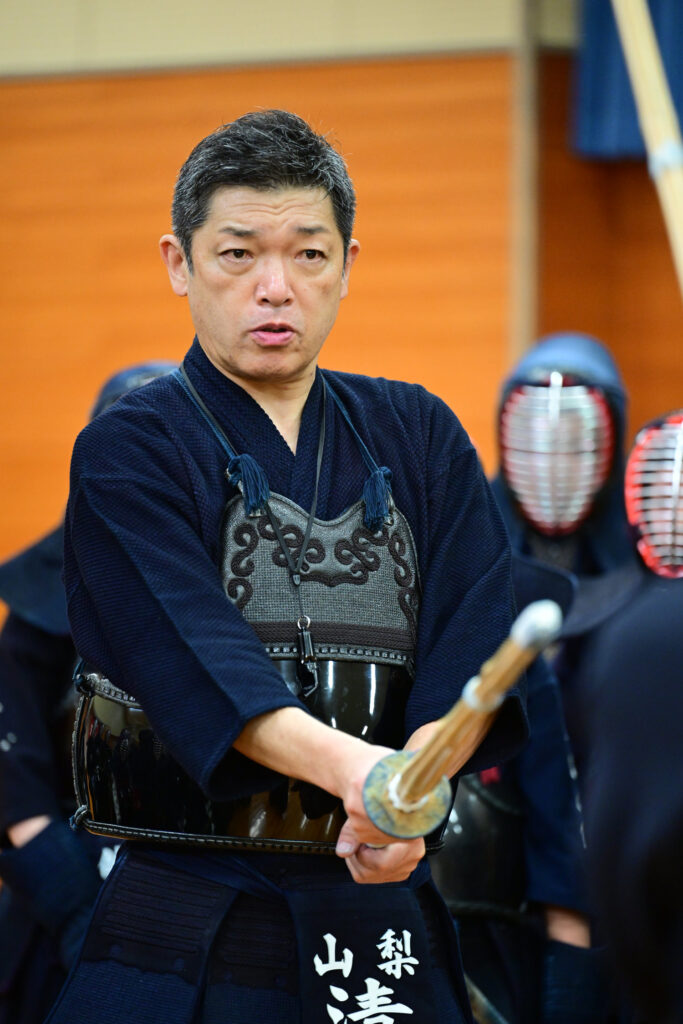
Even when referring to Shikake waza in a single phrase, Kiyono Hanshi emphasizes that what truly matters is not merely the techniques as they appear on the surface, but the movement of the mind that lies behind them.
Alongside his methods for instructing young boy and girl Kendo practitioners at Yamanashi Kenshinkan, he speaks about his own Kendo, reflecting on the journey that led him to be awarded the title of Hanshi earlier this year.
Kiyono Shinobu, Hanshi 8th Dan
Applying Pressure That Pins the Opponent in Place
Practical Training for Shikake Techniques
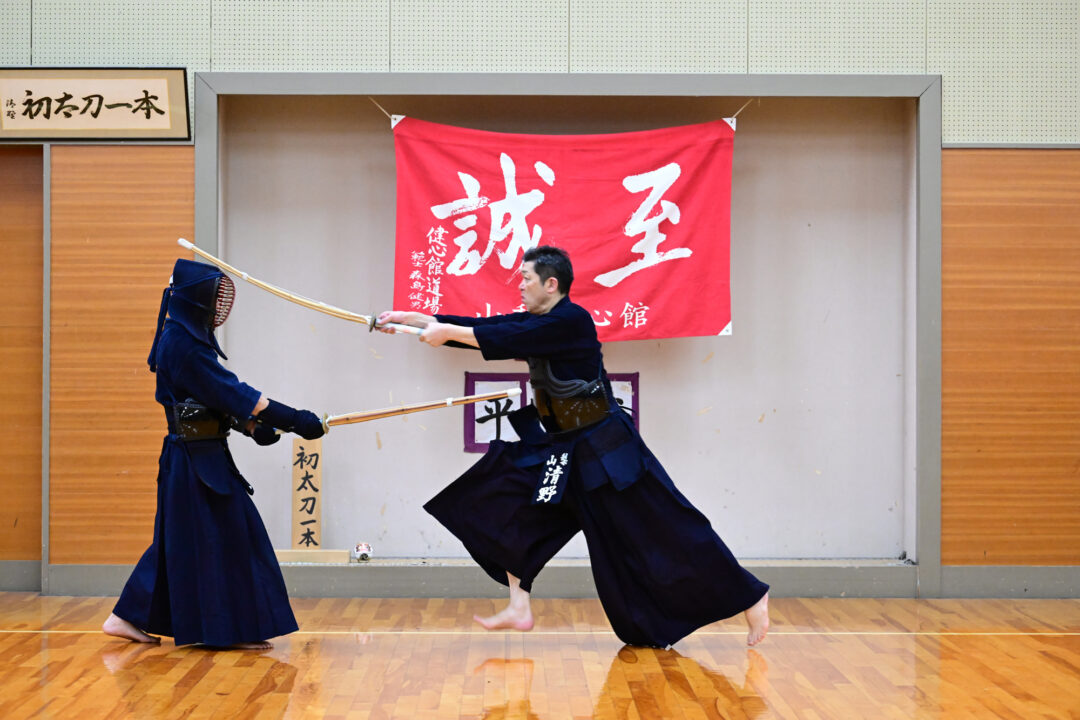
When people speak of Shikake waza, it is often understood simply as taking the initiative, applying pressure, and connecting that pressure directly to a strike. In reality, however, pressing the opponent, fixing them in place, and striking the resulting opening is something I feel is extremely difficult.
With this understanding as a foundation, at Yamanashi Kenshinkan, where I instruct children, we emphasize not only Shikake techniques but all technical training with one central objective: creating a situation in which the Motodachi does not move. Here, “not moving” does not mean striking a motodachi who is merely standing still.
To explain further, when we consider realistic situations for children in actual matches, even if the distance has closed, if the opponent does not feel a clear intention to strike, they will often retreat smoothly. Alternatively, the moment they sense even a slight sign of an attack, many children will raise their left hand and move to evade first. Among adults, more refined exchanges such as controlling the opponent’s sword tip may develop, but for elementary and junior high school students, who do not use Tsuki techniques, raising the left hand to evade becomes the predominant response.
For this reason, the key point of practice is how to create a state within the exchange of pressure in which the opponent’s target areas remain within striking distance. This is a condition close to motodachi practice, in other words a state in which the opponent cannot freely move.
More concretely, when we apply pressure and close the distance, the opponent senses that they are about to be struck and will either evade, retreat, or attempt a technique such as Men. If the opponent retreats or evades, the first strike is avoided and a second strike becomes necessary. However, in the moment when the opponent feels they can strike and moves forward, or when they attempt to evade by raising the left hand, openings appear in the angle of the body or in the hands as they rise. If one commits fully and executes the technique at that moment, the likelihood of scoring an ippon increases significantly.
In other words, what is required is pressure that creates a state in which the opponent cannot move freely, a moment of fixation, and that induces the instant when the opponent initiates a strike. This produces kyo (虚), a state of emptiness. I believe that developing the ability to sense and seize that Kyo as an opportunity for striking is essential in training.
Maai Is Not Distance but a Place of Mutual Perception
The rest of this article is only available for Kendo Jidai International subscribers!