2025.7 KENDOJIDAI
Photography: Nishiguchi Kunihiko
Interview: Teraoka Tomoyuki
*Unauthorized reproduction or use of any images in this article is strictly prohibited.
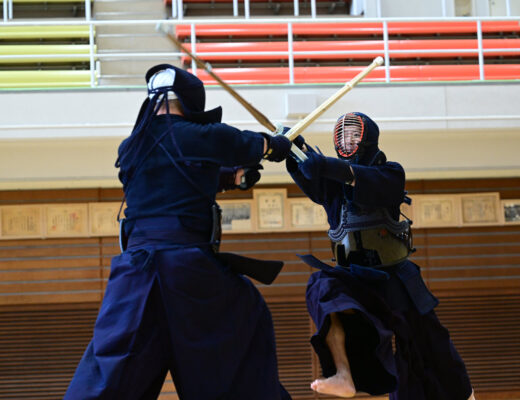
In May of last year, Koseki Taro, Kyoshi, achieved the long-awaited promotion to 8th Dan. He explains that a major key to his success was his commitment to keeping the tip of his Shinai centered.
“Opportunities are not something you force. They emerge naturally within the exchange.”
We spoke with Koseki Kyoshi about his perspective on Maai and the recognition of opportunity.
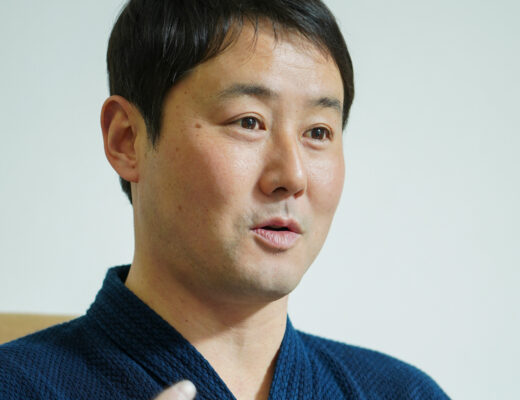
Koseki Taro
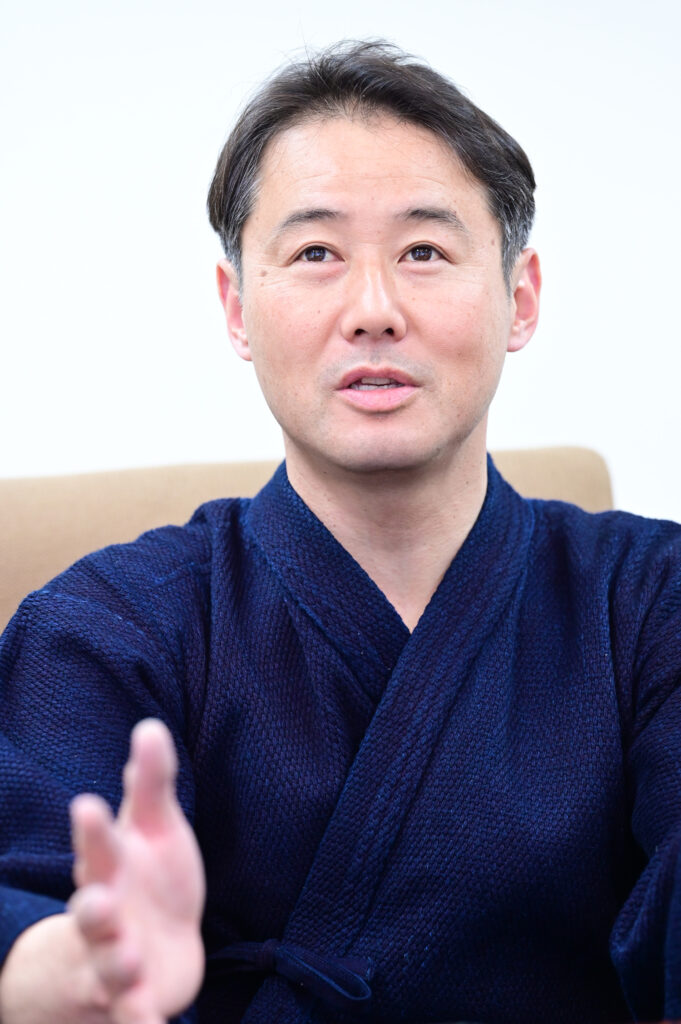
In May 2024, he was promoted to 8th Dan. He currently serves as a Kendo instructor for the Tokyo Metropolitan Police Department, where he is dedicated to training the next generation.
A Teaching from Ajiro Hanshi
“Keep the tip of your Shinai centered.”
The theme this time is Maai and opportunity, so I would like to begin by sharing my experience from the 8th Dan examination.
In May of last year, I passed the 8th Dan exam on my fifth attempt. Looking back now, I feel that my Tachiai at the time of passing was completely different from my first attempt.
On my first attempt, I was able to advance to the second round. However, after that, I could not even pass the first round, and I struggled with the question of what I was lacking.
A major turning point along that journey was the Keiko I had with my mentor from Tokai University, Ajiro Tadahiro Sensei.
Up until that point, I had focused on applying strong Seme, controlling the opponent’s Shinai, and constantly trying to strike. I approached Keiko with Ajiro Sensei in the same way, but he told me, “Keep the tip of your Shinai centered. You should not chase your opponent, respond forcefully to their pressure, or push from your side.”
At the time, I could not fully grasp what he meant. However, I began to understand it more clearly during a Keiko session some time later.
At a Keiko gathering with many experienced Kenshi, none of them seemed convinced by the techniques I executed through forceful Seme. In contrast, when both of us reached Aiki and I struck at the right moment, they would respond with a clear sense of acceptance, as if to say, “Ippon.”
That experience taught me that a truly convincing strike, one that the opponent fully accepts, cannot come from self-centered, forceful Kendo.
Around the same time, I also received guidance from Hirao Yasushi, Chief Instructor of the Tokyo Metropolitan Police Department, who told me, “It is better not to drop your body to find your rhythm.” Although the wording was different, I believe he was conveying the same idea as Ajiro Sensei. Strikes that are driven solely by oneself, neglecting the interaction with the opponent, do not resonate with the opponent’s spirit.
As I continued my Keiko based on this advice, I began to hold my Shinai slightly higher than before, so as not to be influenced by the opponent’s Shinai. Gradually, I started to perceive the opponent’s trajectory and Maai in a way that felt completely different from before.
In April of last year, my role at work also changed, and I had more opportunities to practice with people I had never faced before. Even without knowing their habits, I felt that I was able to engage in good exchanges. With that sense of confidence, I decided to focus only on this point when I stepped into the Tachiai for the May examination.
When I compare my successful Tachiai with my previous ones, the biggest difference was the number of attacks. As I mentioned earlier, when your Kendo is self-centered, the number of strikes naturally increases. On the other hand, when you prioritize the exchange with your opponent and carefully consider Maai and opportunity, the number of attacks decreases.
Looking back at the first round of the exam when I passed, I only executed three strikes. Among them were techniques that gave me a clear sense of effectiveness, and I believe this led to my success in the first round. In the second round, I maintained the same approach in my Seme, and was able to achieve promotion.
Maintaining proper striking distance allows opportunities to reveal themselves naturally
From here, I would like to speak in line with the theme. First, regarding Maai, there are broadly three types: To-Ma, Chika-Ma, and Issoku-Itto-no-Maai. While each person may have a slightly different sense of what defines Maai, I consider it to be the distance between the left feet of both practitioners.
This is often described as “Uchima,” but for me, proper Maai is the distance from which I can strike Men without moving the left foot. How well you can create this Uchima within the exchange is a crucial factor in producing an effective strike.
At this point, what I focus on is creating a Maai that is close for me, yet far for my opponent. It is difficult to express in words, but this situation emerges from the opponent’s reactions, which are induced through adjustments in Kamae, footwork, and the use of the upper body.
I believe that how quickly you can reach and prepare within this Maai is essential for winning the Seme and executing a successful strike. From the moment I rise from Sonkyo, I establish a stance that allows me to strike, and I make a conscious effort to maintain that foundation while applying Seme.
Opportunity is closely connected to the Maai I have just described. When you are fully prepared within proper Maai, there is a sense that the opponent will move on their own, without the need to force an opening.
For example, they may try to strike your Shinai or step deeply into the distance. Capturing the very moment when that movement begins is, for me, the most ideal opportunity.
Returning to the point I mentioned at the beginning, the instruction to “keep the tip of your Shinai centered” is also directly connected to opportunity.
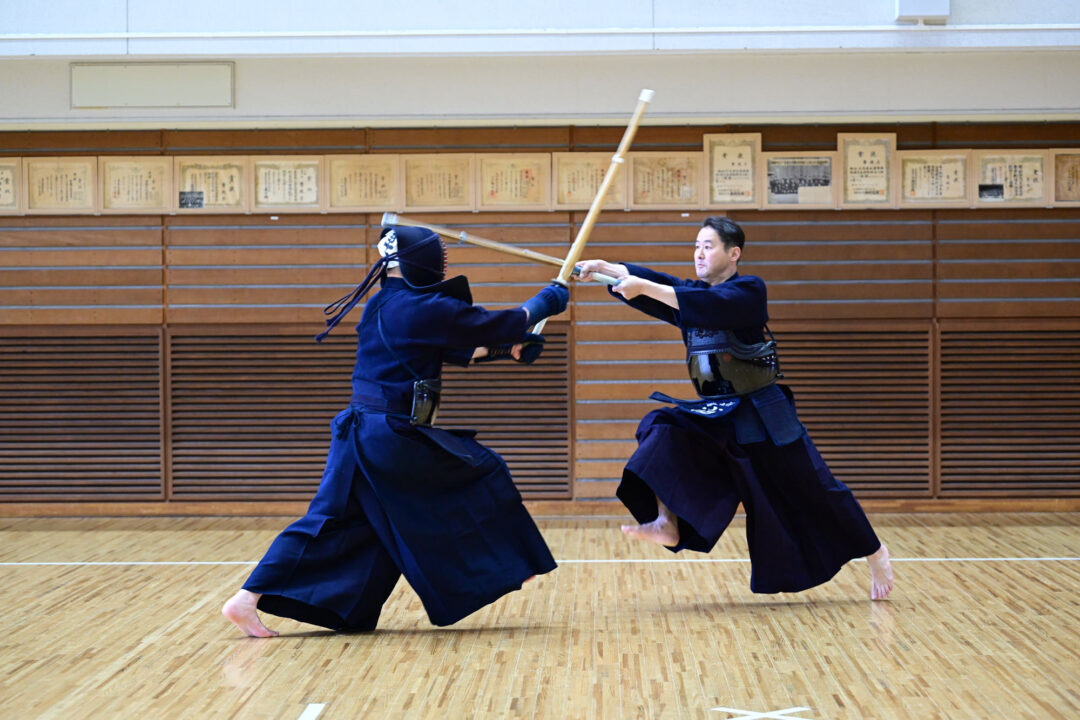
For example, when your opponent presses down on your Shinai, if you react emotionally and try to push back, they will strike as if that very moment were the opportunity they were waiting for. In principle, regaining the center is correct, but doing so in that way can actually give the opponent their timing to strike. You do need to reclaim the center, but it should be done naturally and without force. When you do so, the opponent will, interestingly, not initiate their attack. I believe this is because you are not responding in the way they expect.
By keeping the tip of your Shinai directed toward the center and avoiding excessive reactions to your opponent’s actions, you maintain both physical balance and mental composure. This allows you to perceive even the smallest movements of your opponent, and opportunities begin to reveal themselves.
Opportunities are not something to be forced. They emerge within the exchange.
Keep the tip of the Shinai centered and maintain flexibility in the right knee
The rest of this article is only available for Kendo Jidai International subscribers!