
2026.4 KENDOJIDAI
Photography: Nishiguchi Kunihiko
Interview: Teraoka Tomoyuki
*Unauthorized reproduction or use of any images in this article is strictly prohibited.
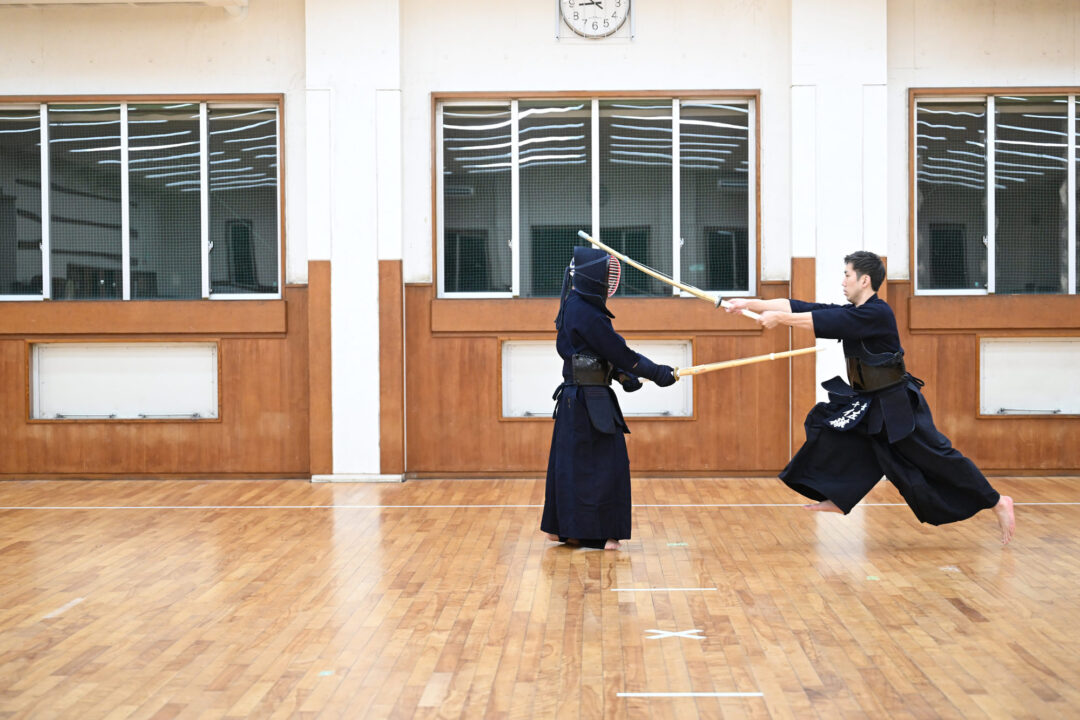
Sato Hirotaka retired from the Chiba Prefectural Police two years ago and has since founded a Kendo school, where he devotes himself to teaching, mainly to elementary and junior high school students. During his competitive career, he achieved numerous results with an aggressive style that overwhelmed his opponents.
“My Kendo is always about taking the initiative. At the core of that is Ashi-sabaki,” he says.
We spoke with Sato about the importance of footwork, along with insights drawn from his own experience.
Sato Hirotaka, 6th Dan
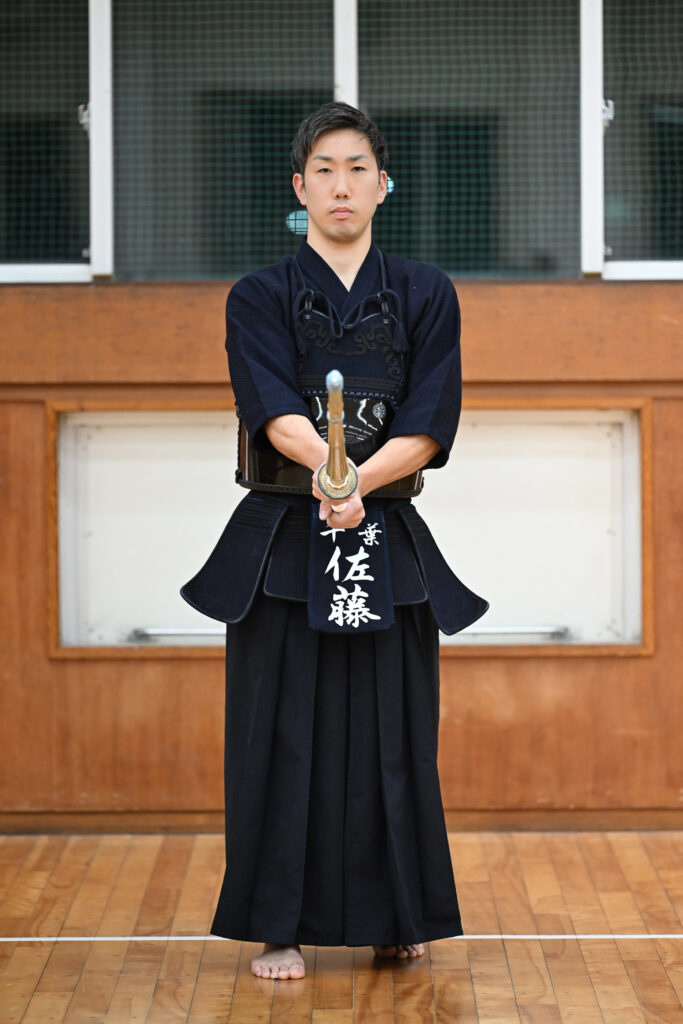
At the end of 2024, he left the police force and established the “MUSYA Kendo School.” In addition to coaching elementary and junior high school students, he actively contributes to the promotion of Kendo by traveling and teaching in various parts of the world.
Ashi-sabaki is not just about moving fast
Build footwork that allows you to strike at any moment
What image comes to mind when you hear the term Ashi-sabaki? Many people would probably say “moving quickly.” While speed is certainly an important element, Ashi-sabaki in Kendo is not limited to that.
What matters even more is what happens after you move. The key is to maintain a stable Kamae and stay in a state where you can launch at any moment. In my view, that is the most important aspect of Ashi-sabaki.
In Japanese, we often describe someone calm and composed as being “grounded.” In Kendo as well, by refining your Ashi-sabaki, you become grounded. This allows you to express your natural Kendo, even in the pressure of Shiai or grading examinations.
When people think of Ashi-sabaki training, many picture the Suri-ashi drills they practiced as children, moving forward, backward, and side to side. Suri-ashi is the foundation of Kendo. Without it, you will inevitably run into problems when trying to develop other techniques.
That is why footwork training is essential when you first begin Kendo. However, it does not mean that once you reach junior high school, high school, or adulthood, you no longer need to train it. On the contrary, I believe you should always maintain the mindset of continuously refining your Ashi-sabaki.
Looking back on my own career, the period when I devoted the most time to Ashi-sabaki was during my years at Awa High School. My mentor, Tokoro Masataka Sensei, placed great importance on footwork, and much of our training time was spent on Ashi-sabaki drills without wearing Men.
His approach was quite different from conventional methods, and at the time I often wondered why we were doing such training. However, the results became clear very quickly. Awa High School was preparing for the Chiba National Sports Festival, and we had many talented players who had already achieved strong results in junior high school. Even so, their movement and striking speed improved dramatically in a short period of time.
As we began to achieve results in competitions, I truly came to understand just how essential Ashi-sabaki is. Those three years made that lesson unmistakably clear.
Why did we place such a strong emphasis on Ashi-sabaki training? At the time, as a high school student, I did not fully understand its essence. But now, I feel I can grasp the reasoning behind it.
Kendo is a discipline where you compete to take Ippon against your opponent. To do that, both speed and powerful strikes are essential. If you watch top-level events such as the All Japan Kendo Championship, you will see that elite Kenshi always possess these two elements.
At Awa High School, in addition to Ashi-sabaki training, we also worked extensively on exercises directly connected to Kendo movement. To truly improve competitive performance, it is not enough to focus only on Shinai techniques. You need to develop your fundamental physical abilities as well.
In the Kendo world, the importance of physical training is often overlooked. From that perspective too, I now realize that placing such a strong focus on Ashi-sabaki was highly meaningful.
Another key point is the speed of initiation and the importance of establishing your footing before your opponent. As I mentioned earlier, in Kendo it is essential to maintain your Kamae without breaking posture, staying ready to launch at any moment. If your balance collapses every time you move, you will not be able to fully commit and execute a technique when the opportunity arises.
By consistently training your Ashi-sabaki, you can maintain proper posture even while moving quickly, allowing you to initiate attacks from a fully prepared state. This enables you to take the initiative and control the flow of the match.
I truly realized this when I was part of the police Kendo training unit (Tokuren). Police Kenshi enter their attacks with remarkable speed. If you are overwhelmed by that speed, you are forced into a defensive position, and in the end, you will be struck.
However, if you turn this around, the principle becomes clear. If you do not give your opponent the time to recover their posture, and instead establish your own position first and initiate the attack, you can create opportunities to strike. With that understanding, I continued to work consciously on my Ashi-sabaki even after becoming an adult.
Even when facing an opponent who may be superior in overall ability, if you fight with a Sen-no-sen mindset, you can create a breakthrough. This is something I have come to realize through my years as a competitor.
To do that, you must develop a certain level of speed and power. But beyond that, it is essential to master Ashi-sabaki that allows you to fully utilize those qualities. That is my firm belief.
To express the movements you envision
Ashi-sabaki training is indispensable
If I were coaching junior high or high school students, I would first emphasize running and sprint training. Some may say that such movements are not necessary for Kendo, but they are fundamental athletic skills. Without them, it is difficult to develop Ashi-sabaki that allows you to move one step ahead of your opponent.
To execute the idea of Sen-no-sen, you also need stamina. No matter how active your footwork is, when a match becomes prolonged, the question is whether you can still take that extra step forward or retreat when needed. From that perspective, building physical endurance is essential.
Another crucial point in Kendo is whether you can execute the movement you have in mind. Even if you intend to strike Debana, if your body does not move at that exact moment, you will miss the opportunity. For junior high and high school students in particular, this connection is not yet fully developed. That is why I tell the students in my school to focus first on moving their bodies, even before theory.
Once you become able to move freely, the range of what you can do expands. To reach that stage as quickly as possible, I believe it is vital to train Ashi-sabaki with dedication.
Since becoming independent, I have had more opportunities to teach overseas Kenshi. Many of them began practicing Kendo as adults, and I feel that Ashi-sabaki is often the biggest hurdle they face.
The same can be said in Japan. When you start Kendo as an adult, it is not easy to dedicate sufficient time to mastering footwork and the fundamentals. As a result, training often becomes centered on Jigeiko, and the awkwardness in movement tends to persist.
If you want to break out of that plateau, I recommend revisiting your Ashi-sabaki first. As your footwork improves, your body will begin to move more smoothly, and that sense of awkwardness will gradually disappear.
I strongly encourage you to take the time to work on it.
Kamae
The rest of this article is only available for Kendo Jidai International subscribers!