2026.4 KENDOJIDAI
Photography: Nishiguchi Kunihiko
*Unauthorized reproduction or use of any images in this article is strictly prohibited.
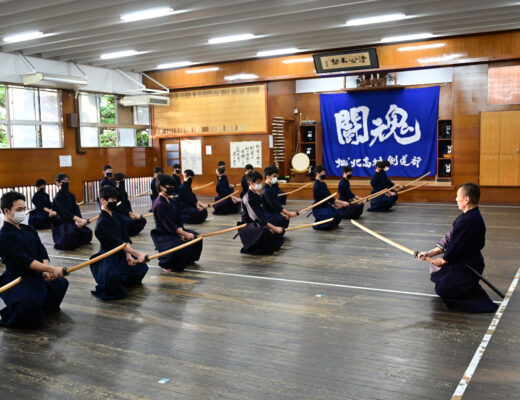
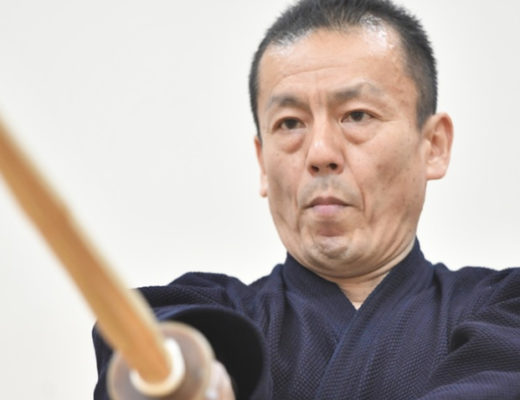
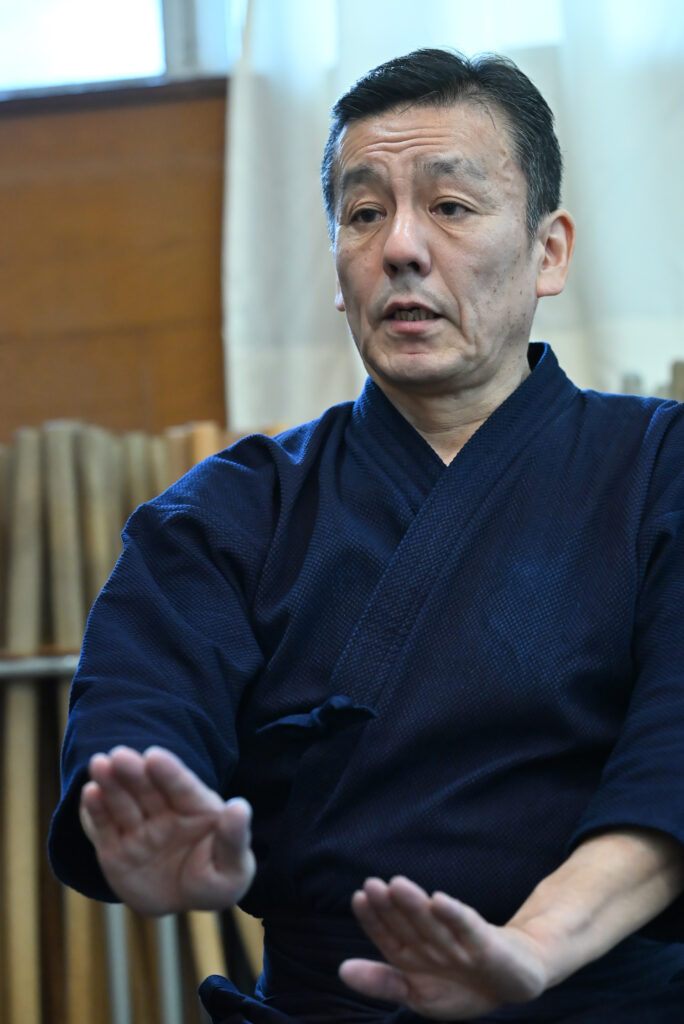
Kadono Sensei, Kyoshi, who teaches at Johoku Junior and Senior High School, hosts a monthly Keiko session called “Mumon-kai,” where he trains together with general Kendo practitioners.
His instruction, which places strong emphasis on the basics, is highly regarded, and he aims to develop the ability to execute correct, decisive strikes in one beat. He stresses that acquiring proper foot positioning is essential for mastering this skill.
Kadono Masato, Kyoshi 8th Dan
Always be aware of weight transfer
From “kicking” to “pushing forward”
I have been teaching at Johoku Junior and Senior High School for 37 years. During that time, I have had the opportunity to coach many Kendo club members, and I provide detailed instruction on Ashi-sabaki, which is the focus of this topic.
Ashi-sabaki refers to how you move your feet in order to strike or evade your opponent, and it forms the foundation of Tai-sabaki.
The floor of our Dojo is made of solid cedar, which is much more slippery than a typical gymnasium floor. For that reason, if you do not establish a proper Kamae and execute techniques from correct posture, it is easy to lose your balance. From bad habits such as “hopping steps” or “shuffling feet,” you cannot execute accurate techniques. Therefore, it is essential to continuously practice Ashi-sabaki, the foundation of Kendo, in order to acquire correct skills.
“Hopping steps” occur when, after executing a technique, the left foot does not slide forward quickly along the floor, but instead lifts upward. This is caused by an insufficient push-off from the left foot. As a result, the left foot lags behind, and your forward movement becomes ineffective.
“Shuffling feet” refers to a state where the right foot faces forward, but the toes of the left foot open outward to the side. In this case as well, you cannot push strongly against the floor, and the left foot drifts backward.
To push strongly off the floor, it is first necessary to establish correct foot positioning. In particular, I believe that one of the main causes of “hopping steps” is an excessive emphasis on the feeling of “kicking.”
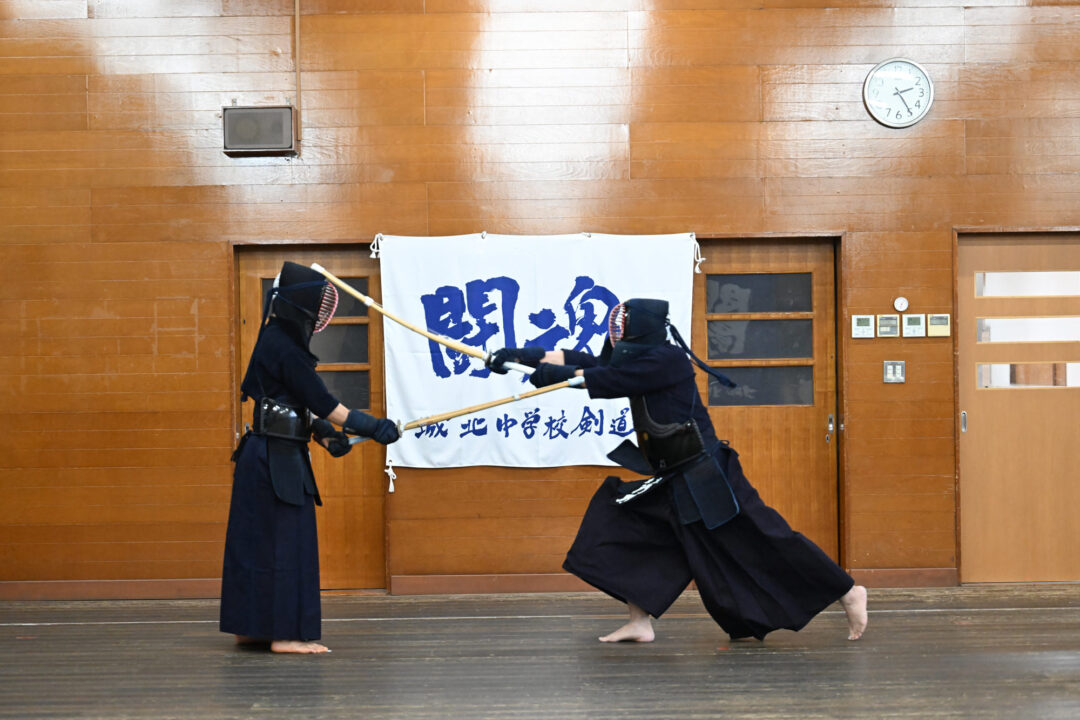
When striking your opponent, you use Fumikomi-ashi, which is essentially an application of Okuri-ashi. In Okuri-ashi, you place your weight on the left foot and advance by moving the right foot forward. On the surface, it appears that the right foot moves first, but what is important is the sensation of initiating the movement from the hips.
In Fumikomi-ashi, you firmly place your weight on the left foot and drive your body forward, shifting your weight onto the right foot as you step in. This allows you to generate a powerful strike.
Tachi-ai is a contest of breaking each other down
If your Kamae collapses, you cannot strike
In Kendo, it is essential to be able to fully express what you have learned in basic training during Jigeiko and Shiai, which are applications of those fundamentals. However, as is well known, this is extremely difficult because your opponent is trying to do the same.
In Tachi-ai, it is important to apply pressure while keeping your Kamae from collapsing as much as possible. In that process, if you can correctly select techniques at key moments such as the “initiation of a technique,” the “end of a technique,” or when your opponent becomes “fixed,” it will lead to effective strikes.
To capture these opportunities, it is essential to keep your left foot in a state where you can strike at any time. If the heel of the left foot touches the floor, however, you are more likely to become fixed, which in turn gives your opponent an opening.
When the desire to strike becomes too strong, tension builds in the upper body, the stance widens, the left hip opens, and the right shoulder tends to move forward. From this position, it becomes difficult to execute a strike that meets the criteria of a valid Ippon.
Even under extreme conditions, if you can maintain a stable Kamae centered on the left side of the body—left hand, left hip, and left foot—while facing your opponent, you will be able to apply pressure. Increasing the number of such moments during exchanges is a key challenge in applied practice such as Jigeiko.
Make Ashi-sabaki training a daily habit
To acquire correct Ashi-sabaki, the most important thing is to practice it consistently in your daily training. It may sound simple, but Kendo training is built on repetition. Since it can be done individually, you can make use of spare time before or after regular Keiko.
The most commonly used footwork in Kendo is Okuri-ashi. It covers eight directions—forward, backward, left, right, and diagonals—so it is essential to train yourself to move your feet properly with movement initiated from the hips.
You should also devote sufficient time to Fumikomi-ashi. In this movement, you place your weight on the left foot and push off powerfully. As mentioned earlier, if you focus too much on the idea of “kicking,” your movement will become a hopping motion. Instead, you should develop a striking motion that begins from the hips, with the feeling of driving your body forward.
Fumikomi-ashi can be trained effectively through repeated Kukan-datotsu (striking practice in the air). Rather than pushing off only with the ankle, you should engage your core and hips, using the entire lower body. Trying to jump too far will break your posture, so it is important to repeatedly practice delivering accurate strikes from Issoku-itto-no-maai.
Maintain your stance width as much as possible
Open the chest and keep the hips upright in Kamae
As mentioned earlier, in Tachi-ai it is essential to maintain your Kamae without collapse. I believe that facing your opponent with the feeling of keeping your hips upright helps release unnecessary tension. If you place too much weight on the left foot and over-engage the hips, the upper body will lean backward. From such a position, it is difficult to respond flexibly, so this must be avoided.
As for stance width, it generally becomes narrower with age. I myself have experienced this, and my stance is now narrower than it was when I was around the time I achieved 8th Dan. As a basic guideline, the distance between your feet is set by aligning the toes of the left foot with the line of the right heel. However, this will vary slightly depending on age and physical condition, so it is important to find a stance width that suits you.
There is one more point I personally keep in mind regarding Kamae: “engaging the inner side of the feet,” especially on the big toe side. By pressing the floor with the base of the left big toe, it becomes more difficult for the left hip to open. This adds stability to the left side of the body, stabilizes the left hand, and in turn strengthens the pressure at the tip of the Shinai.
In Dan examinations, the quality of your Kamae is immediately apparent to the examiners. Any looseness in the left foot (leg) or left hand is particularly noticeable, so careful attention is required.
To concentrate maximum power at the Monouchi, your footwork must be in order
The rest of this article is only available for Kendo Jidai International subscribers!