2025.11 KENDOJIDAI
Composition: Teraoka Tomoyuki
Photography: Sasai Takamasa
*Unauthorized reproduction or use of any images in this article is strictly prohibited.
Kendo is often believed to be something you must start in early childhood, but that is not the case. To help people enjoy steady improvement and continue practicing Kendo for many years, Takahashi Kaiyu, Kyoshi 8th Dan and head of Hatsune Kenshijuku, explains key tips for long-term progress.
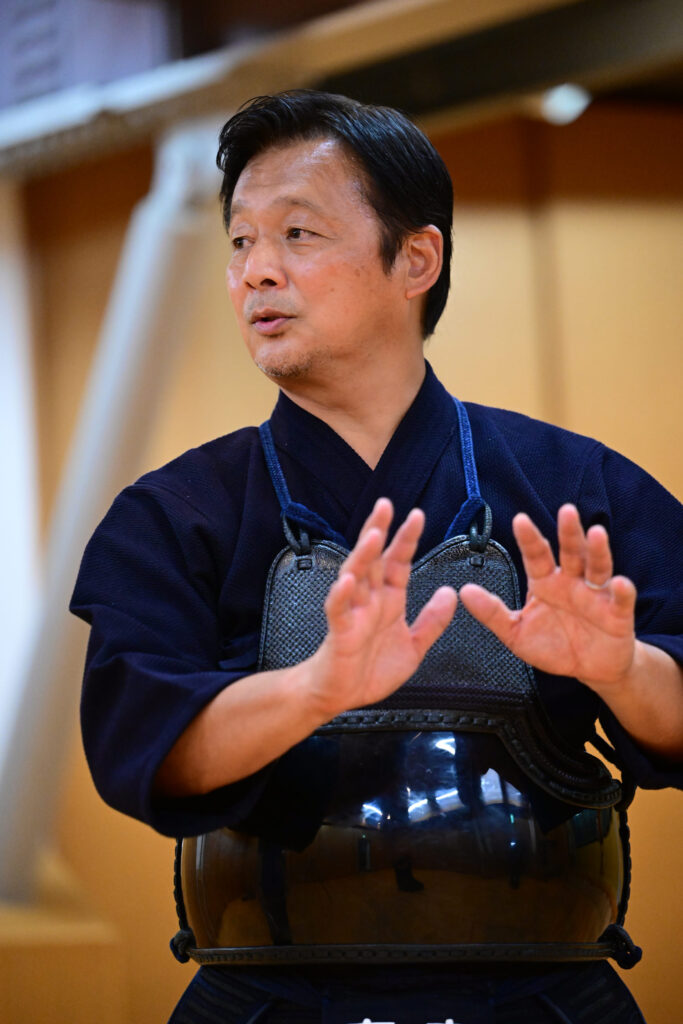
Takahashi Kaiyu, Kyoshi 8th Dan
Month 1: Establishing Proper Basics
In the first month, the primary objective is to help students engage with and enjoy Kendo as a martial art. As with any sport, an uninspiring introduction can diminish motivation. From the instructor’s standpoint, it is important not to criticize what students cannot yet do, but rather to acknowledge what they can do and reinforce their willingness to continue.
The first and most essential element to learn is Reihō (etiquette). Reihō is the entryway to all martial arts, and simply becoming able to perform it properly gives learners a real sense that they are studying budo. Methods such as standing bow and seiza are unfamiliar to many adults, so it is advisable to ensure that students acquire these fundamentals securely at the introductory stage.
Once students hold the Shinai, they learn the correct grip and Chūdan-no-kamae. Even among those with many years of Kendo experience, it is not uncommon to see people who do not grip the Shinai properly. A poor grip hinders later technical development, so instructors should check students’ hands carefully and ensure that they acquire correct grip and posture from the outset.
After they can assume the correct Kamae, they move on to footwork, making sure not to break the posture they have just learned. In the beginning, it can be effective to practice without a Shinai. Kendo has four types of footwork: Okuri-ashi, Ayumi-ashi, Hiraki-ashi, and Tsugi-ashi. At the introductory stage, the focus should be on Okuri-ashi and Hiraki-ashi so that students can move freely forward, backward, and laterally.
Regarding Suburi, it is helpful not only to practice Men swings but also Sayū-Men, Kote, and Dō as air-strikes. Doing so makes later skill acquisition much smoother. For adults who have not exercised regularly, performing dozens of Suburi can be physically demanding. Even twenty repetitions of each type quickly add up to nearly one hundred swings, so the number should be adjusted according to each individual’s physical capacity.
Once the student can perform Men Suburi smoothly from the Kamae position, they will be able to learn correct Men-uchi without difficulty. These milestones constitute the goals for the first month.
Standing Bow (Ritsurei)
In Kendo, the angle of the bow differs depending on the situation. When bowing to an opponent before or after practice or a match, the bow is performed at approximately 15 degrees. When bowing to instructors or toward a shrine or altar before and after practice, the bow is made at approximately 30 degrees.
Seiza and Seated Bow (Zarei)
In accordance with the principle of “left knee down, right knee up”, one enters seiza by lowering the left knee first, and stands up by moving the right foot first. In Zarei, both hands form a triangle on the floor, and the practitioner lowers the head toward that point while keeping the back straight, without rounding it.
Grip of the Shinai
The Shinai should be gripped from above, not from the side. Gripping from the side prevents proper swinging mechanics. A good indicator of a correct grip is that the thumbs point downward, confirming that the hands are placed from above.
Kamae
In Kamae, the left fist is positioned on the practitioner’s centerline. Beginners should keep the Kensaki (tip of the Shinai) pointed straight toward their opponent.
Suri-ashi
Suri-ashi is the most fundamental movement in Kendo. Practitioners first learn okuri-ashi forward and backward, as well as hiraki-ashi. When moving forward, the movement begins with the left foot pushing the body; when moving backward, it begins with the right foot pushing the body.
Month 2: Becoming Comfortable with Striking Techniques and Kendo Equipment
The rest of this article is only available for Kendo Jidai International subscribers!