2025.12 KENDOJIDAI
Composition: Yanagida Naoko
Photography: Sasai Takamasa
*Unauthorized reproduction or use of any images in this article is strictly prohibited.
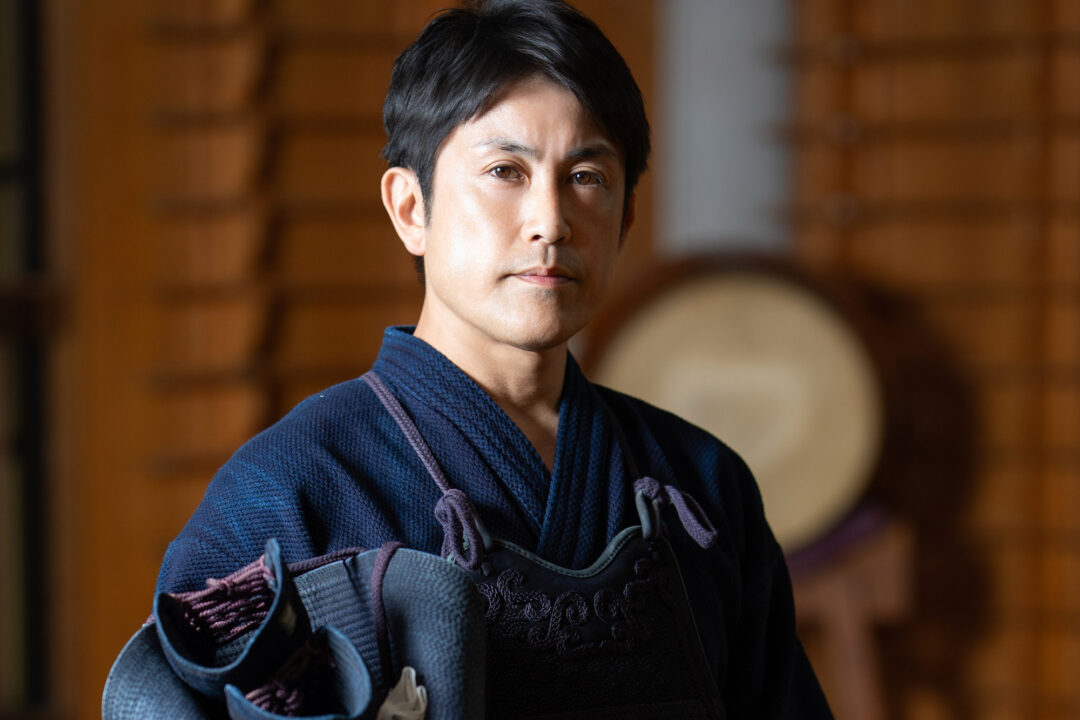
Takanabe Susumu
Born in Kumamoto Prefecture in 1976. After graduating from PL Gakuen High School, he entered the University of Tsukuba. Upon graduation, he joined the Kanagawa Prefectural Police. His major achievements include: three-time team champion and individual champion at the World Kendo Championships; three-time winner of the All Japan Kendo Championship (including one consecutive double title), with one second-place finish and two third-place finishes; four-time team champion and four-time individual champion at the All Japan Police Kendo Championship (including one three-peat); and three-time winner of the All Japan Invitational 7th Dan Kendo Championship. He is currently an instructor at the Kanto Regional Police Academy.
Letting Others See His Current Kendo
Marking a striking debut at the 8th Dan level, Takanabe Susumu, who has captured numerous team and individual titles throughout his career, achieved a remarkable first appearance and first victory at the 25th Prince Tomohito Cup All Japan Invitational 8th Dan Kendo Championship.
“First of all, I felt deep gratitude simply for being selected to compete in this tournament, which brings together so many outstanding teachers. Being given the opportunity to participate is a great honor, but at the same time, I felt a strong sense of responsibility. I believed it was important to be fully aware of that responsibility as a selected competitor.”
This tournament gathers elite practitioners at the highest rank of Kendo, 8th Dan. That sense of responsibility, he says, was reflected in both his attitude and state of mind as he approached each match.
“Of course, when you compete, you aim for victory. However, this time, rather than focusing solely on winning or losing, I shifted my emphasis toward allowing others to see and experience my current Kendo and expressing it as it truly is.”
As an 8th Dan, he felt a distinct sense of responsibility and noted that the experience carried a different weight from that of the All Japan Championships or the World Kendo Championships.
“There was also a sense of self assessment in asking myself what my Kendo is like now as an 8th Dan. At the same time, all of the teachers competing were truly outstanding. This time, Yoneya Sensei from the Saitama Prefectural Police and I were the youngest participants. I believe that naturally allowed me to approach the event with a mindset of learning and challenge.”
The venue was the Tokyo Budokan in Adachi Ward, Tokyo. For Takanabe, it was likely his first time competing there since his days as a student at the University of Tsukuba.
“On the day of the competition, the Tokyo Metropolitan qualifying matches for the All Japan Kendo Championship were held before the 8th Dan tournament. Once the qualifiers ended, the opening ceremony and matches began immediately, so there was no opportunity to warm up while wearing men. Since I do not usually enter matches in that manner, I felt that the key would be how to raise and maintain my level of concentration.”
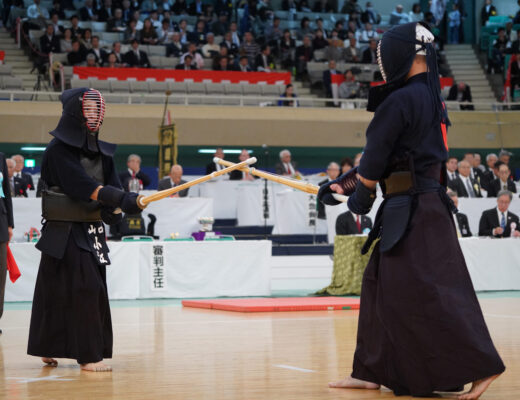
He advanced to the final after defeating Sasagawa Kazufumi, Kyoshi (Metropolitan Police Department), his mentor from the University of Tsukuba Nabeyama Takahiro, Kyoshi (Ibaraki), Sakata Toshiro, Kyoshi (Metropolitan Police Department), and Okamoto Kazuaki, Kyoshi (Metropolitan Police Department). In the final, he faced Iwasa Hidenori, Kyoshi.
Iwasa was the defending champion from the previous year. The match unfolded as a fierce exchange, with momentum shifting back and forth in an intense battle.
“Of course I was nervous, but I focused on fully committing my own Kendo. I scored the first Men quite early, and because of that I felt that I should not fall into a defensive mindset. However, it was returned almost immediately.”
Takanabe took the initiative early with a Men strike, but his opponent quickly answered with one of his own. Looking back, he described it as a misjudgment.
“He Kamae does not easily break. I thought that Tsuki might be a better option than Kote, but when I attempted Tsuki and was countered, I realized that it had been a mistake.”
With the score tied, the match moved into encho. In the end, it was Men that decided the bout. At that point, he says, all that remained was to trust in his own ability.
“There is always the risk of being struck in return with any technique, but I trusted myself and committed to the strike.”
Currently serving at the Kanto Regional Police Academy, he noted that, due to his duties, it had been difficult to adjust his training in the usual meticulous way during the month leading up to the tournament. Even so, his performance culminated in a well deserved victory.
Practicing What He Preaches Leads to Better Teaching
The rest of this article is only available for Kendo Jidai International subscribers!