KENDOJIDAI 2026.2
Photography: Nishiguchi Kunihiko
Interview: Yoshinari Seidai
*Unauthorized reproduction or use of any images in this article is strictly prohibited.
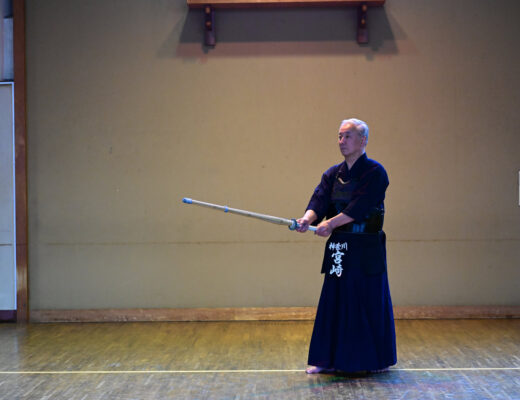
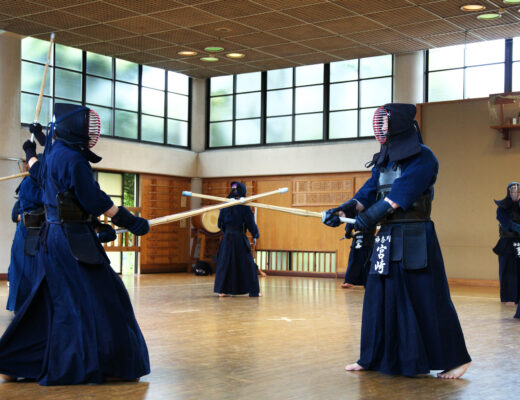
Miyazaki Masahiro, Hanshi 8th Dan (Honorary Chief Instructor of Kendo, Kanagawa Prefectural Police), has achieved an unparalleled record, including six titles at the All Japan Kendo Championship, six victories at the National Police Kendo Championship, and four team championships at the World Kendo Championships, as well as an individual world title.
Drawing on more than fifty years of experience in Kendo, he presents in full the methods, innovations, practical approaches, and thought processes he has cultivated throughout his career.
Miyazaki Masahiro
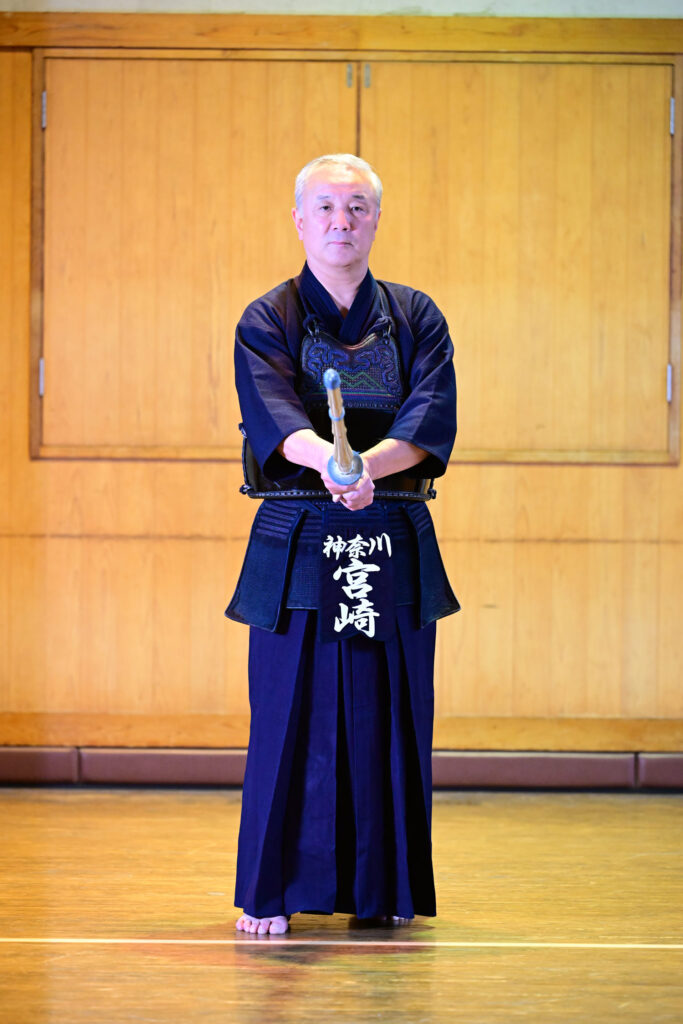
He has compiled an exceptional competitive record, including six victories at the All Japan Kendo Championship, four team titles and an individual title at the World Kendo Championships, team and individual championships at the National Police Kendo Tournament, victory at the All Japan Invitational 7th Dan Championship, and victory at the All Japan Invitational 8th Dan Championship. He served as Head Coach of the Japan Women’s National Team at the 15th through 17th World Kendo Championships. He is currently Honorary Chief Instructor of Kendo for the Kanagawa Prefectural Police, Vice Chair of the All Japan Kendo Federation Strengthening Committee, and holds the rank of Hanshi 8th Dan.
Helping Practitioners Acquire Something That Truly Shines
— In the previous issue, you explained the importance of having clear objectives and goals in Kendo training. With that in mind, what kind of mindset did you bring to your daily Keiko? And after becoming an instructor, how did you approach the task of developing your students?
I began to have clear objectives and goals in my Keiko after entering Tokai University Sagami High School. Until then, I had learned a fundamentals-focused style of Kendo at the Genbukan Sakagami Dojo, but it was not an environment where I was able to push myself through constant rivalry with peers.
That changed completely in high school, where I was confronted with the reality that unless you produced results, you would not be selected to compete. Up through junior high school, there were few practitioners, so I had never experienced the kind of survival competition required to earn a regular position.
During my junior high school years, strong players often competed in both tournaments organized by Dojo federations and those organized by school athletic associations. I did not have access to that kind of environment. The only tournaments I remember entering while wearing my junior high school Nafuda were local ward competitions, what would now be considered preliminaries. I would not even learn about the All Japan Junior High School Championships qualifiers until several years later. In the individual division, I was eliminated in the first round, although the opponent who defeated me went on to compete at the prefectural level.
Despite those results, I wanted to continue practicing Kendo in high school and began thinking seriously about my future path. I did not have any major competitive achievements to my name, but I still carried a sense of hope and a dream that perhaps I could succeed at the high school level as well.
Tokai University Sagami High School came to my attention because seniors from junior high schools in Tsurumi Ward had gone on to study there, and they encouraged me to consider it. The school was nearly a two-hour journey from my home, and when I went to observe practice, it felt almost like going on a trip. It required five train transfers.
When I attended practice, I found myself in a completely different world. Up to junior high school, I had trained only two or three times a week, so it felt as though I had gone through an entire year’s worth of Keiko in a single session.
Even so, I must have had a deep hunger for Kendo. An unfounded sense of hope emerged—“If I work hard here, I can become stronger.” I began to feel that this was a place where I wanted to challenge myself.
The training was intense. Even seniors whom I had thought were strong were completely overwhelmed when they asked Head Coach Yamazaki Sensei for Keiko, unable to do anything in response. The students who would later become my classmates came not only from within Kanagawa Prefecture but also from Kyushu. All of them were competitors who had advanced from prefectural tournaments to national-level competitions.
In terms of competitive achievements, I had none to speak of. However, after entering high school, perhaps through good fortune, I was selected as a team member sooner than expected. As a first-year student, my results in the Kanto Tournament qualifiers and internal team matches were mixed, with both wins and losses, but I was chosen as one of the seven members. A senior had been injured and was forced to withdraw, and I was selected to take his place.
I did not expect to have any opportunity to compete in the actual tournament, but there was another senior who was not in good condition, and I was told that, depending on the situation, I might be put into a match. I was informed of this on the night before the competition, and the next day, my turn came.
I still remember it clearly. We faced Kokushikan High School, and I was unable to win. That match resulted in the first photograph of me ever published in Kendo Jidai. Although it was a loss, it gave me the feeling that I had joined the ranks of the national stage.
Because of those results, I was left out of the team for the subsequent Inter-High School Championship qualifiers. I was taken along to the Gyokuryuki tournament as well, but I did not get an opportunity to compete.
After the team was reorganized, however, I was somehow appointed as Taishō, and from that point on I began to be used regularly as a competitor. Looking back now, I do not think it was because I was particularly strong.
Now that I am in the position of an instructor myself, analyzing that period, I cannot help but feel that this was the case. It is somewhat embarrassing to say this about myself, but I think I may have been seen as the kind of player who “might have one decisive strike,” who was “solid defensively,” and who “could not necessarily win, but also would not lose.”
Yamazaki Sensei advocated a straightforward, orthodox style of Kendo, and Tokai University Sagami High School was well known for its classical approach. Strangely enough, however, I was never subjected to corrective instruction to change my style.
For this reason, I believe it is essential for instructors to respect each practitioner’s individuality to the fullest extent. There are cases where a coach imposes their own ideal form without sufficient reason, but I am reluctant to do that, especially from an early age.
When I scout players, I place great importance on whether they have been allowed to develop freely. Of course, achievements such as winning the Inter-High School Championships or the Intercollegiate Championships are valuable, but I do not approach a player based on results alone. I look for those who possess something that shines—something that suggests, “If this is acquired, they will become stronger,” or “If this area is further developed, they will improve significantly.” When I have the conviction that “this is where they can grow stronger,” it becomes much easier to approach them. In scouting, I believe having a clear and well-founded reason is the most important thing.
Because Keiko is ultimately undertaken in order to become stronger, I think it is especially important for general practitioners, who may have fewer opportunities to receive direct instruction, to analyze their own Kendo and clearly identify what they should work on in order to move toward their ideal form of Kendo.
Instructors Must Exercise Patience: Maximizing Each Athlete’s Individuality
The rest of this article is only available for Kendo Jidai International subscribers!