2025.7 KENDOJIDAI
Photography: Nishiguchi Kunihiko
Interview: Teraoka Tomoyuki
*Unauthorized reproduction or use of any images in this article is strictly prohibited.
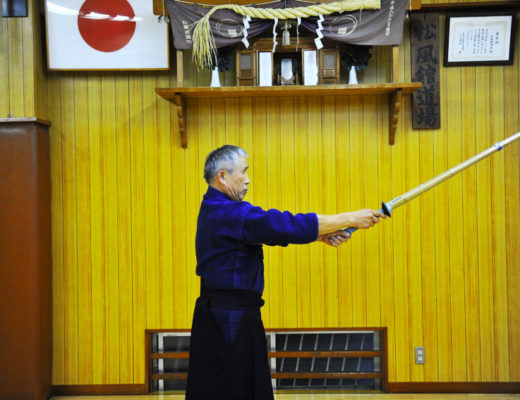
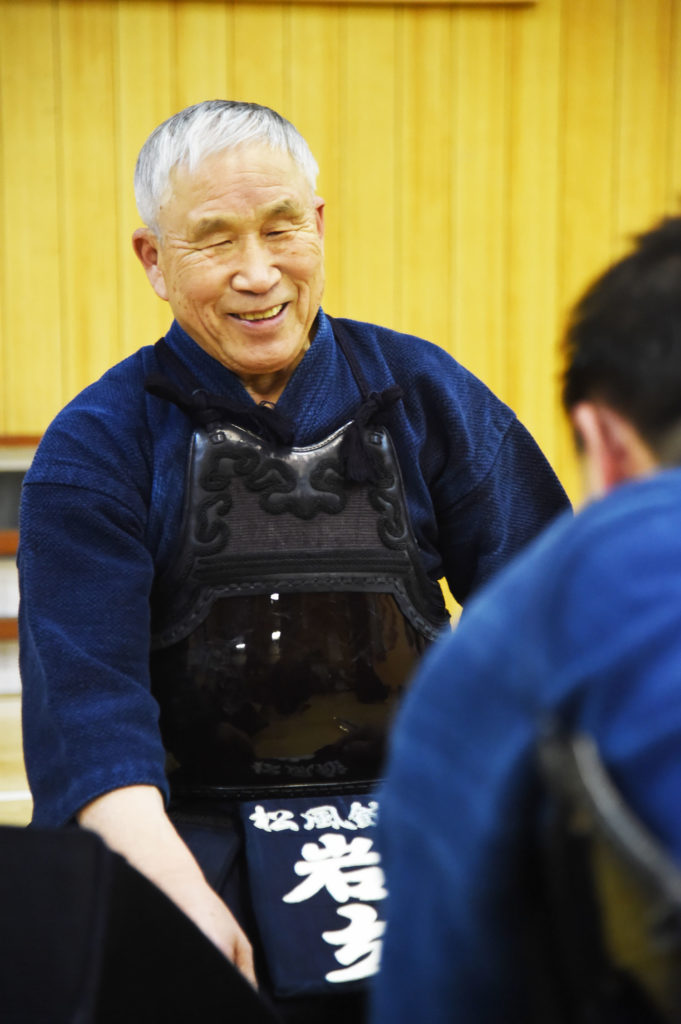
With 71 years devoted to Kendo, Hanshi Iwatate Saburo continues to stand vigorously in the dojo at the age of 86, dedicating himself to the instruction and development of the next generation. He shares the essential principles of Maai and opportunity that he has attained through his lifelong path of Kendo training.
Iwatate Saburo, Hanshi 8th Dan
The Maai of the Shinai and the Maai of the Mind
Maai Changes Depending on the Opponent
When speaking of Maai, the first and most important step is to understand your own Maai. In reality, most people do not truly know their own Maai. I would say that even some 7th Dan practitioners who train at my dojo have not fully grasped it.
What kind of state and positioning in relation to the opponent constitutes your own Maai? It is essential not to simply engage in Keiko, but to practice while thinking deeply about this question.
Those who understand their own Maai naturally have a significant advantage in Tachiai. Conversely, if you do not understand your own Maai, you will end up fighting within your opponent’s Maai instead. Without realizing it, your Maai is taken from you.
Many practitioners become absorbed in exchanges at the tip of the Shinai and lose awareness of the underlying relationship of Maai. This is something I observe quite often.
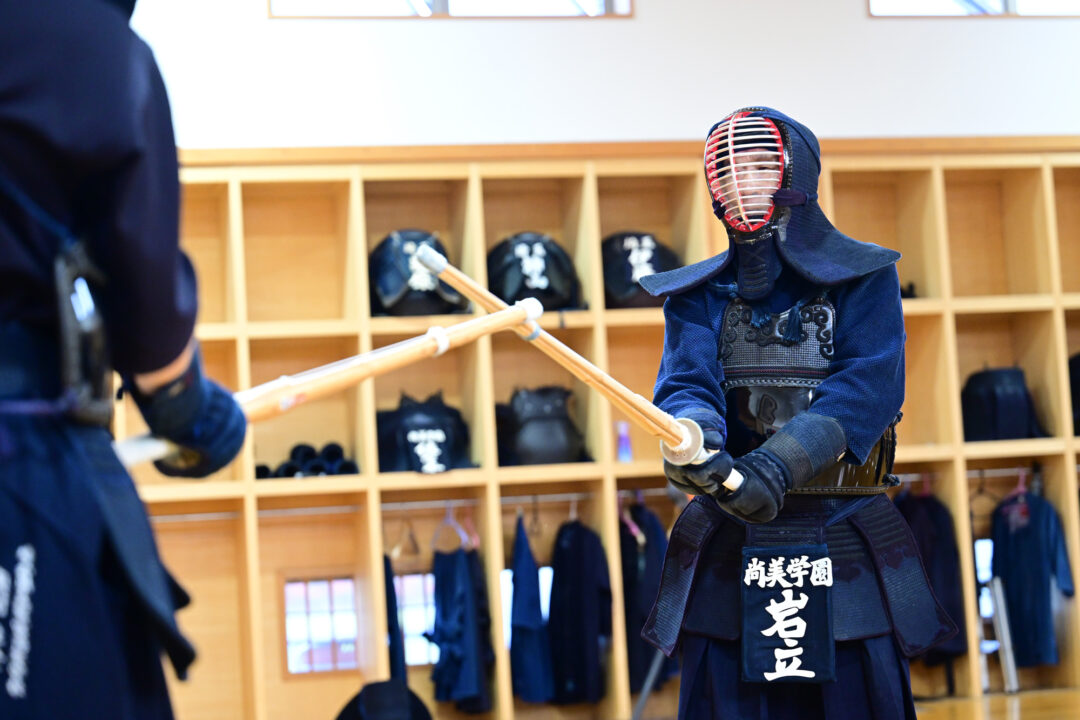
Maai is difficult precisely because your own Maai changes depending on your opponent. Conceptually, there are terms such as Toma, Chikama, and Issoku Itto no Maai, but these are simply verbal expressions. There is no fixed distance that universally defines each Maai.
Some say that the position where the tips of the Shinai meet at the Nakayui represents an appropriate Maai. However, this naturally varies depending on one’s skill level and age. I am now 86 years old, and it would be unrealistic for me to strike from Toma. If I intend to strike my opponent, I must apply seme and enter much closer Maai.
Age aside, physical strength, mental energy, and leg strength differ greatly from person to person. It is therefore impossible to say definitively that one should always strike from a specific distance. This is precisely why it is so important to understand your own Maai.
If Maai changes depending on the opponent, then I believe it is more appropriate to describe it not merely as the Maai of the Shinai, but as the Maai of the mind. Those who can grasp the Maai that is appropriate for themselves against any opponent and develop seme from that distance are truly strong. By pursuing this Maai of the mind, you will begin to perceive new dimensions of Kendo that you may not have previously recognized.
Let me explain the Maai of the mind in more detail. When facing an opponent, accurately assessing their ability is essential in determining Maai. Where can you remain safe, and how far can you enter in order to strike? The functioning of the mind plays a central role in this judgment, something that anyone who sincerely engages in Kendo can readily understand.
For example, when facing a very strong opponent, fear may arise, making it difficult to close the distance. By overcoming that fear and advancing with strong resolve and seme, the Maai of the mind naturally becomes closer, and opportunities to strike will present themselves.
To understand and refine your own Maai, it is essential not to retreat or avoid engagement in Keiko. This is something I can say with confidence based on my many years of experience. In the past, dojo were often narrow, leaving little room to retreat. Practitioners were forced to endure without stepping back, even when their opponent entered their Maai. As a result, they developed a keen sense of Maai as well as the courage to remain present.
If you do not retreat, you will of course be struck. However, you will also begin to see opportunities to strike. In Kendo, it is often said, “Learn by being struck,” and this is indeed true.
Ultimately, the question of Maai lies in how you bring together these two aspects: the physical Maai of form and the Maai of the mind. When these become unified, your own true Maai will emerge, and both your Keiko and Shiai will express a different and deeper level of Kendo than before.
If You Draw the Opponent Out and Strike, It Is Full Marks
If You Wait and Strike, It Is Zero
The rest of this article is only available for Kendo Jidai International subscribers!