2025.12 KENDOJIDAI
Interview and Text: Yanagida Naoko
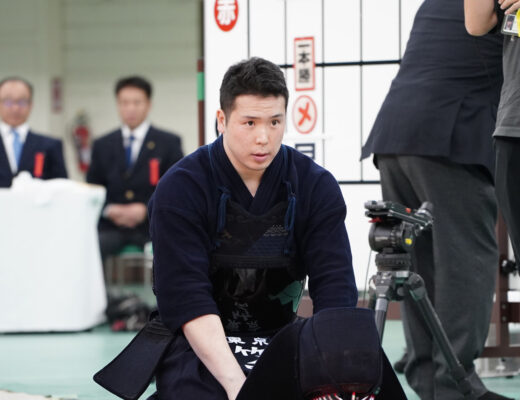
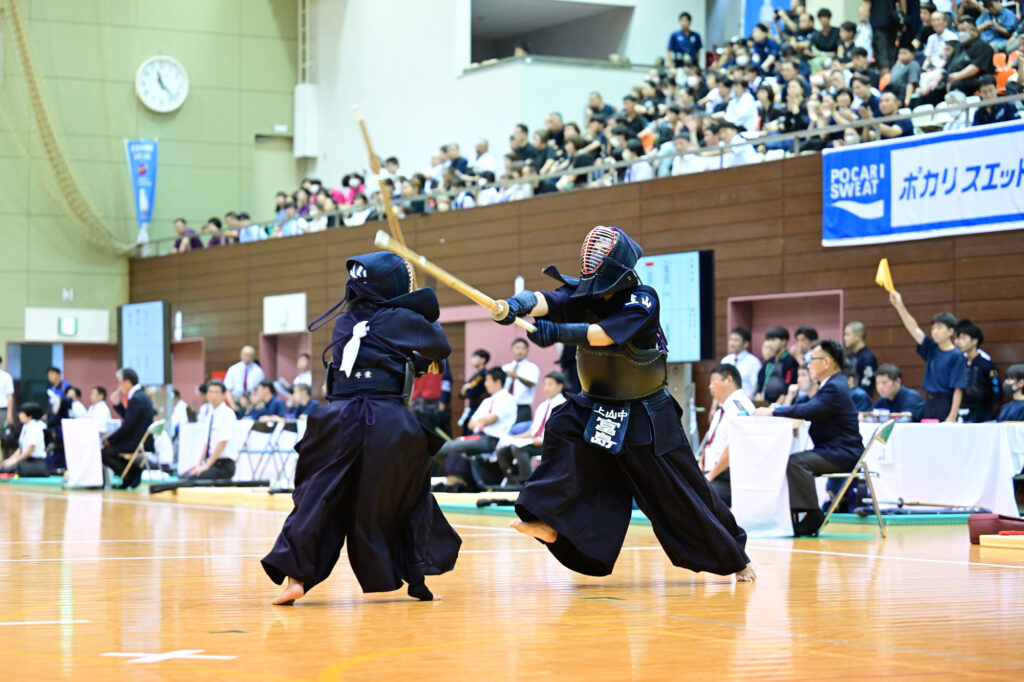
At the All-Japan Junior High School Kendo Championships (Girls’ Individual) held in August 2025 in Miyakonojo City, Miyazaki Prefecture, Tomishima Kanon achieved a historic victory, becoming the first individual national champion from Okinawa Prefecture.
Until then, Okinawa’s only national titles had come at the 1987 Kaiho National Sports Festival, in the youth and adult divisions. This was the first-ever national championship in an individual event for the prefecture, marking a remarkable achievement in a milestone year, 80 years since the end of World War II.
This piece retraces the journey of challenge and perseverance shared by Tomishima Kanon, Gakiya Takeshi sensei, and the students who walked this path together.
Nurturing Children Over the Long Span of Elementary and Junior High School
Kume, Naha City, Okinawa Prefecture. Located just a short distance from the well-known tourist destination Kokusai Street stands Uenoyama Junior High School, which Tomishima Kanon attends. Since Gakiya Takeshi sensei was appointed as the club supervisor five years ago, the school’s Kendo team has rapidly strengthened and transformed into a formidable program aiming for success at the national level.
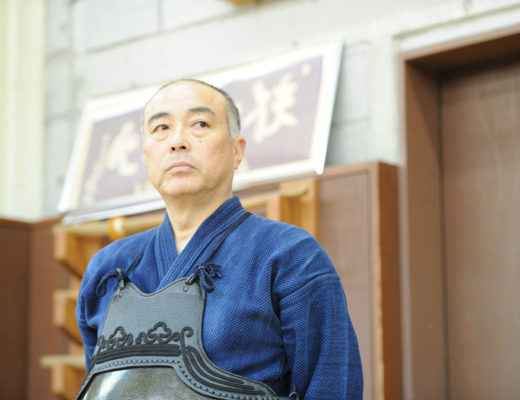
“When I was a student, I practiced Kendo with the goal of becoming the best in Japan. After obtaining my teaching license and returning to Okinawa, I decided that I would pursue that same goal together with my students wherever I was assigned,” says Gakiya Takeshi sensei.
Five years ago, when Gakiya sensei arrived at Uenoyama Junior High School, Tomishima Kanon was at the stage of beginning serious Kendo training at the Tenpi Kendo Dojo, a youth Kendo group active in the same local area. For some time, children from Tenpi had been invited to participate in training sessions at Uenoyama Junior High School, so it was only natural that Tomishima also came to receive instruction directly from Gakiya sensei.
The partnership between Uenoyama Junior High School and the Tenpi Kendo Dojo created an environment in which elementary and junior high school students could be developed together over a long span of time. This environment was one of the decisive factors that enabled Tomishima Kanon to become the best in Japan.
Due to the impact of the COVID-19 pandemic, Tomishima began practicing Kendo relatively late, starting in the fifth grade of elementary school. Even so, over a five-year period she received consistent instruction from Gakiya Takeshi sensei and Wataguchi Shingo sensei of the Tenpi Kendo Dojo, and her growth was remarkable. A strong instructional structure was in place, including Hena Masaki sensei, the assistant supervisor at Uenoyama Junior High School, three external coaches (Wataguchi Shingo, Kokubun Tatsuo, and Gakiya Serika), as well as supporting members. With this comprehensive support system, the foundation was firmly established. In her sixth year of elementary school, Tomishima was also able to compete in the All-Japan Dojo Youth Kendo Tournament.
“When I first met her, she had only just begun wearing full Kendo armor. However, she was physically strong, and as she continued training, she began to show outstanding power and sharpness in her movements. She was a child with high athletic ability, so I felt that if we could make good use of that, she would develop significantly,” says Gakiya Takeshi sensei.
“She was very serious and always tackled the task in front of her with sincerity. I think her love for Kendo was also a major factor. Because of that, she trained earnestly and proactively. With such a foundation, I felt that she would eventually reach a breakthrough point,” says Wataguchi Shingo sensei.
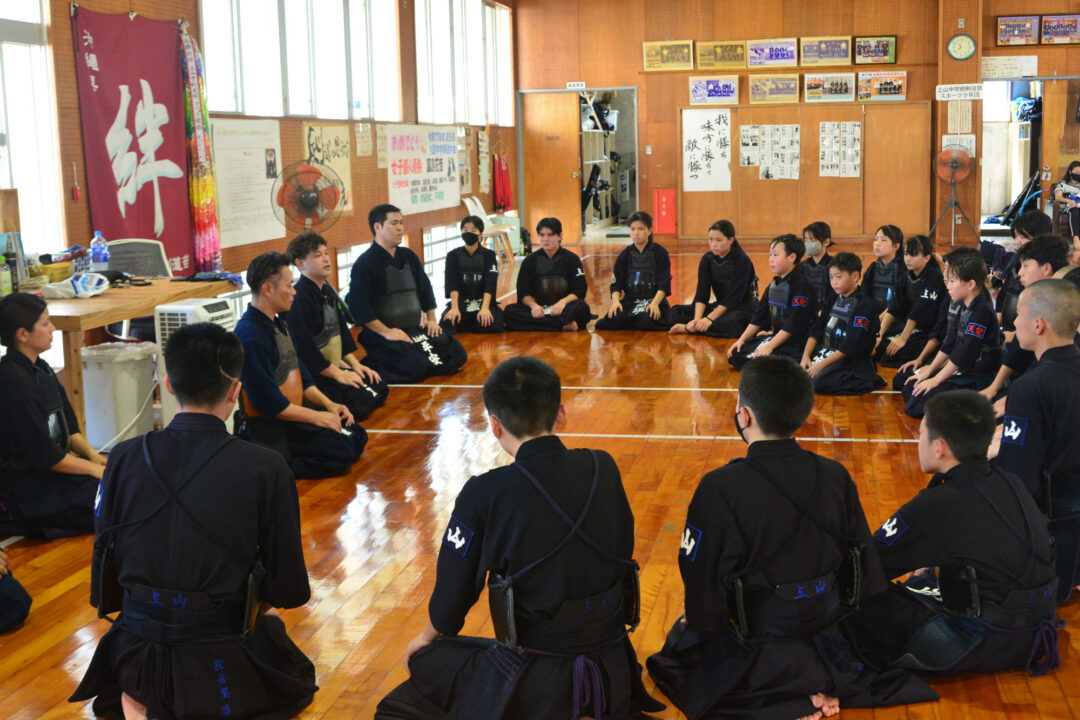
Another important factor was the ability to continue training with the same teammates from the Tenpi Kendo Dojo after entering junior high school, as they could belong to the same Kendo club at Uenoyama Junior High School. The Uenoyama Junior High School Kendo club currently consists of 10 boys and 8 girls across all three grade levels.
At this year’s Okinawa Prefectural Championships, the boys’ team placed second in the team competition, while the girls’ team won the championship for the second consecutive year. In the individual division, Tomishima Kanon finished as the runner-up.
Because many of the students have trained under the same instructors since their time at the Tenpi Kendo Dojo, it is easier for the entire team to understand the intentions behind the sensei’s instruction. Even beginners quickly absorb what they see by learning through observation and imitation of the more experienced students. This cycle has contributed to raising the overall level of the club.
By improving the quality of training, the team has been able to compensate for limited time and environmental constraints associated with being in a remote island prefecture, turning those limitations into steady progress. Over the past few years, the team has developed rapidly, acquiring the ability to compete on a national level.
“Our goal is clearly stated as winning the championship. It is demanding, but whether you lose in the final or in the first round, a loss is still a loss. What matters is entering each match with that level of determination. At the same time, even if the desired results are not achieved, the purpose of practicing Kendo lies in what you gain through Kendo itself. I also tell my students that they may gain something even more important than the result,” says Gakiya Takeshi sensei.
Taking these words to heart, the students devote themselves wholeheartedly to their training. When more students maintain a high level of awareness and strive to put their sensei’s teachings into practice, the overall atmosphere of the team improves markedly.
“Over the past year, the boys’ team finished as runners-up many times. However, they were a group that did not let defeat defeat them. They were able to reset their mindset and focus on how to apply each experience to the next challenge. That kind of single-minded dedication also had a positive influence on the girls. It may have contributed to the girls’ victory at the prefectural championships and to Tomishima’s individual national title. Tomishima’s victory was also the result of everyone’s collective effort,” says Gakiya Takeshi sensei.
Building Kendo Ability Through Footwork-Based Training
At Uenoyama Junior High School, regular club activities are held four weekdays and on weekends, with Thursday designated as a rest day. Training is conducted twice a day: morning practice on weekdays from 7:00 a.m. for 30 minutes, and afternoon practice after school, scheduled according to dismissal times. The duration of afternoon training varies by season and typically lasts between two and three hours.
Many members of the club begin Kendo only after entering junior high school. In order to raise the overall level of the team, including these beginners, the focus is placed on reforming the mindset and guiding students so that they can make the effort to change themselves. Specifically, the program emphasizes the following principles:
- Establishing fundamental daily life habits
- Strengthening mental resilience
- Encouraging parents to work hard together with their children
- Being mindful of preparing the mind before preparing the body
By consistently reinforcing these points, the team creates an environment in which all members can grow steadily, regardless of when they began practicing Kendo.
Although the clear objective set for the team is “winning the championship,” great care is taken to avoid falling into a purely results-driven mindset. Rather than pursuing victory alone, students are encouraged to reflect on what they can learn through Kendo and to value the process of working toward their goals.
This philosophy is shared not only among the students and teachers but also with parents, creating a common understanding. Students, teachers, and parents work together as one toward the same objectives.
“I encourage parents to observe club activities freely. I believe it is important for them to see both my intentions as an instructor and the process of effort the students go through,” says Gakiya Takeshi sensei.
Training sessions are centered on fundamentals. Especially during the junior high school years, he believes it is essential for students to learn the basic techniques that form the foundation of Kendo.
For this reason, training menus are designed with a strong emphasis on constant use of the feet and active movement. On the day of the interview, the practice included the following components:
- Suburi
- Footwork drills (Ashi-sabaki)
- Oikomi
- Uchikomi
- Jigeiko
- Kirikaeshi and kakari-geiko
- Choyaku-suburi
While the specific content of training varies depending on the season, with match-oriented practice incorporated at certain times of the year, the focus on “using the feet” remains consistent throughout the year. Emphasizing footwork is particularly beneficial even for beginners.
“I believe that match performance is ultimately determined by one’s ability to manage the flow of the bout. In competition, there are many possible situations, such as scoring a point, conceding a point, or remaining tied. To maintain both mental and physical energy, I believe footwork is the most important factor. That is why, except during breaks, we constantly incorporate training that keeps the feet moving and raises the level of exertion. In other words, training that focuses on using the feet and pushing the students to work at a high intensity,” says Gakiya Takeshi sensei.
In uchikomi practice, students are instructed to maintain a solid Kamae and a composed mindset, to break the opponent’s balance through pressure, and to strike decisively through the center even if it means being struck themselves.
“I feel this approach is beginning to take hold. Rather than relying on technical manipulation of the Shinai alone, the students are now practicing how to create their own attacking opportunities and strike by breaking the opponent down,” says Gakiya Takeshi sensei.
Beyond daily practice, the team also places strong emphasis on training trips. Throughout the year, they travel to Fukuoka in May, Oita in June, Hyogo in December, and Saga in March, carrying out these trips with the understanding and support of parents. Through these experiences, the team has steadily built its strength. As a result, they have developed the ability to compete for the top one or two positions within the prefecture.
Constantly Reflecting and Refining
The rest of this article is only available for Kendo Jidai International subscribers!