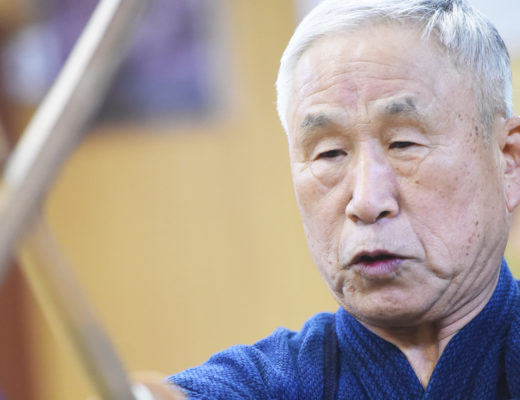
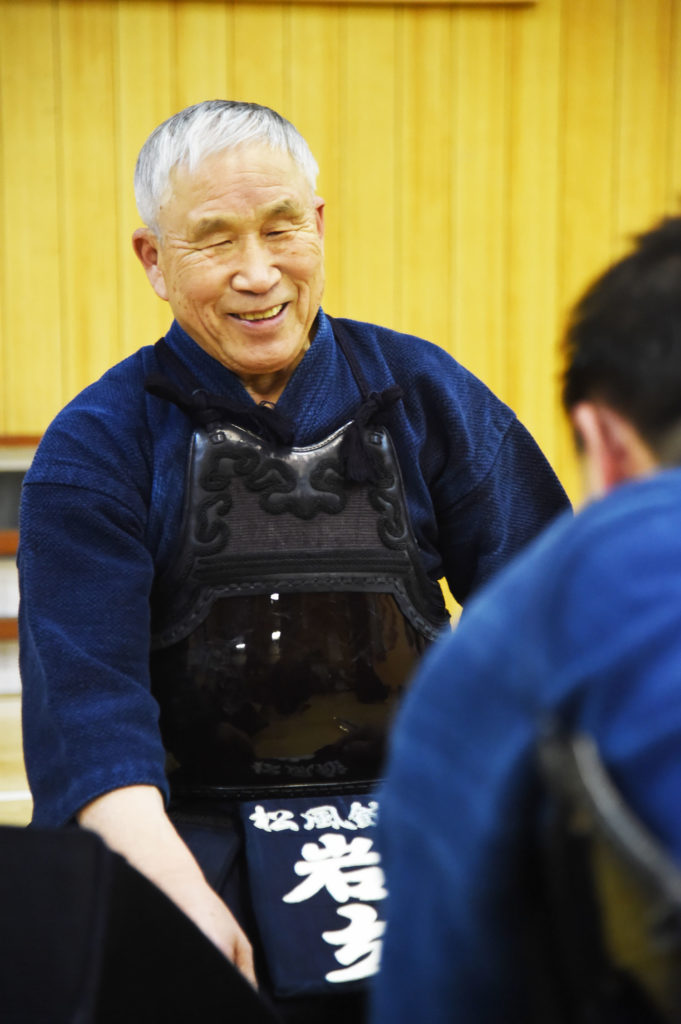
Iwatate Saburo, Hanshi 8th Dan
The Strange Reality That One Returns to Their Former State Within Half a Year After Passing
Previously, I spoke about the mindset necessary for dan examinations. This time, I would like to speak about what happens after passing.
When people fail, they naturally devote themselves to further effort and improvement in preparation for the next examination. However, when they pass, they often relax in relief. If one becomes careless after success, one’s ability can return to its former level in as little as six months.
At Shofukan, many people come seeking to pass their dan examinations. After succeeding, many return to offer greetings and thanks.
Yet several months later, when I meet some of them again at joint Keiko sessions or other gatherings, there are unfortunately quite a few for whom I cannot help but feel, “Their level has declined.”
Kendo strength is built through the steady accumulation of small efforts. However, when those small efforts are neglected or one becomes complacent, one’s ability quickly begins to decline.
Physical strength inevitably decreases with age. Therefore, if one wishes not merely to maintain but to continue improving in Kendo despite aging, the only path is to strengthen one’s overall capability.
This overall capability in Kendo can perhaps best be described as Jiriki — fundamental strength or depth of ability.
In Kendo, people often say things such as, “That person has strong Jiriki,” or “Their foundation is well developed.” Through many years of Shugyo, one gradually develops the ability to predict an opponent’s movements and intentions. One begins to understand what the opponent wants to do before they do it.
The reason senior teachers are often able to effortlessly control spirited young Kendoka is because their predictive ability surpasses that of the younger practitioner, and because their bodies have internalized the appropriate responses through years of Keiko.
Because they can read the opponent’s movement, they are able to strike Debana or counter with techniques such as Kaeshi-do. However, when Keiko becomes lax or superficial, this ability begins to disappear.
After passing a grading examination, people often become occupied with postponed work and responsibilities, making it difficult to secure the same amount of training time as before.
That is precisely why each individual Keiko session must be treasured, and why one must continue striving not to let one’s Kendo decline.
How Many People Will Line Up in Front of You?
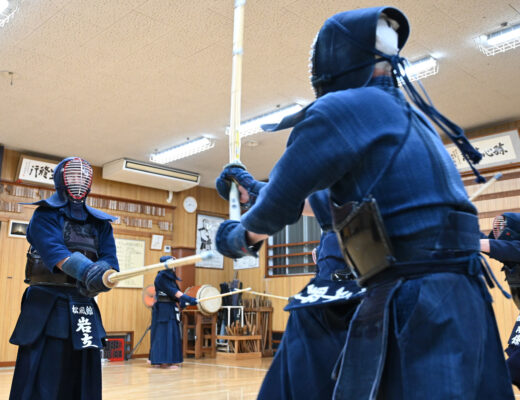
At Shofukan, once a person attains 7th dan, they are asked to sit in the Kamiza. During Keiko as well, it is our principle that they serve as Motodachi.
Once someone reaches 7th dan, they are naturally expected to serve as Motodachi at local Keiko gatherings, so we also use this as part of their preparation and training for that responsibility.
A 7th dan practitioner is a teacher. Therefore, their Kendo must never stray from the fundamentals. It must be the kind of Kendo that makes others feel, “I would like to ask this person for Keiko again.”
I often tell those who achieve 7th dan:
“The value of a Motodachi is determined by how many people choose to line up before them.”
A 7th dan is an instructor. Once one becomes a teacher, one of the most important responsibilities is to support and elevate less experienced practitioners.
One must never practice selfish Kendo.
Instead, one should carefully assess the other person’s ability and strive to provide Keiko that allows the opponent’s techniques and strengths to come alive.
Instructional Keiko sessions usually last anywhere from forty to ninety minutes. During that entire time, the Motodachi must be able to engage with the very first person and the very last person in the same consistent manner.
The Kakarite may choose which teacher to request Keiko from, but the Motodachi has no such choice. A Motodachi must be capable of responding appropriately to any opponent. That is the very nature of being Motodachi.
And above all, the Motodachi must bring out and elevate the less experienced practitioner.
At the former Meijimura Kendo Taikai, where carefully selected 8th dan masters from around the country gathered, there was a Keiko session held the day before the tournament in which 9th dan Sensei served as Motodachi.
When I once requested Keiko from Nakanishi Yasushi Sensei, he repeatedly said, “One more,” and allowed me to strike Men again and again.
At the time, I had a habit of circling my Kensaki before striking. Looking back, I believe he was teaching me through the Shinai itself how to correct that flaw.
Mochida Moriji Sensei taught that an instructor should conduct Keiko “with the strength of a 2nd dan when facing a sho-dan, and with the strength of a 3rd dan when facing a 2nd dan.” In other words, a teacher should always practice at a level only slightly above the other person.
If one simply strikes the opponent unilaterally, it no longer becomes true Keiko.
I keep this principle in mind whenever I stand as Motodachi, although in practice it is far from easy. Even so, I always try to provide Keiko that draws out the full potential of the less experienced practitioner.
Currently, Takasaki Yoshio Sensei, now over ninety years old, still comes to Shofukan. Just recently, he stood as Motodachi and instructed others continuously for sixty minutes.
I can only stand in amazement that even beyond the age of ninety, he is still able to seize the initiative and strike Men with such spirit and vitality.
Repeating Keiko That Takes the Initiative and Rides onto Men
The rest of this article is only available for Kendo Jidai International subscribers!