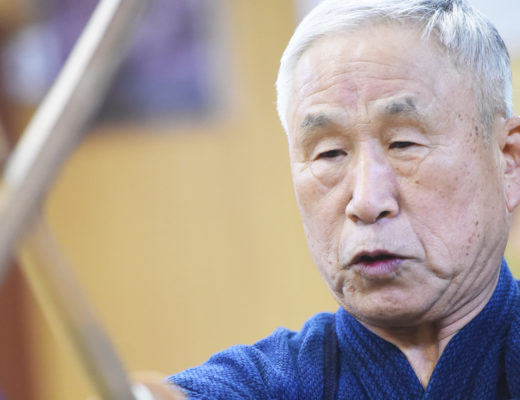
Iwatate Saburo, Hanshi 8th Dan
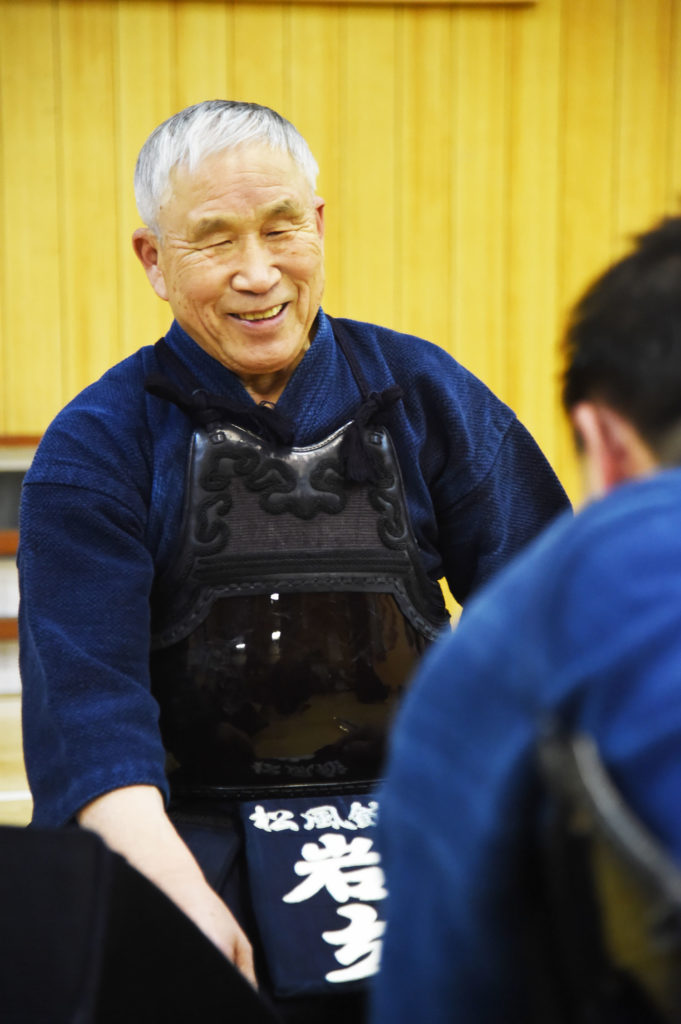
No Shiai Keiko at All
Days Spent Under the Guidance of Local Sensei
This time, I would like to share the story of my life in Kendo.
I was born in March 1939 (Showa 14) as the third son of a farming family in Inba District, Chiba Prefecture. Seven years later, my younger sister was born. During the daytime, my family would go out to work in the fields, so taking care of her became my responsibility.
In 1945, when I was in the first grade of elementary school, Japan reached the end of the war. From 1945 to 1952, Kendo was prohibited in Japan, so I grew up without even knowing of its existence. As for sports during my childhood, the only thing I really remember was enjoying baseball with a glove I had made myself.
I later entered Narita High School. I admired my cousin and wanted to become a police officer, so I begged my parents to allow me to continue on to high school. At the time, I had the preconceived idea that becoming a police officer required practicing Judo, so I went to observe the Judo club. However, all the members training there were large and strongly built. When I looked next door at the Kendo club, I saw smaller-built students practicing there. As I stood watching their training, the club advisor, Ito Shoji, called out to me, “Come in.” That encounter naturally led me to join the Kendo club.
That was my first encounter with Kendo.
It was a poor era, so I could not afford my own Kendo equipment. I searched for heavy, painful bamboo Dō armor that others no longer used, stuffed cotton into worn Kote gloves and stitched them myself in order to assemble my gear.
At the time, a 3-shaku 8-sun Shinai cost 240 yen — the equivalent of a full day’s wages for a road laborer. That is how expensive a Shinai was. We could not simply replace them easily, so whenever the bamboo cracked, I would crush rice grains into a paste to use as glue, apply it to the split sections, and carefully maintain the Shinai every day. I still remember how precious it was to me.
I commuted 10 kilometers from home to high school by bicycle, riding endlessly along unpaved gravel roads. Looking back, perhaps that is what strengthened my legs and hips.
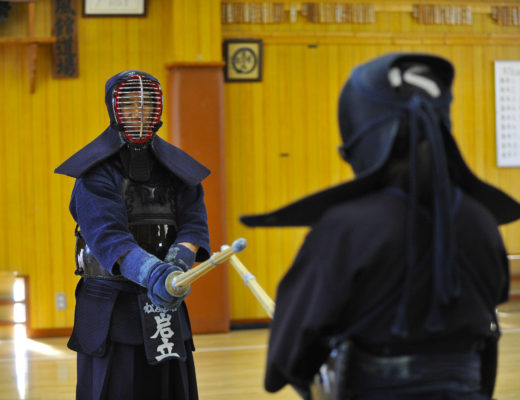
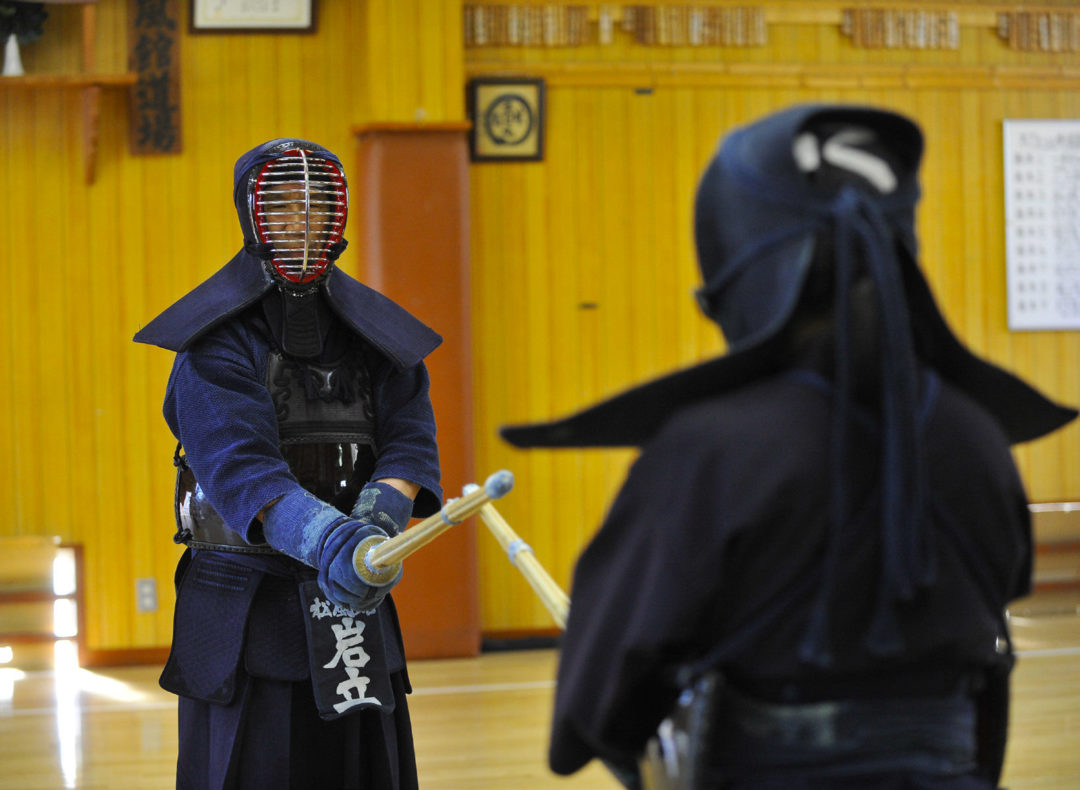
Training in those days was also very different from today. Rather than forming pairs and practicing efficiently in organized drills, we would simply ask our Sensei and senior students for Keiko. We did not do standardized Uchikomi practice such as repeated Men strikes or Kote-Men combinations. We simply trained by receiving instruction directly from our teachers and seniors.
At that time, local 6th and 7th dan Sensei regularly came to practice at Narita High School. Because of that environment, we rarely practiced evenly matched Keiko among classmates, and we never did Keiko specifically for Shiai practice.
When I was a third-year high school student, I attended a Keiko session organized by the Kendo federation. There, a Sensei dressed entirely in white Keikogi and Hakama stepped into the Dojo. His appearance was impeccable, his posture dignified, and his Kendo highly refined. Even as a high school student, I could immediately sense that he was no ordinary person.
That swordsman in white was none other than Itoga Kenichi, who would later become my instructor in the Chiba Prefectural Police. I admired him instantly.
Some time later, all of the third-year members of the Kendo club were summoned to the principal’s office. When we opened the door, Itoga Sensei was there. He asked us, “Would you like to join the police?” and encouraged us to become police officers.
At the time, becoming a police officer was highly competitive, with approximately twenty applicants for every position. Even the sons of police officers often failed the examination. Under such circumstances, being personally invited was an extraordinary piece of good fortune, and I raised my hand without hesitation.
Narita High School was a powerhouse school that had won the first Kanto Tournament and finished runner-up the following year. However, I was not one of the team’s regular competitors. Even so, I never missed a single day of Keiko and continued training diligently. I do not know whether that dedication was what earned their recognition, but in the end, I was accepted into the Chiba Prefectural Police.
The Seven Years as a Tokuren Member
Devoting Myself Entirely to Full-Commitment Training
In 1957 (Showa 32), I was accepted into the Chiba Prefectural Police. After completing one year at the police academy, I became a special Kendo training member, known as a Tokuren.
However, in my case, during the off-season I was assigned to work at a local police box. At the time, this arrangement was known as a “commuting Tokuren” system, meaning that I traveled from the police housing in Matsudo to attend Keiko.
Commuting from Matsudo to Inage was difficult, but when I thought about being able to train under the admired Itoga Kenichi, it never felt like a burden.
Here, I would like to introduce Itoga Sensei’s background. Born in 1913 (Taisho 2), he advanced from Chiba Middle School to Tokyo Higher Normal School. After graduation, he served as an assistant professor at the Tokyo College of Physical Education, where he instructed students.
After the war, with the revival of Kendo, he became the Kendo instructor at the police academy of the Chiba Prefectural Police and thereafter continued teaching within the police organization.
Because Itoga Sensei came from Tokyo Higher Normal School, his instruction was highly theoretical and extremely easy to understand. He guided us carefully through the fundamentals step by step.
Itoga Sensei was exceptionally skilled at imitating our movements. If we struck Men, he would strike Men along the exact same trajectory; if we struck Kote, he would mirror our Kote strike in precisely the same way. Through this, he corrected our bad habits and technical flaws.
He was also the kind of teacher who would praise us when we lost a match and scold us when we won. Above all else, his focus seemed to be on cultivating correct and proper Kendo.
Like Itoga Sensei, Mabuchi Kokichi, the Kendo instructor at the Chiba Prefectural Police Academy, also trained us very strictly. Mabuchi Sensei was born in 1915 (Taisho 4). At the Kyoto Kodokan, he became a direct disciple of Ogawa Kinnosuke, and he also trained in the instructor’s course at the Budo Senmon Gakko. He loved Keiko, and with him as well, all we did was devote ourselves completely to training.
During my years as a Tokuren member, I also have fond memories of visiting the Tokyo Metropolitan Police Department and the Imperial Guard Headquarters for Keiko.
At that time, the training hall of the Tokyo Metropolitan Police Department was lined with extraordinary masters standing at the front, including Mochida Moriji, Saimura Goro, and Horiguchi Kiyoshi. Even just waiting in line for my turn was enough to leave me short of breath from nervousness.
I became a Tokuren member at the age of twenty and at the time I was only 2nd dan. Having only just graduated from high school, there was no question of engaging in equal practice with such teachers — all I could do was Kakari Keiko.
At the Imperial Guard Headquarters, I also had the opportunity to train under Sato Sadao. Sato Sensei would always allow me to strike Men, receiving my attacks again and again as I repeatedly charged forward across the floor in Uchikomi practice.
In 1959 (Showa 34), Kawabata Tomiyasu, who currently serves as chairman of the Chiba Prefecture Kendo Federation, became a special Kendo training member of the Chiba Prefectural Police.
Kawabata Sensei was known for his quick and agile movements, and he later went on to win the National Police Kendo Championship three times, remaining a leading competitor for the Chiba Prefectural Police over many years. He was truly a man of relentless effort. Even at night, he would repeatedly practice Suburi alone in the Dojo, never wasting a spare moment and constantly accumulating effort through daily training. I believe that dedication ultimately led to his three championships. Training alongside him during that period also taught me a great deal.
As for myself, during my years as a Tokuren member, the highest level of competition I was able to participate in was the Kanto Regional Police Tournament, and I was never able to achieve particularly outstanding competitive results.
However, during that time, I was blessed with extraordinary training opportunities. In addition to Itoga Sensei and Mabuchi Sensei, many distinguished teachers from outside the police community also came regularly to train at the Dojo.
Because of this environment, I was able to devote myself fully to Kakari Keiko. Those experiences became one of the greatest treasures of my life in Kendo.
At the Age of Thirty-Eight, I Became a Police Kendo Instructor
And Began Aiming for 8th dan
The rest of this article is only available for Kendo Jidai International subscribers!