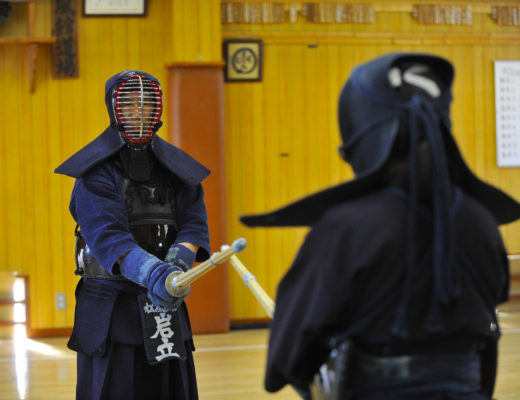
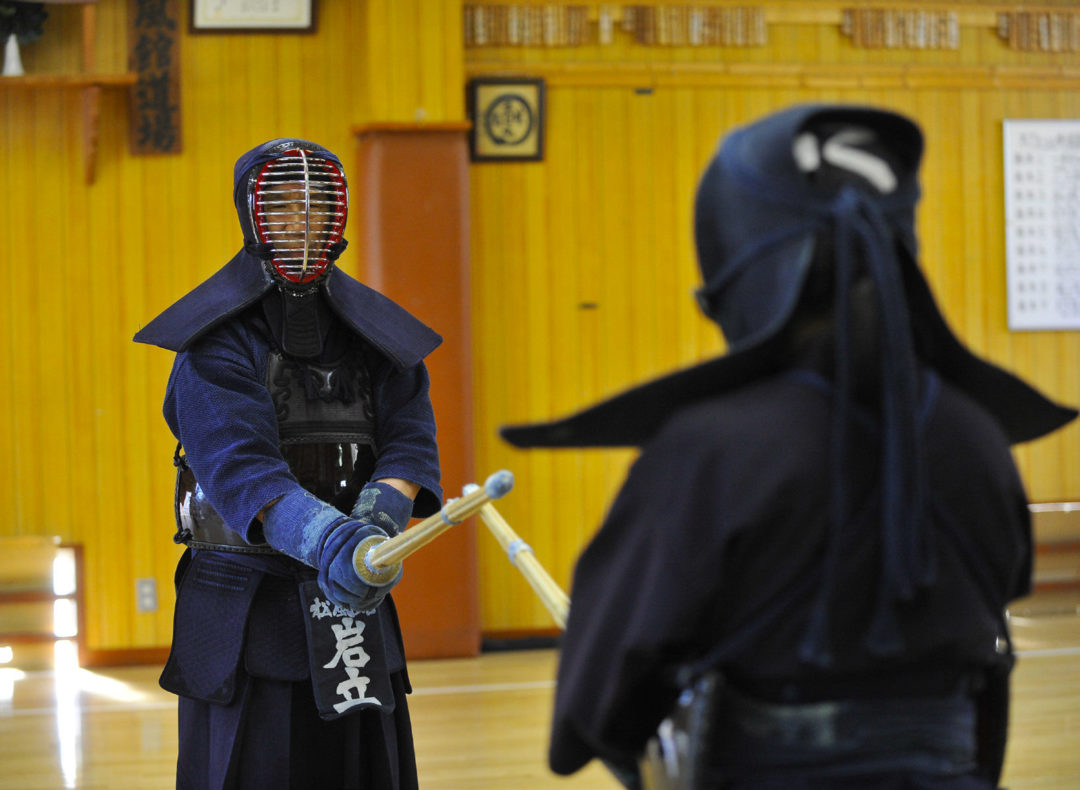
Iwatate Saburo, Hanshi 8th Dan
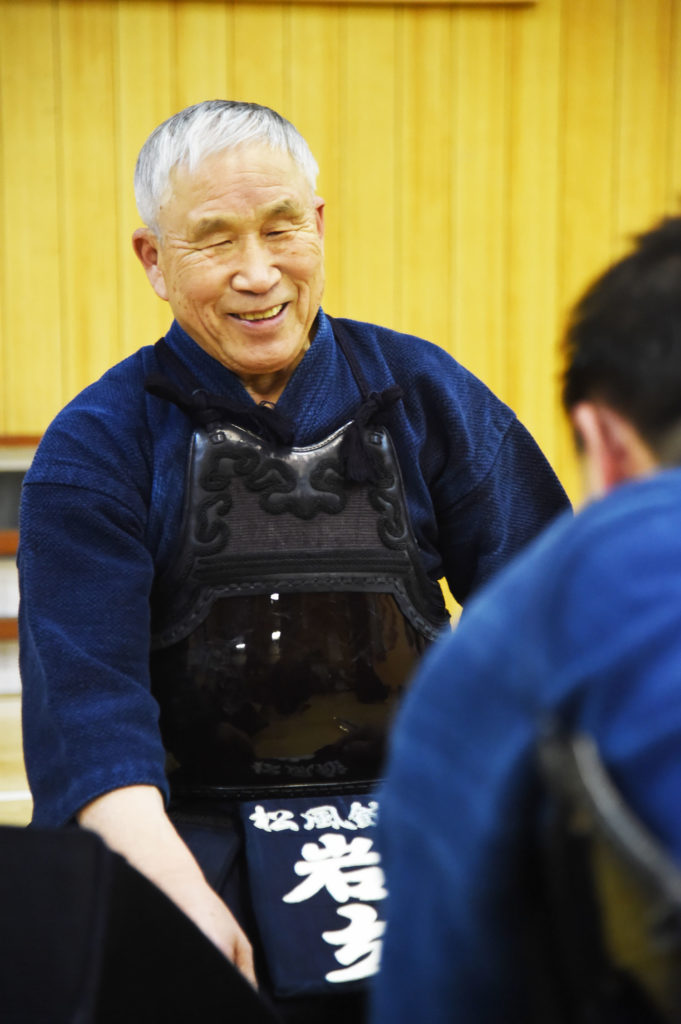
As expressed in the teaching,
“First the eyes, second the feet, third the courage, fourth the strength,”
the role of the eyes is considered the most important element in Kendo. It would not be an exaggeration to say that the function of the eyes can determine victory or defeat.
In other words, the state of one’s eyes changes one’s Kendo.
For example, if the gaze becomes unstable, posture and Kamae will also collapse. On the other hand, if the gaze remains steady, one can maintain correct posture and Kamae, making it possible to produce a truly satisfying Ippon.
Whenever I face an opponent, I try to keep my gaze constant regardless of the situation. Furthermore, regardless of the opponent’s height, I assume Kamae with the feeling of looking slightly down upon the opponent from above.
By doing so, I am able to maintain proper posture and Kamae while also responding instantly to the opponent’s movements.
In this way, maintaining a gaze that looks down upon the opponent from above produces various effects. I have spent time reflecting on those effects in my own way.
The Effects of Conscious Metsuke — Part 1
Recently, I have often seen people neglecting Sonkyo. Sonkyo is referred to as the “stance of the lion” — a posture from which one is ready to spring forward and attack at any moment. If Sonkyo is treated carelessly, it becomes impossible to enter a match with fully developed Ki.
Metsuke is also extremely important during Sonkyo.
I make a point never to lower my gaze. From the moment of mutual Rei, through Sonkyo, and until standing back up, I never take my eyes away from my opponent’s eyes. Ideally, one should hardly even blink.
When practiced this way, the Ki gathered in the Tanden becomes even more fully charged, allowing one to enter immediately into the psychological and spiritual exchange of seme from the very start of the match.
Conversely, if the gaze drops downward, Sonkyo loses its strength and stability.
One effective way to train oneself not to break eye contact with the opponent is through practicing Nihon Kendo Kata. While maintaining focus on the opponent’s eyes and trying not to blink, one performs the Kata.
In particular, when stepping back to resheathe the sword or when reestablishing Kamae, the gaze most easily drifts away. Those are precisely the moments when one should consciously train oneself not to blink or lose Metsuke.
The Effects of Conscious Metsuke — Part 2
The Men is designed to be worn so that one looks through the Monomi — the space between the sixth and seventh bars of the Mengane. By viewing the opponent through this point, one is able to maintain correct posture.
However, surprisingly few people are truly conscious of looking through the Monomi.
If one does not use the Monomi correctly, Kamae gradually leans forward, the hips pull back, and the head drops downward. Once the head lowers, the practitioner reverses the fundamental principle of Maai — instead of becoming “far for the opponent, close for oneself,” the distance becomes “close for the opponent, far for oneself.”
Because the head has dropped lower, the opponent can more easily reach one’s Datotsu-bui.
As a preventive measure, it is important to keep the neck aligned against the collar of the Keikogi and maintain proper posture. When the neck is properly aligned with the collar, the spine naturally straightens. Once the spine straightens, the Metsuke also stabilizes.
If one can maintain this posture while facing the opponent, the proper Maai — “far for the opponent, close for oneself” — should naturally emerge.
The Effects of Conscious Metsuke — Part 3
The rest of this article is only available for Kendo Jidai International subscribers!