2026.8 KENDOJIDAI
Photography: Nishiguchi Kunihiko
*Unauthorized reproduction or use of any images in this article is strictly prohibited.
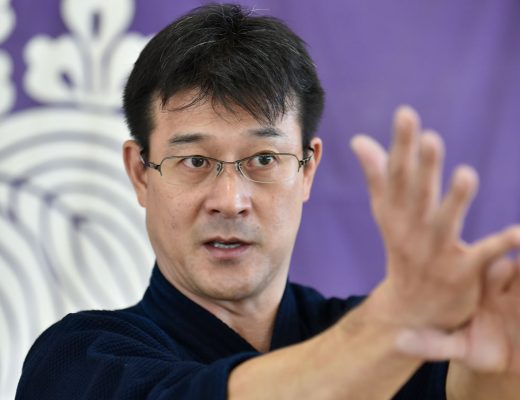
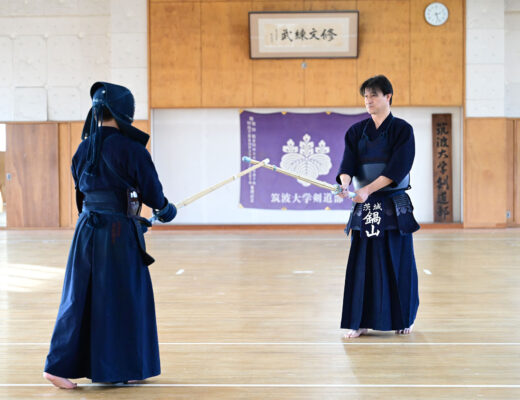
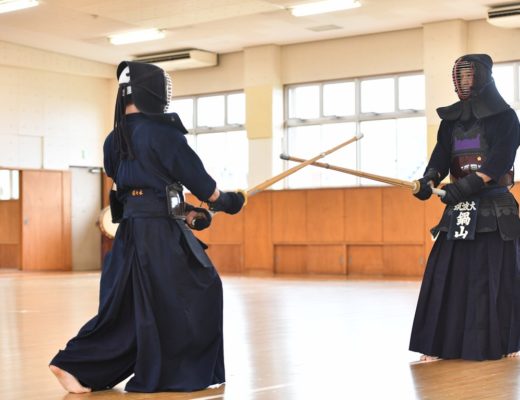
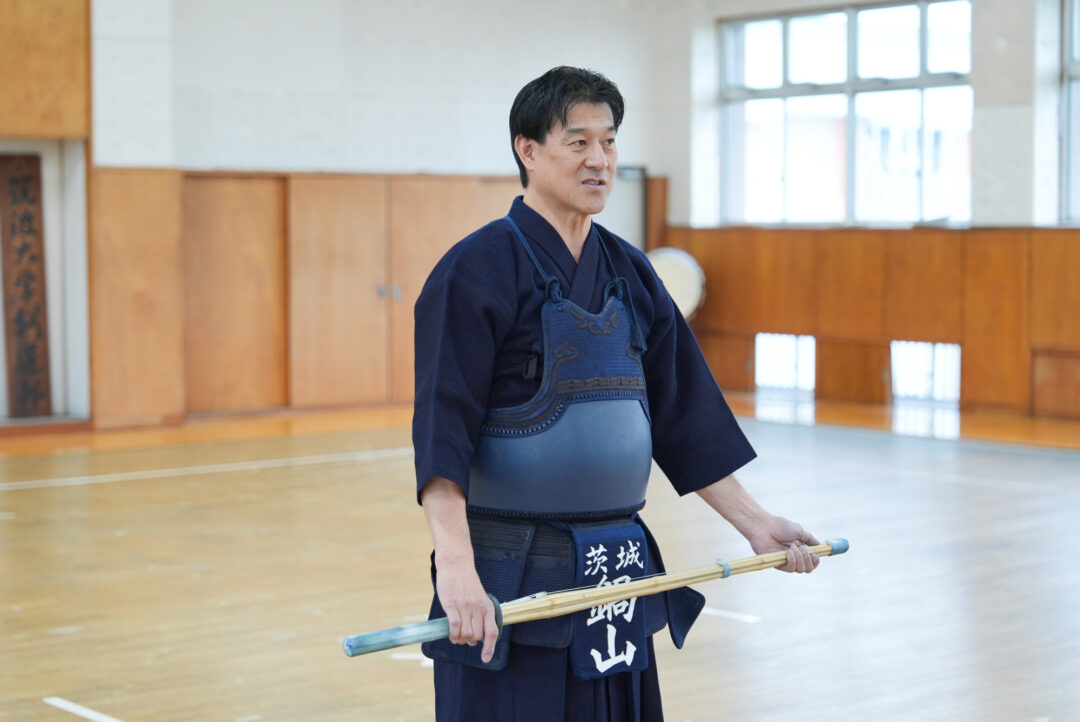
“Kendo is an interpersonal discipline. It is essential to sense your opponent’s intentions and guide them to move as you intend,” emphasizes Nabeyama Takahiro Kyoshi 8th Dan. In this article, he explains in detail how to apply seme from above and below to unsettle the opponent’s mind and influence their actions.
Nabeyama Takahiro, Kyoshi 8th Dan
If you have practiced kendo for any length of time, you have probably been told at least once that “there is no seme” in your kendo or that you are “simply throwing techniques.” Because kendo is practiced against an opponent, opportunities to strike arise from an exchange of intent that is rarely visible on the surface. I believe this is what lies behind such comments.
For that reason, simply closing the distance does not constitute seme. Seme becomes effective when, in the process of entering maai, your opponent’s mind begins to move—for example, when they feel that a men strike is imminent. When seme takes effect, the opponent may raise their hands or rush into an attack. Keeping this principle in mind during everyday keiko is essential.
The theme of this article, “applying seme from above and below,” does not simply refer to raising or lowering the kensen. What matters is maintaining a strong and balanced kamae, applying pressure to the opponent, and, throughout that process, creating striking opportunities by conveying the intention to attack from above at one moment and from below at another.
The Kendo Seminar Reference Manual published by the All Japan Kendo Federation highlights several key points for teaching advanced practitioners under the topic of “Seme and Kuzushi.” It advises that practitioners should remain alert even in the subtle contest over a single step or half-step of maai, so they can always seize the initiative and launch techniques during forward, backward, and evasive movement. It also emphasizes that movement should always be accompanied by fully developed spirit (kisei), while cultivating a calm and composed state of mind free from attachment. Finally, it encourages practitioners to study the use of the kensen, keeping it directed toward the center between the opponent’s eyes, or the opponent’s left eye as a basic principle, while also learning to restrain, deflect, press, or wrap the opponent’s shinai according to the situation in order to deprive them of freedom and create opportunities to strike.
These are extremely important principles. While always maintaining the initiative and a fully developed spirit (kisei), I believe it is essential to continue studying and refining the “contest over maai” and the “use of the kensen” described in these guidelines.
In jigeiko or instructional keiko, opponents rarely respond exactly as the principles suggest. When practicing with senior teachers, there is often no time to stop and think. At the same time, however, simply throwing out techniques without purpose only wastes valuable training time.
When I practice with my students, I sometimes ask them, “Why did you choose that technique at that moment?” Ideally, techniques should emerge naturally and without conscious thought. However, that kind of spontaneity is built upon repeated practice in which you think carefully about every action. For that reason, keiko requires continual reflection, analysis, and study.
When applying seme, the key is to have a clear idea of the response you want to draw from your opponent. Do you want to break their guard by disrupting their hands, or do you want to invite them to attack so you can capitalize on their technique? Your choice of maai and shinai work should change according to that objective. In the following sections, I will introduce the approaches I use in my own kendo.
Building Your Offense Around Men
During my years at PL Gakuen High School, the majority of our training was devoted to mastering men techniques. There is a well-known teaching about maai: “Keep yourself close while keeping your opponent far away.” Kawakami Takashi Sensei at PL Gakuen believed that being able to strike from a distance where the opponent could not yet reach you was a tremendous advantage. With that goal in mind, we repeatedly practiced uchikomi.
In practice, being able to strike from beyond the opponent’s effective distance became a powerful weapon. As the opponent closed the distance, they were constantly under the pressure of thinking, “I might be struck on men.” Naturally, this made them more likely to raise their hands, creating opportunities for kote, and at times hidari-do.
Of the four datotsu-bui (men, kote, do, and tsuki), men is the furthest target from the attacker and therefore the most difficult to strike. Precisely because it is difficult to reach, it becomes a genuine threat that creates pressure for the opponent. For that reason, I believe that everyday keiko should place particular emphasis on developing strong men techniques.
That said, repeatedly practicing men alone will not broaden your technical repertoire. While men should remain the foundation of your offense, it is equally essential to train kote, do, and tsuki thoroughly. In competition, you cannot rely on techniques you have never practiced. That is why it is important to challenge yourself and use a wide variety of techniques in keiko.
The Fundamentals of Seme: Learning to Control Pressure
Alongside mastering the fundamentals, developing a sense for interacting with an opponent is indispensable in kendo. One of the most important elements of that awareness is seme. Even for experienced kendoka, seme is such a profound concept that it cannot be easily defined. Yet without consciously studying it in keiko, meaningful improvement is difficult to achieve.
Many students describe simply closing the distance as seme. I take a different view. Seme only exists when it is felt by the opponent, so I prefer to think of it as pressure. In my opinion, what creates opportunities to strike is the ability to control the intensity of that pressure.
Pressure is not something vague, such as spirit or intimidation. It always manifests itself physically in some way. For example, when facing an opponent in kamae, standing completely upright creates no sense of pressure. Shift your center of gravity even slightly forward, however, and your opponent begins to think, “They may be about to strike.” On the other hand, if too much of your weight settles onto your left foot and your movement becomes fixed, your opponent may instead think, “Now I can strike.”
The important thing is to become conscious of varying the intensity of your pressure while analyzing your opponent’s condition. Do they want to strike, or are they trying to avoid being struck? At the same time, carefully observe how changes in your own balance and weight distribution influence your opponent’s reactions. There will naturally be many failures along the way, but if you can identify the reason—”I applied too much pressure,” or “I eased the pressure too much”—then those failures become meaningful opportunities to learn.
Minimizing Your Initiation: Never Telegraph Your Attack
In kendo, it is essential to seize the moment your opponent begins to move. Equally important, however, is preventing your own initiation from being detected.
Many practitioners unconsciously separate the sequence into closing the distance, preparing to strike, and then striking. The problem is that this “preparation” is exactly what the opponent recognizes as your initiation. Instead, your preparation should take place as you close the distance, flowing seamlessly into the strike itself.
Beginners often develop a predictable pattern of preparation, making their initiation easy for the opponent to recognize. By varying the timing both while preparing to strike as you close the distance and between the preparation and the strike itself, you make it much more difficult for the opponent to anticipate when the attack will come.
Kendo is a discipline in which victory is decided by seizing a fleeting opening. To help students learn how to conceal their initiation, I sometimes use a simple exercise that they also enjoy. Both partners begin in close maai. The kakarite strikes men, while the motodachi’s only task is to evade the attack. The motodachi may even raise the shinai into a defensive position near the men in advance. Even then, if the initiation of the strike cannot be detected, the attack cannot be avoided.
In kendo, even the slightest movement, such as a subtle rise or fall of the body, can reveal your intentions. Some players intentionally use vertical movement as a feint before striking, but relying on this means you become dependent on a preparatory motion before every attack. Instead, it is important to develop the ability to strike instantly from a stable kamae, without telegraphing your movement.
Threaten Men to Strike Kote. Threaten Kote to Strike Men.
The rest of this article is only available for Kendo Jidai International subscribers!