
KENDOJIDAI 2026.10
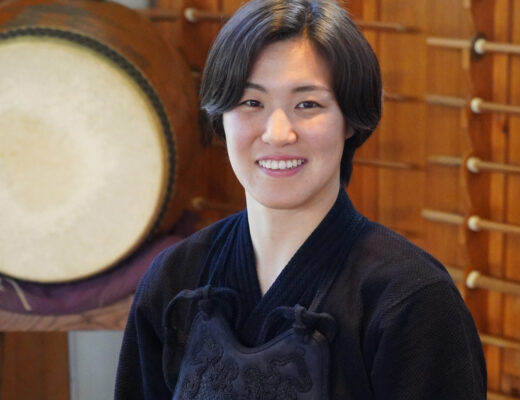
Interview: Naoko Yanagida
“Competing for Japan requires absolute resolve.”
Just six months after returning to the national training squad, where the members of Team Japan are selected, Takahashi followed her victory at the All Japan Women’s Kendo Championship by becoming the first-ever women’s individual champion at the Asia-Oceania Kendo Championships.
“I will not let my opponent strike me. At the same time, I will take the initiative and apply pressure myself. When the moment comes to commit, I will not hesitate.”
Drawing on the experience she had gained on the world stage, Takahashi defeated one formidable opponent after another with her characteristically aggressive Kendo. It was a performance that demonstrated the composure and skill of a seasoned competitor who knows what it takes to compete at the highest international level.
Takahashi Moeko

Using Her Attacking Strength to Become the Inaugural Champion
At the 1st Asia-Oceania Kendo Championships, Takahashi Moeko claimed victory in the Women’s Individual Open Division, the first event in which Japan took to the competition floor. The triumph gave her another major title following her victory at the All Japan Women’s Kendo Championship last November.
The moment athletes step onto the court to represent Japan, they also carry with them the conviction that they cannot afford to lose. Representing one’s country comes with an immense sense of responsibility.
Japanese Kendo is often regarded as overwhelmingly strong, but there are no guarantees in competition. No matter how thoroughly one prepares, there is always uncertainty about what will happen once the match begins. Takahashi dispelled that uncertainty with one of her greatest strengths: her powerful, attacking style of Kendo.
This was the first time she had entered the individual competition at an international championship, and she admits that finding the right mental approach was not easy.
“I had competed in an individual event at the Combat Games before, but this was my first time competing individually at an international championship after going through national team training camps together. Perhaps that was part of the reason, but I felt much more nervous. This time in particular, I made a conscious effort to relax and ease the tension.”
In an individual competition where she is competing solely for herself, Takahashi says that when nerves set in, she can calm herself by thinking, “Even if I lose, it’s okay. I’ll be fine.”
This time, however, she could not tell herself that.
She was competing for Japan, representing her country on the international stage. With the responsibility and resolve that came with wearing the Japanese flag, allowing herself the thought that “even if I lose, it can’t be helped” was simply not an option.
“I told myself, ‘No, no—you can’t just say, “If I lose, it can’t be helped.”’ I thought a great deal about how to prepare myself mentally.
The way you approach a team competition is different from an individual competition, and competing domestically is different again from competing internationally. I considered the particular demands of each and made sure I was as thoroughly prepared as possible, both technically and mentally.
Toyama Minori of the Tokyo Metropolitan Police Department, who was my junior at Hosei University, had competed in the individual event at the World Kendo Championships, so I also asked her about her experience there.”
According to the tournament bracket, if Takahashi advanced, she would face a Korean competitor in the second round. With the women’s individual competition being the first event for the Japanese team, she was determined not to let Japan begin with a loss. That thought only strengthened her resolve.
“If I were to lose, it might give competitors from other countries momentum, and that could have an impact on the men’s individual competition, the team competitions, and even the World Kendo Championships further down the line. There is a legacy that generations of Japanese competitors have worked to uphold, so I simply could not afford to lose. I felt that I had done everything I could to prepare.”
The championship was held at Tokyo Budokan in Ayase, Adachi City. Once inside the venue, Takahashi felt that the atmosphere was not all that different from a domestic competition. Perhaps the familiar feeling of competing on home soil in Japan gave her an added boost.
Her first-round opponent withdrew, giving Takahashi a win by default. Her first match of the tournament therefore came in the second round, against SIEUN PARK of Korea.
“This was my first time competing in an individual event in this kind of setting, but when I looked around, Coach Takenaka, the other coaches, and my teammates were all there with me. That was incredibly reassuring. It made me want to fight in a way that would raise the team’s motivation for the team competition the following day. I had to be careful because I couldn’t afford to throw out any half-hearted strikes, but at the same time, I was determined to take the initiative right from the start.”
“Never let my opponent touch any of my targets. At the same time, I would apply pressure myself and be the one to initiate the attack.”
Committing to an attack and going for a strike inevitably means accepting the risk of being struck in return. What matters is the ability to recognize precisely when the moment has come to commit.
Against Korea, Japan’s long-standing rival, Takahashi demonstrated that ability to full effect. With the very first exchange of the match, she surged forward with a Tobikomi Do to take the lead, instantly capitalizing on the moment her opponent raised her hands.
A point from the very first attack—the crowd erupted in surprise.
Her concentration was razor-sharp. Takahashi continued to control the match from the second exchange onward, and midway through the bout, she struck with a Tobikomi Men to secure a convincing two-point victory.
She continued her winning run, defeating opponents including KISHIKAWA of Australia, who had reached the last eight in the individual competition at the World Kendo Championships, before advancing to the final against Toyama Minori.
“Before the competition, Toyama and I had exchanged a casual ‘See you later,’ almost as if to say that we would meet again further down the tournament. We had come here with the responsibility and mission of achieving a clean sweep for Japan. When we both made it through to the final, my first thought was, ‘We’ve done our job together.’
“Once we reached the final, I think both Toyama and I felt, ‘Now that we’ve come this far, we’re going to take the title.’ During the match, I could really feel just how determined she was to win.”
Neither competitor gave an inch as they engaged in an intense battle of Seme. Midway through the match, Takahashi caught Toyama at the very moment she initiated her attack and struck Kote, securing victory and becoming the champion of the inaugural tournament.
“Sensei and colleagues from the Kanagawa Prefectural Police had also come to support me. Their presence gave me strength and helped me refocus so that I could fight all the way to the end.
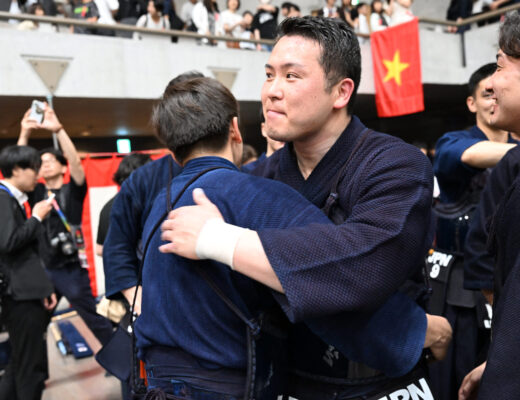
“After the final, I saw Toyama openly shedding tears of frustration. I understood exactly how she felt because I have experienced that kind of disappointment many times myself. We are teammates who have worked hard together to reach this point, each carrying many different emotions along the way. I have nothing but gratitude for Toyama.”
Returning to the National Team Training Camp
The rest of this article is only available for Kendo Jidai International subscribers!