2026.9 KENDOJIDAI
Interview: Yanagida Naoko
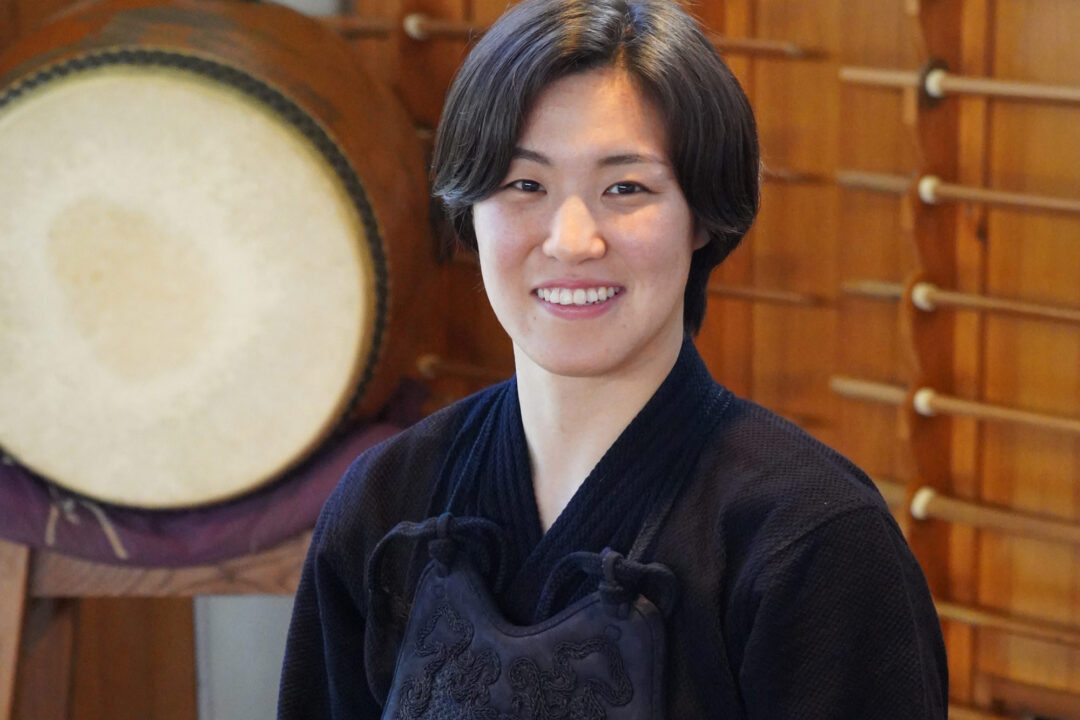
At the inaugural Asia Oceania Kendo Championships, Matsumoto Chika served as captain of the Japanese women’s team. Drawing on her experience of representing Japan at two World Kendo Championships, Matsumoto brought the team together as one and also contributed to Japan’s victory in the women’s team competition.
“To fulfill the responsibility of representing Japan, I have to focus entirely on what I can do for the team.”
That was the answer Matsumoto arrived at.
Matsumoto Chika
Born in 1996 in Fukuoka City, Fukuoka Prefecture. Matsumoto began Kendo at Imajuku Junior Kendo Club. After attending Chikushidai High School, she entered the National Institute of Fitness and Sports in Kanoya. Following graduation, she joined the Kanagawa Prefectural Police. She has won the team title twice at the World Kendo Championships and placed third at the All Japan Women’s Kendo Championship. At the National Police Kendo Championship, she has won the title once, finished second once, and third once. At the inaugural Asia Oceania Kendo Championships held in May, she served as captain of the Japanese women’s team and contributed to its victory in the team competition. Kendo 6th Dan.
Overcoming the Pressure with a Two-Ippon Victory, Fighting on Instinct to Lead Japan to the Title
“It wasn’t only Korea, our longtime rival. No matter which country we faced, my mindset was that Japan absolutely could not lose—we were going to win. So I focused on the opponent right in front of me, one match at a time, and concentrated solely on taking an Ippon.
The Head Coach and coaches had also told us, ‘This team is made up of strong players. As long as you can perform to the best of your abilities, you will not lose.’ So…”
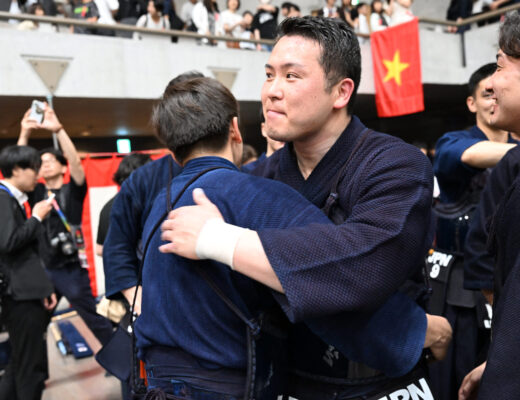
Looking back on her first international tournament as captain, Matsumoto reflected on the inaugural Asia Oceania Kendo Championships. Carrying the weight of representing Japan, both the men’s and women’s teams delivered outstanding performances, claiming titles in both the team and individual competitions.
“The atmosphere was a little different from the World Kendo Championships. If you asked me exactly what was different, I cannot really give you a clear answer, but perhaps the absence of the European teams had something to do with it. Since the tournament was held in Japan, the atmosphere felt closer to that of a domestic tournament. There were so many spectators cheering for Japan, and their support gave us strength.”
The tournament was held over two days. On the first day, Takahashi Moeko and Toyama Minori competed in the women’s individual competition, taking first and second place respectively.
With Japan gaining momentum from its success in the individual competition, the women’s team also made an excellent start on the second day. Japan defeated Thailand in the first round, Malaysia in the quarterfinals, and Singapore in the semifinals, winning each match 5–0. They then advanced to the final, where they faced their longtime rival, Korea.
In fact, Matsumoto says she has almost no memory of the matches after the Senpo match. Perhaps it was the combination of tension and her intense focus on the contest immediately in front of her that put her in such a state.
“I was competing as Fukusho. In the Senpo match, Mizukawa Haruna scored an early Hiki-men. She then conceded an Ippon, but she did not seem shaken at all, so I was able to watch and support her without worrying.”
Mizukawa eventually scored another Hiki-men to win the Senpo match, giving Japan the opening victory. In the Jiho position, Morooka Atsuko followed with a powerful Tobikomi-men to win by one Ippon, while Takenaka Miho drew her match as Chuken. With Japan leading 2–0, it was then Matsumoto’s turn as Fukusho.
It was a crucial moment with the outcome of the final at stake. A win or a draw for Matsumoto would secure the team victory for Japan.
“When I stepped into the match, I think I was able to focus on the opponent in front of me while maintaining the same positive sense of tension that I usually have. We were one step away from securing the title, but rather than thinking, ‘I want to be the one to finish it,’ I tried to focus entirely on, ‘What can I do for the team in this situation? How should I apply Seme in order to contribute?’”
Japan was just one win away from securing the championship. In such a situation, it is only natural for the desire to strike to become stronger. And with that can come hesitation: “Perhaps there is an opening here. Or perhaps my opponent is trying to draw me in.”
But there could be no hesitation. Nor could she afford to make the wrong decision. Time and again, she faced moments that demanded sound judgment: “Is this really the right decision?”
“One wrong decision could have completely shifted the momentum of the match, so above all, I was careful not to misjudge those moments. To be honest, there were several times when I thought, ‘I might be able to go here,’ but I could not simply make a move without being certain. ‘Do I go for it? Do I hold back? Is this a moment when I can go?’ I was constantly having to make those decisions, and when I scored the valid strikes, my body simply reacted on its own.”
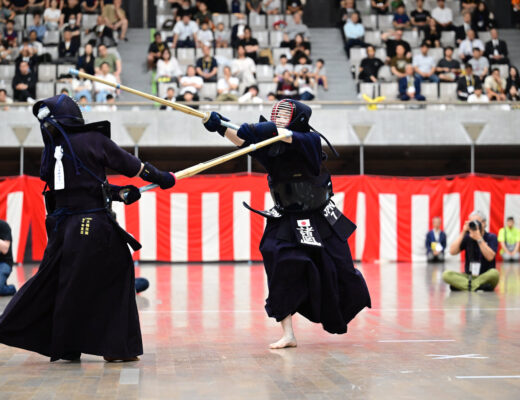
Matsumoto fought the Fukusho match almost entirely on instinct. She took consecutive Ippon with Men and Kote to secure a victory by two Ippon, clinching the championship for Japan.
“When I later watched the footage of the entire match, I could see that both Morooka and Takenaka had remained completely focused on fulfilling their respective roles. It made me realize once again just how strong this Japanese team is.”
Trusting her teammates, and trusting herself. Matsumoto had spent a year and a half preparing since being appointed captain. Now, she had accomplished her first mission: leading Japan to victory at the Asia Oceania Kendo Championships.
“The fear of losing was always there beside me. This team had prepared as thoroughly as possible in order to win, and I was confident that we had a very strong team. But in Kendo, there is never any guarantee that you will win.
What frightened me was the thought that ‘the Japanese women’s team might suffer its first defeat while I am serving as captain.’ On the day of the tournament, Moeko-senpai (Takahashi) won the individual title and Toyama finished second. We were able to carry that momentum into the team competition and win the championship there as well. I feel relieved.”
The next goal is the major stage awaiting her one year from now: the 20th World Kendo Championships next May. Matsumoto hopes to carry the experience of this tournament forward in the best possible way.
“Personally, there were still some issues in my own performance. There were aspects where the way I actually fought did not match the Kendo I ideally want to practice. I think a player who can consistently put their ideal Kendo into practice is someone who can win consistently. The Asia Oceania Kendo Championships was a learning experience for me, and I feel that I have to carry those lessons forward.”
“When I think about the World Kendo Championships, I know that if I do not address these issues, they could lead to major mistakes.”
With that in mind, Matsumoto remained firmly focused on the challenges ahead.
Drawing on Everyone’s Strength to Unite the Team and Fulfill Her Role as Captain
The rest of this article is only available for Kendo Jidai International subscribers!