KENDOJIDAI 2026.8
Hirao Yasushi, Head Coach of the Japan Men’s Team
—How do you feel about winning the inaugural Asia Oceania Kendo Championships?
HIRAO: Since this was the inaugural tournament, the first champion will be remembered and talked about for generations to come. With that in mind, we entered the tournament with a strong sense of responsibility that, as Team Japan, we had to win. Now that we have, I feel relieved.
—This is a major new international tournament, second only to the World Kendo Championships. Did you approach your preparations in the same way as you have for other international competitions?
HIRAO: Yes. We worked on a wide range of things so that we would be prepared for any situation. For example, we had heard that there would be many Nito players at this tournament, so during our training camps we devoted a considerable amount of time to preparing specifically for Nito.
—Could you tell us what you focused on when selecting the national team?
HIRAO: We selected these nine members based on an overall assessment of their results in both internal matches and matches against outside opponents. In addition, we considered their suitability for competing against international opponents—in other words, we selected players who we believed would be able to adapt to the different styles of Kendo they would encounter overseas.
—You changed the lineup from match to match in the team competition. What was your intention behind that?
HIRAO: With next year’s World Kendo Championships in mind, we wanted to make sure that every member had opportunities to compete so that they could gain valuable experience. At the same time, our plan was to field the players who were in the best condition in the later stages of the tournament.
—Looking back at the tournament through the semifinals, how did you feel about the team’s condition and performance?
HIRAO: Overall, I think each player fulfilled his role exactly as he needed to.
—What was your impression of Korea’s progress through the tournament?
HIRAO: I felt that a straightforward style of Kendo, attacking through the center, has become more prevalent than before. For Japan, I think this allows us to compete in a way that is closer to how we fight in domestic tournaments. However, if Korea continues to develop this style, I believe they will become even stronger in the future. We need to remain fully aware of that as we continue our preparations.
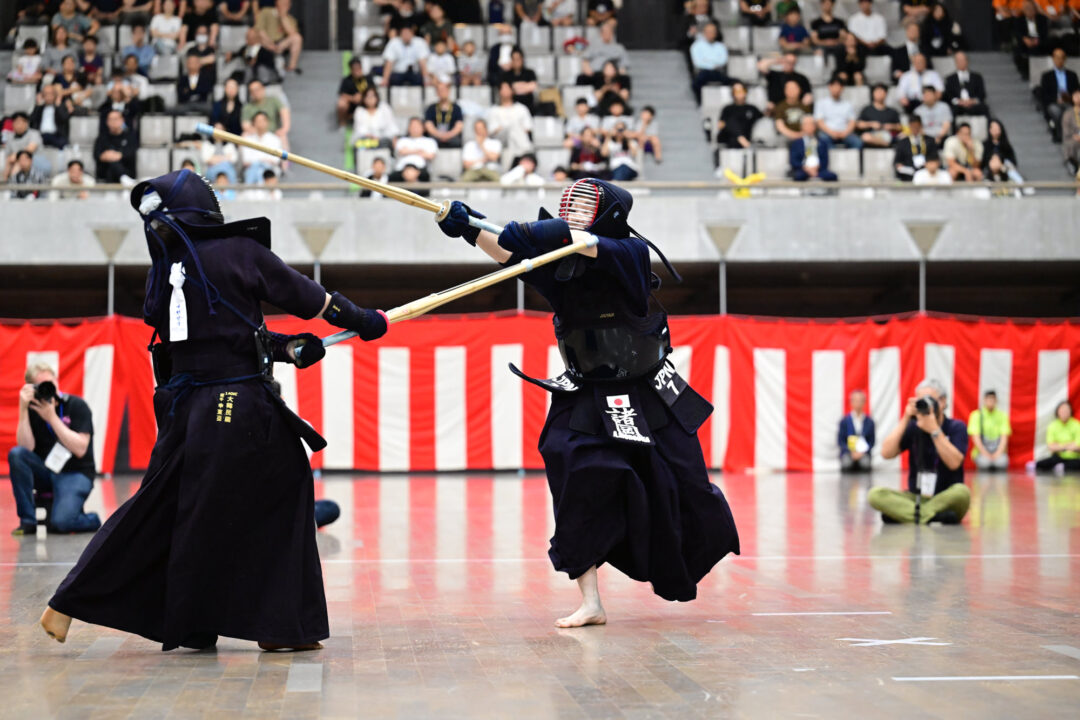
—In the final against Korea, Seike and Sanada secured two important wins for Japan in the first half of the match.
HIRAO: I had thought that if we could get through the first two matches with something like one win and one draw, we would be in a good position. Instead, both of them scored the first Ippon in their matches and maintained their concentration all the way through. Getting two wins in the first half was an extremely significant result for the team.
Watching how they had prepared leading up to today, I knew that both of them had trained tremendously hard. The same was true of the other members of the team. They had put so much into their Keiko that I believed the god of Kendo would not abandon them.
—The final three positions were filled by Hoshiko, Matsuzaki, and Takenouchi, three of Japan’s leading players today. What did you think of their performances?
HIRAO: Before the match, I told the players, “You are not fighting alone. The five of you are fighting together.” In that sense, I think the three players in the latter half of the lineup competed while keeping the situation of the entire team in mind.
—How do you assess the current balance of strength between Japan and Korea?
HIRAO: If we look only at the final, I would say the actual contest was evenly matched. I feel that we happened to come out on top this time. Korea will naturally analyze this tournament and develop strategies for the World Kendo Championships. Unless Japan responds with even more thorough preparation and continues to build through Keiko, next year’s World Kendo Championships will be a very difficult battle.
—Finally, could you share your determination heading toward the World Kendo Championships?
HIRAO: Over the remaining year, we will continue to devote ourselves to Keiko so that Team Japan can properly embody and express Kendo as a traditional culture of Japan. We appreciate your continued support.
Takanouchi Yuya, Men’s Team Captain
—Could you begin by sharing your thoughts on competing in the inaugural Asia Oceania Kendo Championships as captain of the Japan men’s team?
The rest of this article is only available for Kendo Jidai International subscribers!