2026.10 KENDOJIDAI
Photography: Nishiguchi Kunihiko
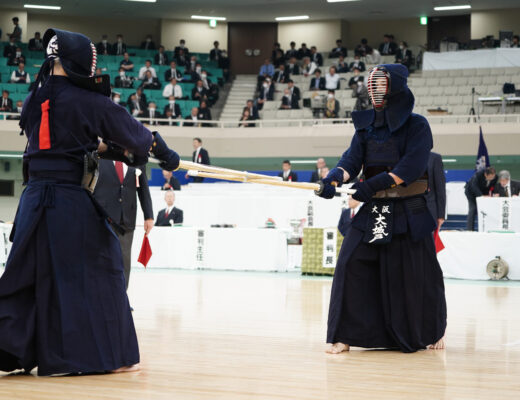
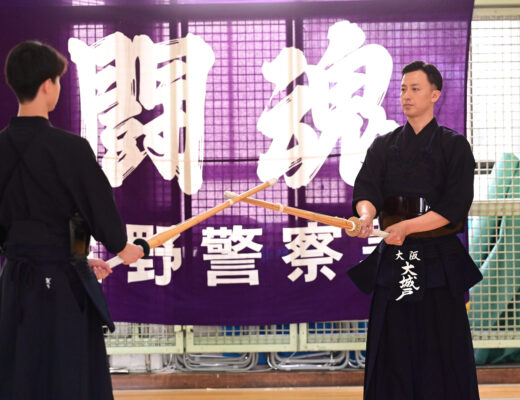
Okido Satoru, Kyoshi, secured an impressive third-place finish at the All Japan Invitational Kendo 7th Dan Championship for the second consecutive year. Last year, he took up a new position as a faculty member and head coach of the kendo club at his alma mater, the National Institute of Fitness and Sports in Kanoya, bringing a dramatic change to his environment. Despite this major transition, he delivered another outstanding performance on one of kendo’s most prestigious competitive stages.
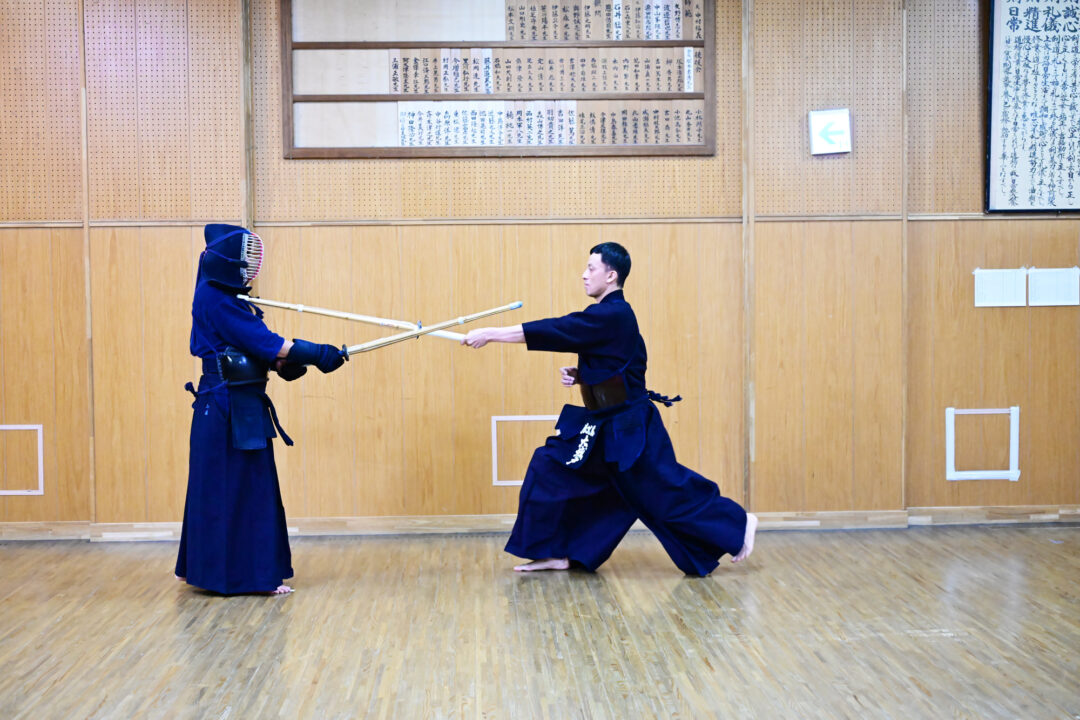
Amid these new challenges, Okido has placed particular emphasis on aligning what he teaches with his own kendo. He strives to demonstrate through his own shinai the principles he teaches his students. By bringing his words and techniques into harmony, he has taken his kendo to an even higher level. His perspective as an instructor continues to deepen his strength as an active competitor.
Okido Satoru, Kyoshi 7th Dan
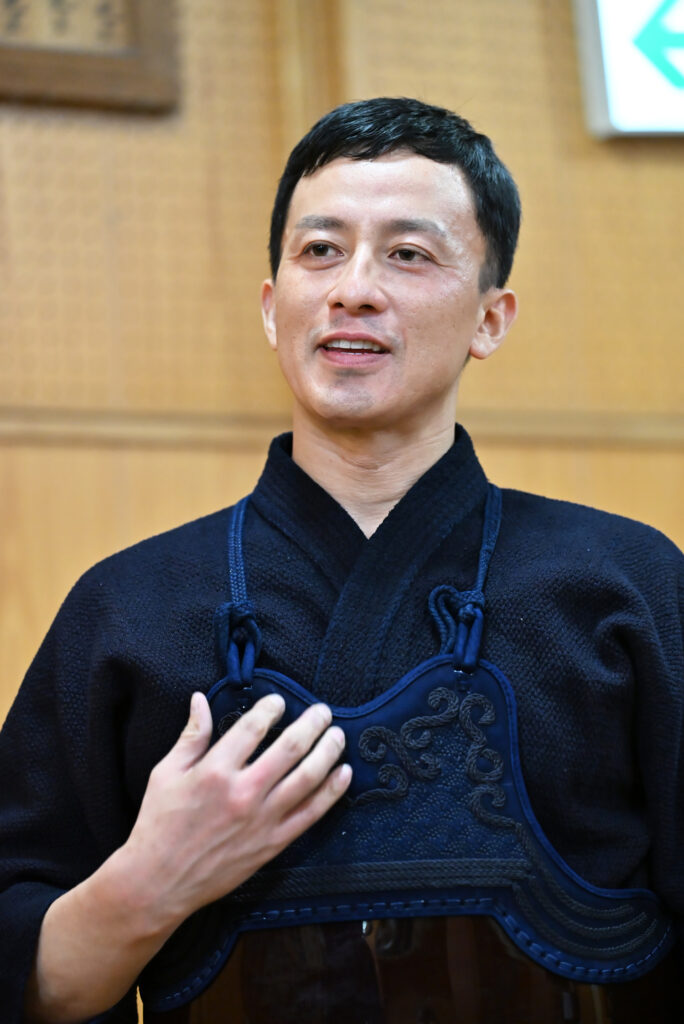
Last April, I became a faculty member at my alma mater, the National Institute of Fitness and Sports in Kanoya, which brought a major change to my environment. I went from instructing police officers to teaching university students. While continuing to improve my own kendo, I now face the daily challenge of guiding students in ways that encourage their independence and bring out their individual strengths. I regularly exchange ideas with Maesaka Shigeki, Director of the Kendo Club, and Takenaka Kentaro, General Head Coach, as we put these ideas into practice.
Of the approximately 110 members of our kendo club, only about 10 percent have the opportunity to compete in official tournaments. Achieving outstanding results in competition is certainly important, but if we focus solely on winning, we lose sight of the broader purpose of studying kendo at our university. It may sound like a familiar expression, but one of the primary goals of training in kendo at our university is to understand both its cultural characteristics as a martial art and its competitive aspects, and to be able to put that understanding into practice independently.
The kendo style of the National Institute of Fitness and Sports in Kanoya is characterized by quick initiation of attacks and the ability to strike without hesitation whenever an opportunity arises. Maintaining a position from which one can strike at any moment is essential, and this is something I continue to emphasize in my own daily practice.
I had the opportunity to compete in this year’s 7th Dan Championship and finished in third place. Although the result was the same as last year, despite the significant changes in my environment, I felt that my performance was different in several respects, including the content of my matches, how I created opportunities before striking, and the mental and technical aspects of my kendo.
Since becoming a university instructor, one principle I have become particularly conscious of is ensuring that what I teach is consistent with my own kendo.
I constantly remind myself that if I expect my students to practice kendo at a high level, but my own kendo falls far short of those standards, my teaching will lack credibility. Whether I am actually living up to those expectations is something only others can judge. Nevertheless, I make a conscious effort to keep this principle firmly in mind in my daily instruction, starting with the fundamentals of proper attire and etiquette.
In my teaching, I place great importance on carefully developing the process of applying seme to break down an opponent’s defenses. Speed and power are certainly important elements in kendo, but relying too heavily on them can lead to self-centered kendo. I pay particular attention to waza-mae, the process of creating an opportunity before executing a technique. When facing an opponent in kamae, I try to make them sense something through my presence and seme. Of course, since seme is a mutual exchange, there are also moments when I sense something from my opponent. I believe that increasing the proportion of exchanges in which I am the one making my opponent feel that pressure is what leads to effective seme.
Since leaving the police Tokuren team, I have had far fewer opportunities to compete, and the chances to test my abilities in actual matches have decreased significantly. Of course, this is a natural part of getting older, and I believe what matters is making the most of my current environment. That is precisely why I want to approach every opportunity without trying to perform beyond my present abilities, but instead focus on bringing out the best of what I am capable of now. To achieve this, I intend to approach my daily practice with the same sense of intensity and focus that I would bring to a match.
Looking ahead, I am expected to explore how the practical knowledge and experience I have accumulated over the years can be evaluated academically through practice-based research, including research published in the Journal of Sports Performance Research, which is promoted by the National Institute of Fitness and Sports in Kanoya.
In that sense, I have a great deal of work ahead of me, and my days are both busy and fulfilling.
Maintaining Proper Left-Hand Position for a Flexible and Adaptable Kamae
Chudan-no-kamae is the foundation of all other kamae. Ideally, it should allow for correct posture and the freedom to attack or defend as the situation demands. However, even if you can assume an ideal kamae in front of a mirror, you may find yourself unconsciously losing that posture when actually facing an opponent.
A strong, well-established kamae leads to sharp, effective techniques, and I believe that the position of the left hand is particularly important in achieving this. When I was younger, I was afraid of being struck, and whenever I sensed danger, I would immediately raise my hands and move in close to my opponent. Closing the distance in this way might prevent the opponent from finding an opportunity to strike, but it also eliminates my own opportunities to attack.
For this reason, I now try to face my opponent from toma, gradually closing the distance while maintaining my kamae as much as possible. By the time I reach shokujin-no-maai, I aim to have already taken the initiative.
Of course, my opponent is thinking along similar lines and is also trying to close the distance. If I focus too much on maintaining my kamae without allowing it to change, I risk becoming static and unable to respond. Therefore, I make a conscious effort to observe my opponent with enzan-no-metsuke, keeping a broad awareness of their entire body, so that I am ready to respond to any movement at any moment.
Cultivating Mental Readiness Through Etiquette Before Facing an Opponent
The rest of this article is only available for Kendo Jidai International subscribers!