2026.9 KENDOJIDAI
Match Report: Yoshinari Masahiro
Interviews: Yanagida Naoko, Teraoka Tomoyuki
Photography: Nishiguchi Kunihiko, Sasai Takamasa
The 13th All Japan Invitational Kendo 7th Dan Championship was won by Kotani Akinori (Chiba), who claimed the top spot among Japan’s 7th Dan competitors. Reaching the final for the second consecutive year, Kotani defeated Hatakenaka Kosuke (Tokyo), winner of the 11th tournament, to capture his first championship title.
This unique event brings together 16 elite Kendoka selected from across Japan, providing a stage where they put their exceptional technical skill and mental strength to the test against one another. It was a day of intense competition that showcased the profound depth of “7th Dan Kendo”—the Kendo of practitioners who, even as they accumulate years of experience, continue to pursue and refine their own Kendo.
[Final] After a Battle to the Limit, Kotani Commits Everything to a Decisive Strike
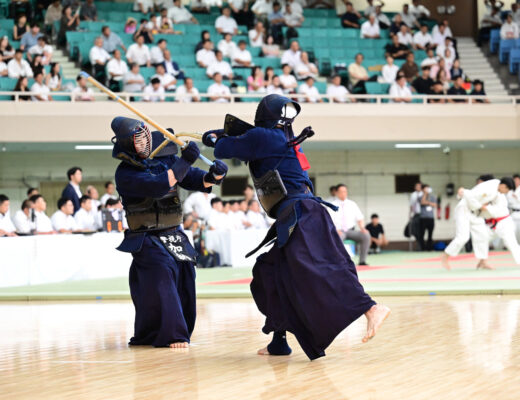
On one side stood the champion of the 11th tournament two years ago; on the other, last year’s runner-up. Hatakenaka, 39, and Kotani, 41, had both fought their way to the final with energetic, fearless, and aggressive Kendo.
The instant the Shushin called “Hajime,” Kotani began moving to his left with quick, small steps. Both competitors filled the venue with powerful Kiai. Possessing speed that rivaled even that of younger competitors, the two entered Kōjin-no-Maai, maintaining such intense tension that one could hardly afford to blink.
Hatakenaka initiated the first exchange. As Kotani closed the distance, Hatakenaka feinted a Men strike before attacking Kote. Kotani compactly deflected it with the Omote Shinogi and responded with Men. The opening exchanges were almost like two boxers trading jabs.
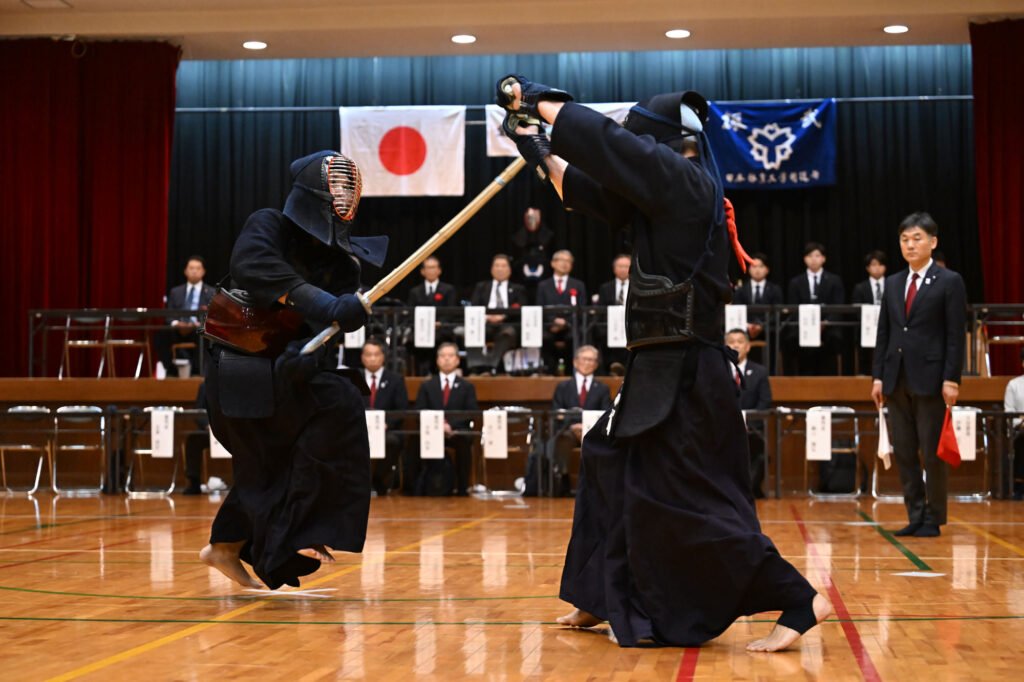
Hatakenaka initiated the second exchange as well. After closing the distance, he boldly extended forward for Men, but Kotani evaded the strike with his footwork. Kotani stood with a relatively wide distance between his front and rear feet, giving him a deeper defensive range than his Kamae might suggest. At the same time, he was remarkably quick at drawing up his left foot and driving forward with Seme.
In the third exchange, Kotani took the initiative. At Kōjin-no-Maai, he applied an assertive, almost surging Seme, feinted toward Men, and then launched another attack to Men. Hatakenaka managed to evade it with his Omote Shinogi, but it was a formidable strike.
Hatakenaka, however, immediately drew the contest back into his own Maai, closing the distance with footwork measured in mere millimeters and applying intense pressure on Kotani. From the middle stages into the closing minutes, both men fought fiercely to prevent the other from taking control of the pace, sustaining a tense series of exchanges in which neither could afford to let his concentration slip.
As the match entered its final stages, Kotani seized a fleeting opportunity—the kind that comes only once—and, with a sharp turn of the wrists, swept aside Hatakenaka’s Shinai and struck Men. Shortly after the four-and-a-half-minute mark, he closed the distance and unleashed a powerful Kote, seeking to break through Hatakenaka’s rock-solid defense. The crisp sound of his strikes echoed throughout the venue, seemingly forcing Hatakenaka to become increasingly conscious of attacks to his hands and adding to the psychological pressure.
Even after the match entered Encho, Kotani continued to apply Seme without deviating from his own style. Hatakenaka, meanwhile, appeared to be having some difficulty finding a way to attack. However, just before the end of the first period of Encho, Kotani momentarily lowered his Kensaki as if probing his opponent’s blade. Hatakenaka did not let the slightest opening escape him, sharply driving a Tsuki from the Ura side toward the center. The strike veered only slightly to the right, making it an extremely close attempt.
The rest of this article is only available for Kendo Jidai International subscribers!