2025.5 KENDOJIDAI
Interview by: Yanagida Naoko
*Unauthorized reproduction or use of any images in this article is strictly prohibited.
Kai Sensei has spent many years as a teacher, consistently guiding students based on the belief that “a correct Kamae leads to a correct strike.” He has applied the same principle to his own Kendo training. This steady accumulation of effort culminated in his successful attainment of the 8th dan rank in 2023.
Kai Shuji, Kyoshi 8th Dan
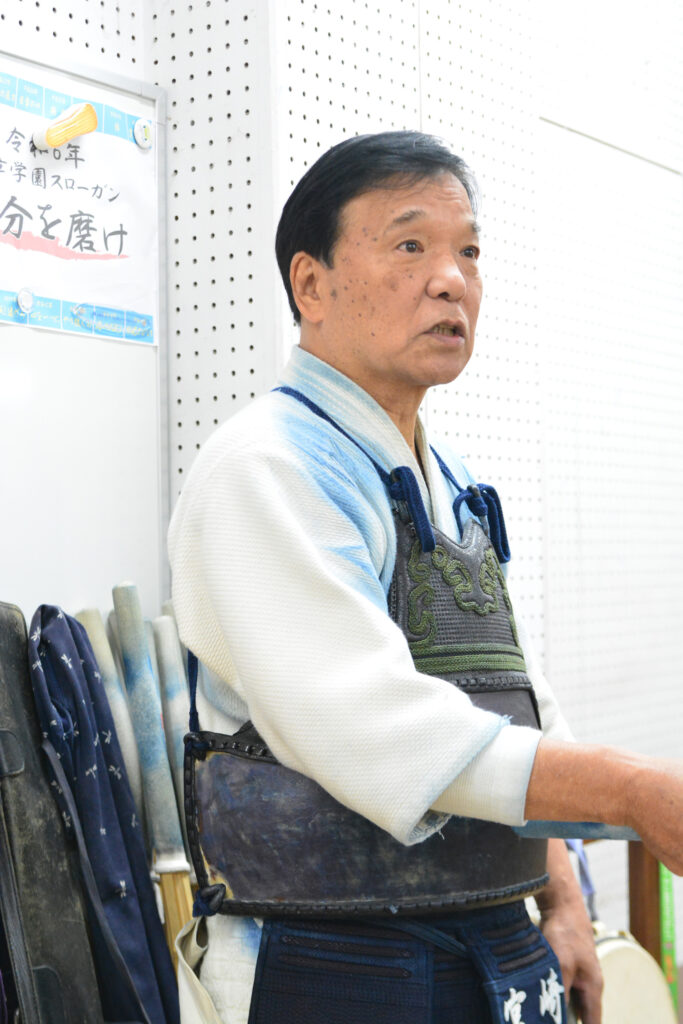
After retiring from Takanawa High School in Tokyo in 2016, I began teaching at Nissho Gakuen Junior and Senior High School in Miyazaki, where I have continued to train alongside the high school students while pursuing my own Keiko as well.
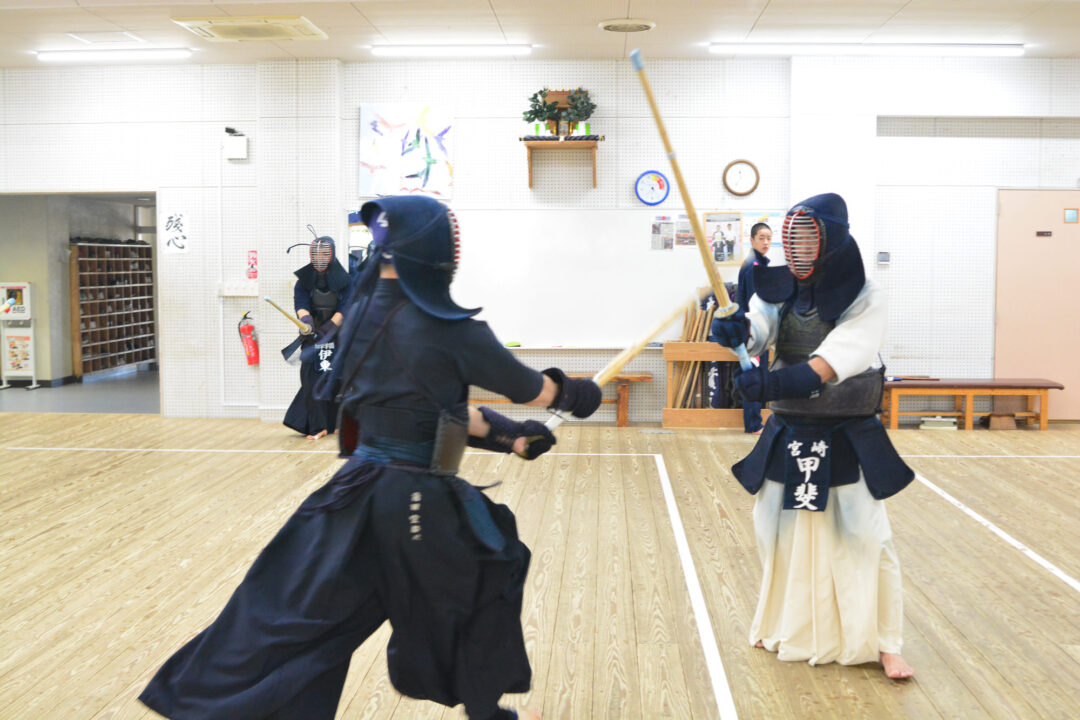
The most important principle in my instruction is to strike from a correct Kamae. When facing an opponent in a tense, close contest, the key to victory lies in whether one can execute a fully committed technique. To produce such a strike, one must first have a proper Kamae. If the Kamae is unbalanced, it becomes impossible to deliver a strong and direct strike along the shortest path.
Most students who join our Kendo club have previous experience from youth Kendo and possess a high level of technical skill in competition. However, this often comes with the downside of ingrained bad habits. I guide them to correct these habits. Some students are able to correct them within a year, while for others, it may take up to three years. Once they graduate, it becomes much harder to correct these habits, especially if they attend a general university where they won’t have the same volume of training—unless they continue Kendo at a specialized university program. That is why I believe it is crucial to address and correct these habits during high school.
Striking from a correct Kamae has been something I have valued deeply in my own training as well.
I successfully passed the 8th dan examination in November 2023. I began attempting the exam at the age of 48 and continued to challenge it twice a year without fail. It took approximately 40 attempts before I finally succeeded.
While I was at Takanawa, being located in Tokyo allowed me to visit many other Dojos for Keiko. However, after being assigned to Nissho Gakuen in Miyazaki, such opportunities have become rare. When I was in Tokyo, I used to think, “Someday, I’ll make it somehow,” and took the challenge lightly. In the end, it took me nearly 20 years to achieve this goal.
After being assigned to Miyazaki, I passed the 8th dan examination on my third attempt at the first-round screening. Three years ago, I injured my neck and continued Keiko with my students while undergoing rehabilitation. During the examination the year before last, I approached the first-round match with the mindset of borrowing my opponent’s chest—that is, I resolved not to strike until my opponent made a move.
When I later reviewed the video, I saw that I had not struck for the first 35 seconds after the tachiai (match) began. Perhaps thanks to that mindset, I was able to seize the moment and strike as my opponent began to move. I believe that being able to stand my ground with the same frame of mind during the second-round screening also contributed to the positive result.
It was not about “wanting to strike,” but rather about enduring the urge to strike—what one might call a state of mushin (no-mind). It was a curious sensation. Later, a sensei who had observed my tachiai kindly told me that it was good.
The opportunity to strike debana—at the very start of the opponent’s movement—is fleeting. To respond instantly in that moment and deliver a strike with perfect unity of spirit, sword, and body (ki-ken-tai no ichi), one must maintain a correct Kamae. This is something I felt keenly through my own experience, and it is a lesson I hope to pass on to my students.
To strike correctly, one must grip correctly
The rest of this article is only available for Kendo Jidai International subscribers!