2026.8 KENDOJIDAI
Interviews: Teraoka Tomoyuki (Men’s Team), Yanagida Naoko (Women’s Team)
Photography: Nishiguchi Kunihiko, Yanagida Naoko, Sato Mariko
*Unauthorized reproduction or use of any photographs in this article is strictly prohibited.
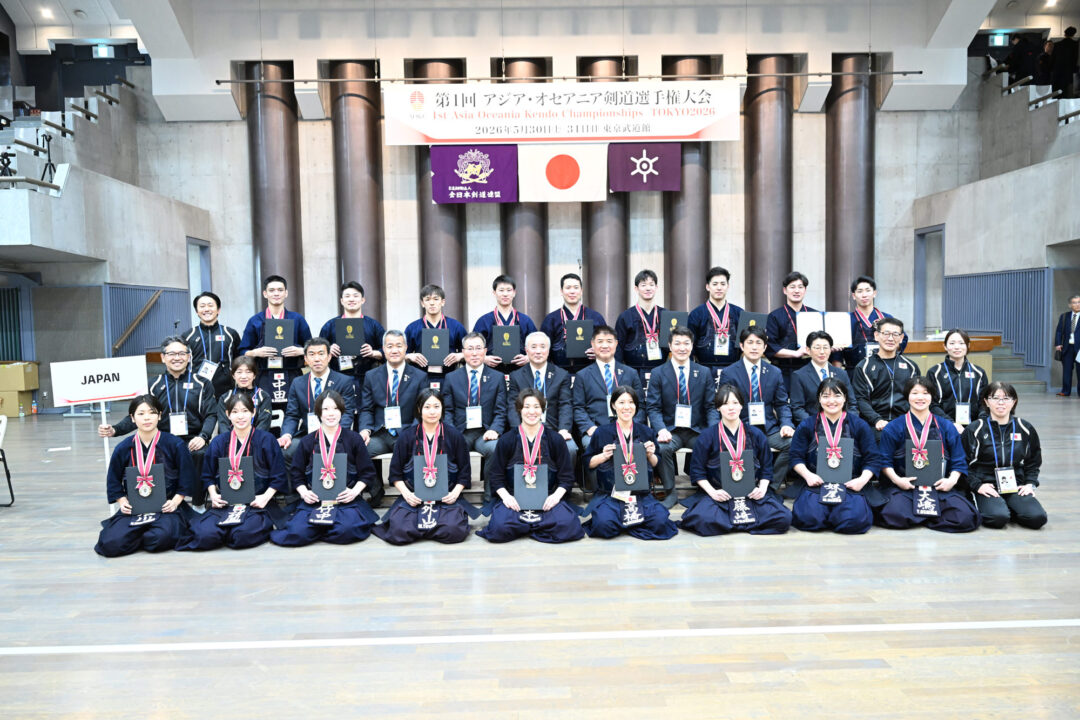
With the aim of further promoting and developing kendo throughout the region, the Asian Oceanian Kendo Federation (AOKF) was established. The 1st Asian Oceanian Kendo Championships was held as its inaugural flagship event. Japan competed in all four divisions—men’s and women’s team events, as well as men’s and women’s individual events. The championships served as both a showcase of kendo’s continued global expansion and a stage on which the true standard of Japanese kendo would be tested. Japan went on to claim all four titles, completing a clean sweep of the competition.
Men’s Team
Japan Defeats Korea to Become the First Asian-Oceanian Champions
The inaugural Asian Oceanian Kendo Championships carried special significance. For many years, the World Kendo Championships have been regarded in Japan as a tournament that simply cannot be lost. This new championship was viewed in much the same way. As the nation that has long led the international development of kendo, Japan entered the competition knowing that anything less than victory would be unacceptable. With the honor of becoming the first-ever champions at stake, the Japanese delegation felt every bit as much pressure as they would at a World Championship.
Japan’s men’s team consisted of nine athletes. Alongside experienced international competitors such as Takenouchi Yuya, Hoshiko Keita, and Matsuzaki Kenshiro, former World Championship team members Miyamoto Keita, Ohira Shoshi, and Kimura Keito also earned selection. The squad also featured several new faces, including Sanada Hiroyuki, a key member of the Kanagawa Prefectural Police team, Seike Rai, known for his aggressive style with the Osaka Prefectural Police, and promising newcomer Nakata Ryunosuke, who had only recently graduated from Kokushikan University.
Japan opened the tournament with a commanding 5-0 victory over China before defeating Macau and Chinese Taipei to reach the final. The team’s core trio of Matsuzaki, Hoshiko, and Takenouchi appeared in every match, while the remaining members rotated throughout the tournament. Every victory came by nihon-gachi, underlining Japan’s overwhelming superiority.
As many had anticipated, their opponent in the final was long-time rival Korea, advancing from the opposite side of the bracket.
The biggest storyline for the Korean team was the return of Jin Yong Jo to the national squad. At the 17th World Kendo Championships, held in Korea in 2018, Jo had been involved in a memorable battle with Japan’s captain, Ando Sho. Although he was not selected for the 2024 World Championships in Italy, there was no doubt that his experience and ability remained intact. His return added another formidable challenge for Japan.
Korea also progressed to the final in dominant fashion, defeating Mongolia, Kazakhstan, and Thailand. Every member of the Korean team claimed nihon-gachi victories in the opening round against Mongolia. The only setback came in the semifinal against Thailand, where Jo suffered an upset defeat to Sii. Rather than weakening the team, however, that lone loss seemed only to sharpen Korea’s determination heading into the championship match.
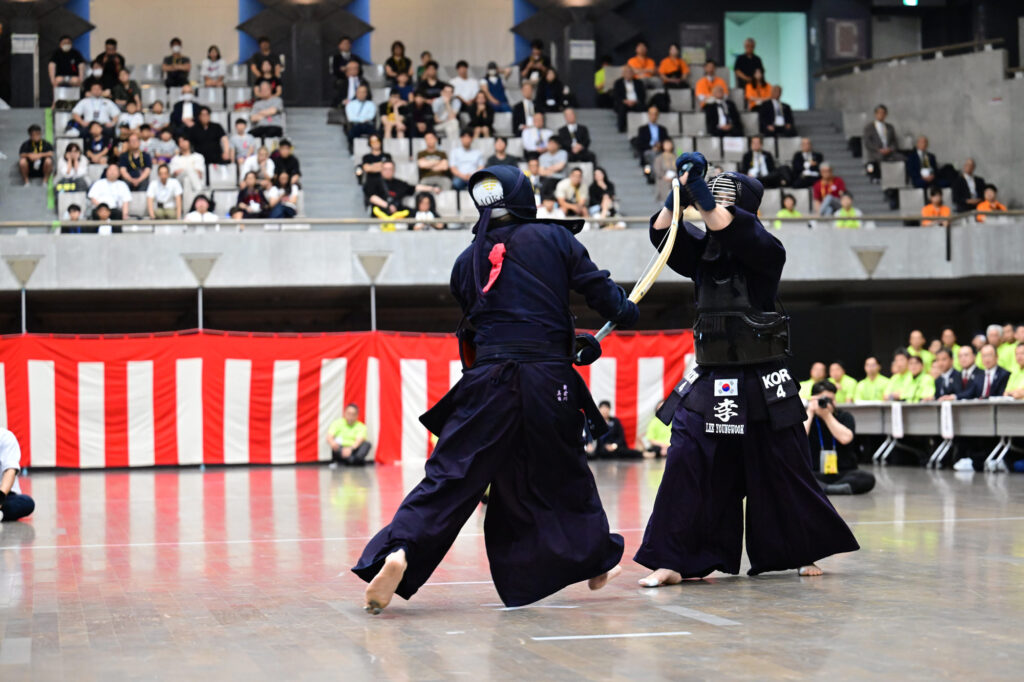
Korea Fights Back, but Japan Claims the Inaugural Title with a 4–0 Victory
The rest of this article is only available for Kendo Jidai International subscribers!