2011.3 KENDOJIDA
Photography by Tokue Masayuki
Sumi Masatake
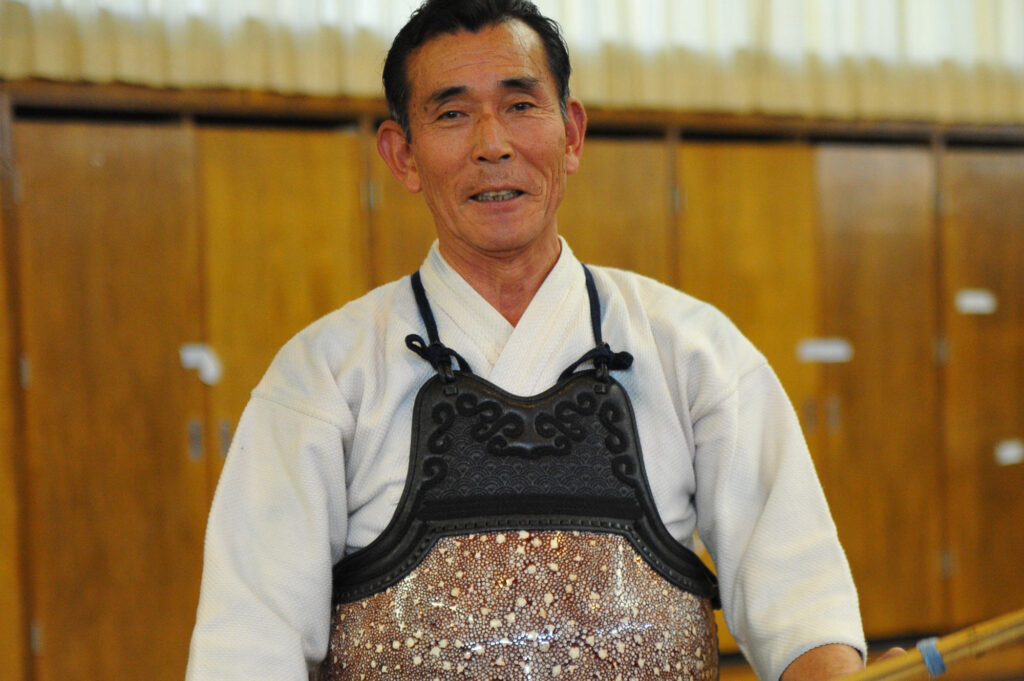
*This article originally appeared in the March 2011 issue of Kendo Jidai. The profile reflects his career and achievements at the time of publication.
The Kendo Dan Examination Regulations, which came into effect in April 2000, clarified the nature of Dan ranks during their revision by stating that “Dan ranks indicate the level of technical proficiency in Kendo, including its mental and spiritual aspects.”
Article 14 of the regulations establishes the criteria for awarding ranks from 1st Dan through 8th Dan. Furthermore, the examination guidelines specify the key points to be evaluated at each rank. These provisions are intended to establish a common understanding between candidates and examiners, thereby improving the validity and objectivity of Dan Examinations. However, because absolute evaluation standards cannot be established, efforts are made to ensure consistency by respecting the experience-based judgment of carefully selected examiners.
Since candidates are evaluated not only according to consistent rank-awarding criteria and progressively more demanding evaluation points, but also through the accumulated experience and judgment of examiners, they must recognize that “Dan Examinations are a mirror of one’s daily training.”
This means that practitioners must reflect on whether their regular training is appropriate for refining and completing the abilities expected of their current rank.
In other words, what is being assessed is whether candidates have developed the ability to fully demonstrate the technical qualities specified in the rank-awarding criteria when facing an opponent of equivalent rank.
For higher Dan ranks, particularly 6th through 8th Dan, qualities such as *riai* (the underlying principles and logic of technique), dignity, and commanding presence become increasingly important. At these levels, the examination goes beyond a contest of technical ability and assesses whether the deeper principles and essence of Kendo have become firmly established in the practitioner’s Kendo.
Candidates must therefore understand that these qualities cannot be acquired or convincingly demonstrated through superficial, last-minute preparation immediately before the examination.
It goes without saying that practitioners must recognize and correct their bad habits. Beyond that, there is no alternative to steadily and earnestly accumulating training based on jiri-itchi, the unity of theory and practice.
When someone is described as strong or highly skilled in Kendo, their ability often includes a certain degree of technical cleverness and sophistication. However, practitioners must be careful, as these qualities can sometimes become obstacles to developing the dignity and commanding presence expected at higher Dan ranks.
As practitioners advance toward the higher ranks, their training often tends to focus primarily on Gokaku-geiko (Jigeiko with opponents of equivalent ability). However, it is not uncommon for them to develop undesirable habits without realizing it, such as leaning the upper body forward, lifting the rear foot excessively, tensing the shoulders, or allowing the body to turn sideways during strikes.
These tendencies are particularly common among practitioners who have extensive experience competing against opponents in situations where technical superiority is emphasized.
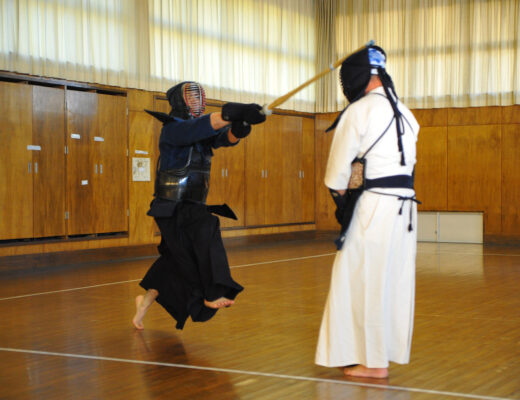
Practitioners should strive to maintain correct upper-body posture based on *shizentai* (natural posture), avoid lifting the right foot excessively when stepping forward, and develop the habit of maintaining proper posture after striking through strong, decisive Fumikomi.
By thoroughly mastering the principles of striking with the hips and the hara, practitioners can deliver strikes with full commitment and forward momentum. Even if the opponent manages to block such a strike, it may still receive a high evaluation because it demonstrates a powerful, fully committed attack.
Embrace Kakarigeiko and Strike Without Missing Changes in Fighting Spirit
The rest of this article is only available for Kendo Jidai International subscribers!