2008.11 KENDOJIDAI
I myself was often told that my Kensen was weak, and repeatedly instructed to make my Kensen felt and pressure the opponent.
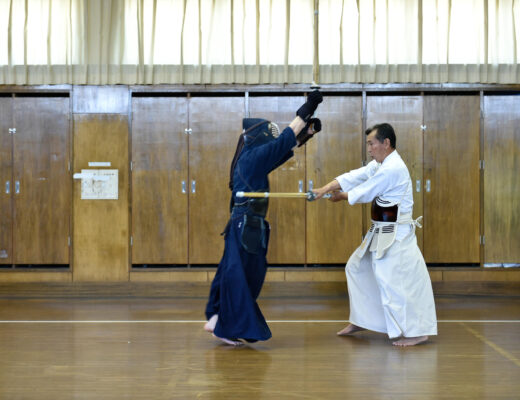
The strength of the Kensen is the barrier created through one’s Kamae. It carries a sense of pressure and allows one to break the opponent’s posture.
Here, I would like to explore how this can be cultivated through Ji-geiko.
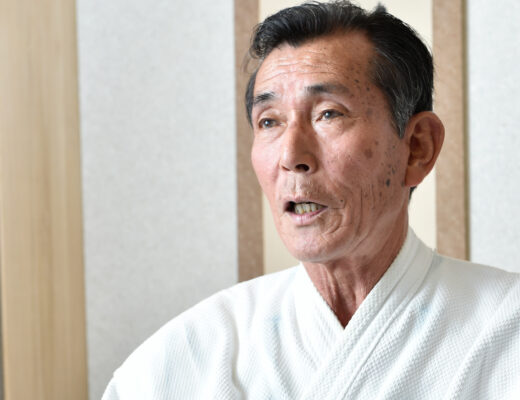
Sumi Masatake
Born in 1943 in Fukuoka Prefecture. After graduating from Chikushigaoka High School, he went on to Fukuoka Gakugei University (now Fukuoka University of Education). Following graduation, he worked as a high school teacher before returning to his alma mater as an assistant. He later became a professor in the Department of Health and Physical Education and retired in 2007.
Physical Posture, Mental Readiness, and the Kensen
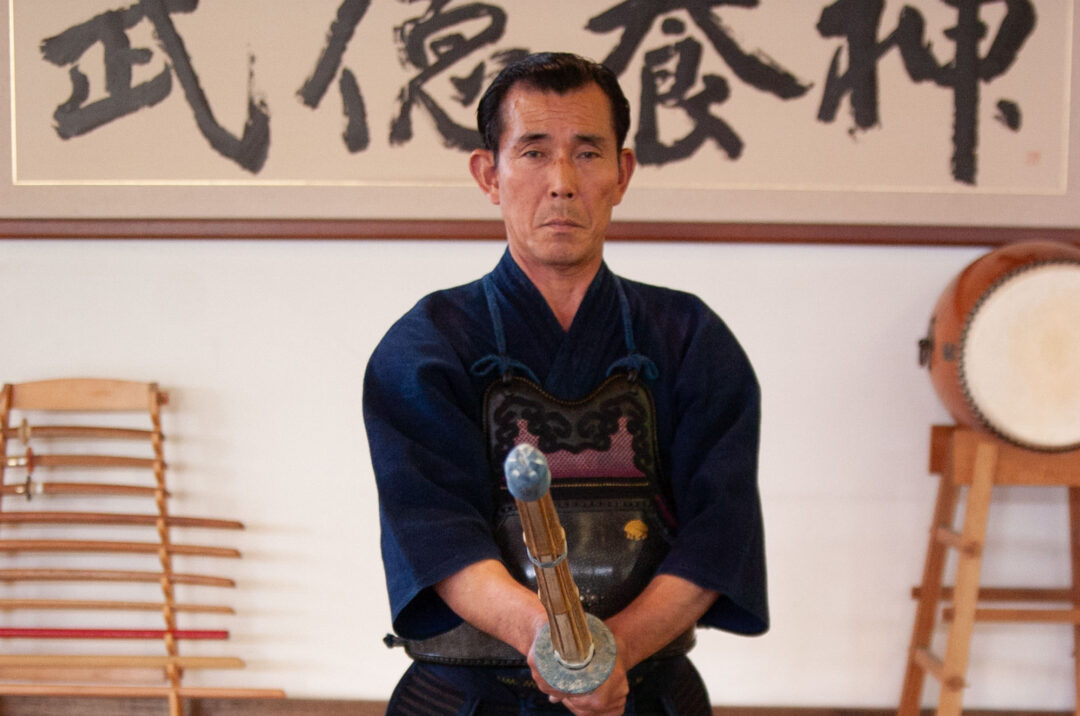
The fundamentals of Kendo begin with assuming Chudan-no-Kamae. As for the position of the Kensen, it is generally taught that its height should be set around the opponent’s throat, with the extension of the Kissaki directed toward the space between the opponent’s eyes, or slightly toward the left eye.
Regarding the position of the left fist, it should be drawn in and lowered to a point about one fist’s distance in front of the lower abdomen. The first joint of the left thumb is positioned at the height of the navel, and the Shinai is gripped from above, with the little, ring, and middle fingers firmly engaged to maintain control.
At the beginner level, when this Kamae is properly assumed, the Shinai is directed straight toward the opponent in alignment with the body’s frame—its width across the shoulders, torso, and hips. As a result, it may appear as a single point, represented by the thickness of the Kensen, or as a line, seen in the length of the Shinai from above or below, creating an impression of a piercing, thrusting force.
However, when facing a high-level practitioner in Chudan-no-Kamae, one begins to perceive something quite different. With the Kensen as its apex, it feels almost like a three-dimensional presence, with both depth and width.
Even when focusing on the height of the Kensen, beginners are taught to hold it at a fixed level, roughly at the opponent’s throat. Through training, however, one learns to adjust its height in response to the opponent. Eventually, it is no longer a matter of fixed height at all, but of using the Kensen freely—both to apply pressure and to suppress the opponent’s attack.
Also, when considering the relationship between the left fist and the Kensen, at the beginner level the left fist and the Kensen are simply aligned along one’s center line, extending straight toward the opponent. However, through training, in accordance with a natural right-foot-forward stance, the left fist comes to create an impression of a triangular plane formed together with the Kensen and the center of the face.
Furthermore, this develops into a presence that seems to advance as a three-dimensional form, even incorporating the full width of the body.
In this way, the power of the Kensen evolves from a stage that relies primarily on physical posture to one in which mental posture plays the dominant role.
Engaging the Lower Abdomen and Creating a Barrier through Kiai
The rest of this article is only available for Kendo Jidai International subscribers!