2011.3 KENDOJIDA
Photography by Tokue Masayuki
These days, I often see practitioners confusing Uchikomi-geiko with Kakarigeiko. In Uchikomi-geiko, the practitioner strikes the targets presented by the motodachi, whereas in Kakarigeiko, the practitioner actively initiates attacks and strikes at openings they perceive in the opponent’s defenses.
Kendo training progresses through different stages. Kirikaeshi and Uchikomi-geiko form the foundation, followed by Kakarigeiko and Hikitate-geiko.
In the past, instructors would say things like, “You are not yet at the stage where you should be practicing Kakarigeiko. You need to work more on Kirikaeshi and Uchikomi-geiko.” In this way, the appropriate stage of training was determined to some extent by each practitioner’s level of development.
Practitioners would progress step by step, first learning to maintain proper posture and body balance during Uchikomi-geiko, then developing solid strikes and sharp tenouchi, and eventually becoming able to respond immediately to changes in their opponent’s movements. Only after acquiring these skills would they be instructed to begin Kakarigeiko.
Kakarigeiko is a form of training in which practitioners build up their fighting spirit and commit themselves completely to executing techniques with a spirit of sutemi (total commitment without hesitation). The distinction between Kakarigeiko and Uchikomi-geiko is therefore clear.
Let us take this opportunity to develop a thorough understanding of the differences between Uchikomi-geiko and Kakarigeiko.
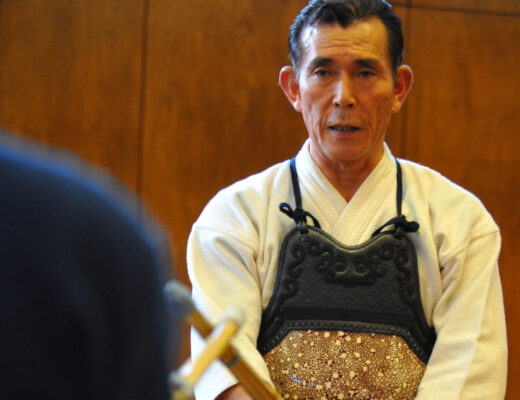
Sumi Masatake
Born in 1943 in Fukuoka Prefecture. After graduating from Chikushigaoka High School, he entered Fukuoka Gakugei University (now Fukuoka University of Education). Upon graduation, he became a high school teacher in Fukuoka Prefecture. In 1972, he returned to his alma mater, Fukuoka University of Education, as a research assistant and later became a professor. He retired in 2007. He competed in the National Kendo Tournament for Teachers and Staff and the All Japan East-West Kendo Tournament, and placed third in the Meiji Mura Kendo Tournament.
*This article originally appeared in the March 2011 issue of Kendo Jidai. The profile reflects his career and achievements at the time of publication.
Uchikomi-geiko: Maintaining a Stable Posture with Proper Hip Engagement
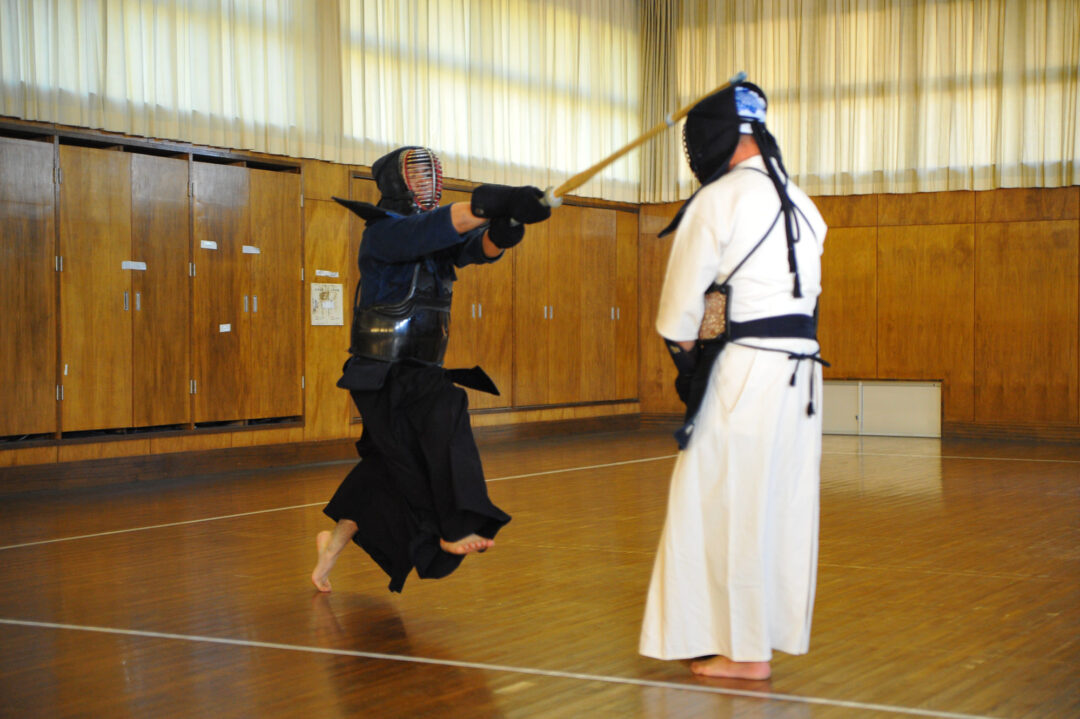
In Uchikomi-geiko, the practitioner strikes the targets presented by the motodachi with large movements, retreats to create distance, immediately closes the distance again to prepare for the next strike, and continues attacking and retreating. An essential point is to execute several strikes in one continuous breath, without pausing to breathe between them.
To make proper body contact with the opponent after striking, both hands must be correctly positioned in front of the abdomen. This requires a stable posture at the moment of striking, with the hips properly engaged. It is therefore important to recognize that developing a stable striking posture is one of the fundamental objectives of Uchikomi-geiko.
Only when a stable posture is maintained can practitioners deliver sharp, precise strikes with effective tenouchi. Even if someone appears to be striking with great effort by putting strength into the upper body, it does more harm than good if the hips are pulled back and the lower abdomen lacks strength and engagement.
The essence of Uchikomi-geiko lies in mastering large, stable, and smooth body movements while learning to maintain a continuous reserve of breath and fighting spirit. These qualities form the foundation for developing sharp, effective strikes.
It is therefore essential to reflect on the traditional teaching:
“Do not strike with your hands; strike with your feet. Do not strike with your feet; strike with your hips. Do not strike with your hips; strike with your hara.”
Training with this principle in mind is crucial.
At the same time, practitioners should recognize that serving as motodachi during Uchikomi-geiko provides opportunities to practice a wide range of techniques themselves.
By coordinating your shinai movements with those of the kakarite, you can repeatedly practice the movement of a straight Men strike executed in “one breath,” even though you are not actually striking.
You can also develop a practical understanding of the tenouchi required for Suriage-waza by effectively using both the left and right shinogi of the shinai. Similarly, you can practice the shinai movements involved in receiving a Men strike and immediately countering with Do.
Rather than simply allowing the kakarite to strike you as though you were a stationary striking dummy, actively evading attacks and responding with countertechniques will help bring out the kakarite’s attacking spirit and concentration.
Kakarigeiko: Practicing a Variety of Initiating Techniques
The rest of this article is only available for Kendo Jidai International subscribers!