2026.9 KENDOJIDAI
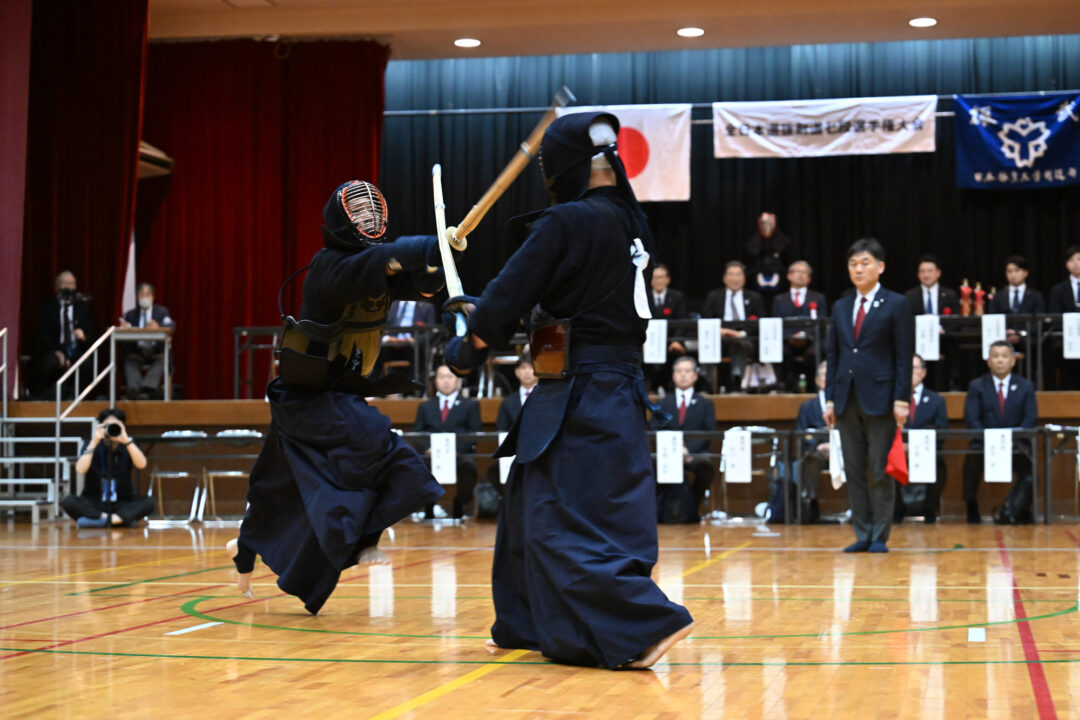
Toyomura Azumori, Hanshi 8th Dan; Hirao Yasushi, Kyoshi 8th Dan; Takei Koji, Kyoshi 8th Dan; and Nabeyama Takahiro, Kyoshi 8th Dan served as referees at the 13th All Japan Invitational Kendo 7th Dan Championship.
From their position on the court, how did they view the 31 matches contested by 16 selected competitors from across Japan? The four referees reflect on the Kendoka and matches that left a lasting impression, the subtleties of the exchanges, the process leading to a valid strike, and the dignity and presence distinctive to a championship for 7th Dan practitioners. Through their perspectives, we revisit what made this year’s tournament so compelling.
The Essence of Kendo as Both Competitive and Traditional Culture
Toyomura Azumori, Hanshi 8th Dan
Born in Kagoshima Prefecture in 1950. After graduating from Kagoshima Jitsugyo High School, he attended Chukyo University. Following graduation, he worked for a private company before joining the All Japan Kendo Dojo Federation, where he currently serves as Executive Director.
In one of Ozawa Hiroshi Sensei’s books, he writes: “You can tell a person’s refinement by the way they wear their Kendo equipment; their stature by their etiquette and conduct; their dignity by their Kamae; and their resolve by their first strike.” If I were to sum up my impression of this tournament in a single sentence, I would say that it truly embodied these words.
Proper and beautiful attire is an expression of respect for one’s opponent and of a sincere approach to Kendo. Every competitor wore their Kendogi, Hakama, and Kendo equipment impeccably, conveying a strong sense of dignity.
Moreover, etiquette in Kendo is not merely a matter of formality. It is an important practice through which we express gratitude and respect toward our opponent while bringing the mind and body into harmony. This is not something that can be acquired overnight. The competitors’ everyday attitude and discipline were clearly reflected in their conduct.
As for Kamae, every competitor displayed a beauty that left no opening. It is said that an undisturbed Kamae means the absence of the “three openings”: an opening in one’s Kamae, an opening in one’s movement, and an opening in one’s mind.
Then there was the first strike. The competitors’ ability to commit fully to their strikes was remarkable, as was their judgment in identifying the right opportunity to attack. I believe this led to decisive strikes delivered with resolve that fulfilled the requirements of a valid strike.
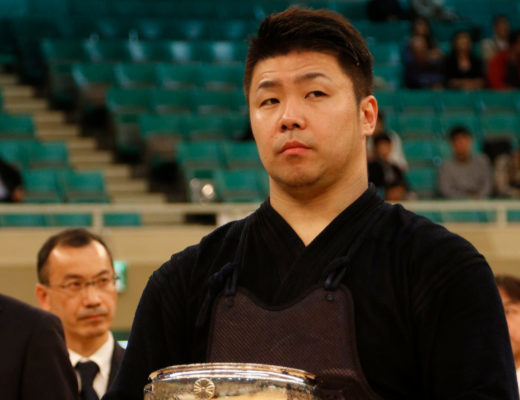
This tournament brings together 16 competitors selected from across Japan to engage in fierce competition. All of them have distinguished records in events such as the All Japan Kendo Championship, and scoring a valid strike against opponents of this caliber is by no means easy. Every one of the 16 competitors left an impression on me, but Kotani (Chiba), who ultimately prevailed in this highly competitive field, demonstrated particularly skillful Kote techniques. In the semifinal, he scored two consecutive Kote to win by two points—an extremely difficult feat at this level.
This was Kotani’s fourth appearance in the tournament, which perhaps places him among the more experienced half of this year’s field. He had previously finished second at the All Japan Kendo Championship, the All Japan Police Kendo Championship, and the previous edition of this tournament. Having reached the final on several occasions only to fall just short of the title, I imagine he was determined to finally claim an individual championship.
Meanwhile, although Hatakenaka (Tokyo) narrowly lost in the final to finish second, I could also see further growth in his Kendo. He is one of the leading Kendoka of his generation, having competed in the World Kendo Championships, placed third at the All Japan Kendo Championship, and won both the team and individual titles at the All Japan Police Kendo Championship. Two years ago, at the 11th edition of this tournament, he won the championship on his first appearance.
In the preliminary league, he scored two consecutive Men against Hashimoto (Saitama), who was making a tournament-record eighth appearance, and advanced from the group with one win and two draws. In the final tournament, he defeated his fellow Keishicho competitor Hayashi (Tokyo) in the first round, followed by Okido (Kagoshima), to advance to the final. After being eliminated in the quarterfinals at the previous tournament, I sensed a strong determination in him this time to capture his second title.
Okido once again finished third, while Kinoshita earned his first placing in the tournament. Last year, Okido returned to his alma mater, the National Institute of Fitness and Sports in Kanoya, as a faculty member and took on the role of Kendo team coach, where he is now helping to develop the next generation of Kendoka. His performance showed that he has continued to devote himself seriously to Keiko in Kagoshima. Kinoshita, meanwhile, advanced to the semifinals despite the demands of his work as a senior police officer. The Men-kaeshi-Do he scored in the first round of the final tournament was a perfect example of drawing out the opponent’s attack and then striking.
What struck me most after watching all 31 matches was the way each of the 16 competitors approached their Kendo. From the development of the matches, I could sense that in their regular Keiko they train with a clear sense of purpose and work deliberately to address the challenges they have identified.
The referees were also highly accomplished competitors themselves and possessed extensive refereeing experience. Despite a succession of extremely demanding matches, they carefully assessed the “requirements and elements of Yuko Datotsu” stipulated in Article 12 of the Regulations of Kendo Shiai and Shinpan, and officiated to an exceptionally high standard.
It is said that a tournament reaches its fullest potential when the competitors, referees, and spectators come together as one. This tournament made me feel the truth of that very strongly.
A Standout Match: “Hayashi in Stillness, Hatakenaka in Motion”
Hirao Yasushi, Kyoshi 8th Dan
Born in Hokkaido in 1967. After graduating from PL Gakuen High School, he attended Tokai University. Upon graduation, he joined the Tokyo Metropolitan Police Department, where he currently serves as Chief Kendo Instructor.
Among the competitors’ opening matches, Matsumoto (Kanagawa) particularly caught my attention. I felt that his techniques emerged from solid Seme that effectively broke down his opponent. His performance reflected the results of the study and training he has consistently pursued in his daily Keiko in his efforts to reach an even higher level.
The rest of this article is only available for Kendo Jidai International subscribers!