
2026.6 KENDOJIDAI
Interview: Yanagida Naoko
Photography: Nishiguchi Kunihiko
*Unauthorized reproduction or use of any images in this article is strictly prohibited.
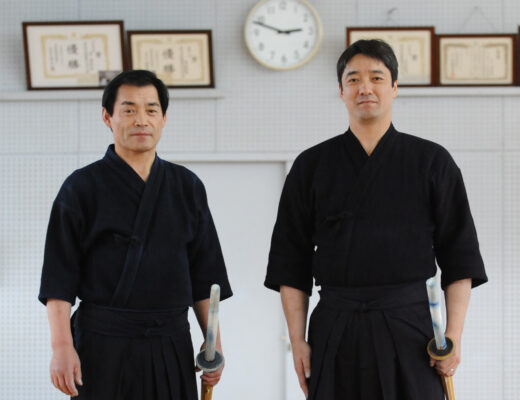
Yosuke Nomura competed at the highest level for 17 years as a member of the Kendo Special Training Squad of the Kanagawa Prefectural Police until last year.
Through those years of competition, he came to realize the importance of practicing a style of kendo that enables him to respond to anything his opponent does, at any moment. According to Nomura, the key to achieving this ideal lies in the preparation leading up to competition.
Nomura Yosuke, Renshi 7th Dan

After graduating from high school, I joined the Kanagawa Prefectural Police and served as a member of its Kendo Special Training Squad for 17 years, until last fiscal year. Throughout those years of daily training, I always kept in mind the teaching I received from Miyazaki Masahiro Sensei, Hanshi 8th Dan: preparation is essential.
One of his words that left a particularly strong impression on me was that a match does not begin with the referee’s command of Hajime. In other words, the outcome of a match is largely determined by how much preparation has been completed before it even begins.
When I was younger and had only just begun to understand this lesson, my approach was rather simplistic. I thought that if I supplemented my nutrition properly, I would be able to train hard again the next day, or that if I concentrated during practice just before a tournament, I would be fine in the match itself.
As I grew older, however, I began to focus more on whether I could fully demonstrate the results of my daily training when it mattered most. In particular, I came to place great importance on being able to compete as my usual self at all times. Ideally, by training every day with actual competition in mind, this mindset and readiness become second nature, and preparation for the match naturally falls into place.
As a competition approaches, it is easy to fall into the mindset of thinking, “I need to add one more skill,” or “I still need to improve this.” In other words, there is a tendency to keep adding more to your preparation. However, when the day of the competition draws near, I believe it is more important not to become unsettled or make unnecessary changes—to focus instead on what I would call the process of elimination.
For example, if you routinely inspect your shinai and equipment and regularly review the fundamentals, such as etiquette and proper conduct, there is no need for frantic last-minute preparation the day before or on the day of the competition. Everything can proceed smoothly because the essentials have already been taken care of.
The same principle applies to nutrition. As part of my daily routine, I avoid greasy foods and pay close attention to how I fuel my body, including learning when to eat foods such as white rice that can be quickly converted into energy. Throughout the year there are periods devoted to competition and others focused on intensive training, and I adjust my diet according to the demands of each phase.
The same applies to practice. By taking the actions that are necessary for each situation, those actions gradually become part of your routine, and that routine itself becomes a source of confidence.
In my case, I tried to establish routines within my everyday behavior. These may seem like small details, but they helped stabilize my mind. As competition approached, they allowed me to prepare with the firm resolve that I was ready to fight at any time.
I also paid attention to very minor details, such as the condition of the floor at the venue. The strength of the air conditioning and the humidity on the day can affect how slippery the floor is.
These points may seem small, but I believe paying attention to them is essential for practicing the kind of kendo that enables you to respond to your opponent’s movements at any moment.
Delivering the Fastest One-Handed Men from Jōdan by the Shortest Path
I normally fight from Jōdan-no-kamae.
Jōdan is often described as the kamae of heaven and the stance of fire. It is an aggressive posture that applies pressure from above with both arms raised, while at the same time exposing vulnerable targets such as the Dō and Tsuki.
One of the most important aspects of fighting from Jōdan is being able to execute one-handed techniques smoothly and decisively. To achieve this, I pay close attention to how I use the left side of my body in my daily practice so that, when the moment to strike presents itself, I can accurately hit the intended target.
The ideal one-handed Men strike is one that follows the correct blade angle (Hasuji) while traveling by the shortest possible path.
When executing a one-handed strike, I consciously initiate the movement in sequence—from my left wrist, to my left forearm, left elbow, left shoulder, and finally my left shoulder blade. For that reason, I believe the position of the left fist in Left-jōdan is extremely important.
Personally, I position my left fist about one to two fist-widths in front of the left side of my forehead. If the left fist is held either too high or too low, the left wrist, arm, elbow, shoulder, and shoulder blade cannot move smoothly, making it difficult to maintain correct blade angle (Hasuji).
When I swing, I work backwards from the point where the strike is meant to land, visualizing the path the shinai should travel. I have found that this helps produce a smoother, more efficient motion. Focusing on guiding the kensaki with my left fist also allows me to swing without unnecessary tension.
At the end of the strike, I also pay close attention to Tenouchi. Rather than over-tightening my grip, I focus on maintaining proper blade angle so that the Kensaki finishes with a natural upward rebound. At the same time, it is essential to grip firmly with the little finger to complete the Tenouchi. If I fail to do so, the Kensaki tends to drift to the right, and my body is easily pulled off line with it.
I believe that unless I remain conscious of striking with my left side, I cannot produce a truly sharp and decisive ippon.
Developing effective one-handed techniques requires a certain level of strength to control the Shinai with one hand, which in turn demands a substantial amount of practice. Because these techniques place considerable strain on the left side of the body, regular stretching and massage are equally important. I make a habit of stretching my arms and joints whenever I have the opportunity—not only before practice, but throughout the day whenever I notice stiffness.


When executing a one-handed Men strike, I work backwards from the intended point of impact, visualizing the path the Shinai should take to reach the target.
Footwork in Suburi Lays the Foundation for Effective Striking
The rest of this article is only available for Kendo Jidai International subscribers!