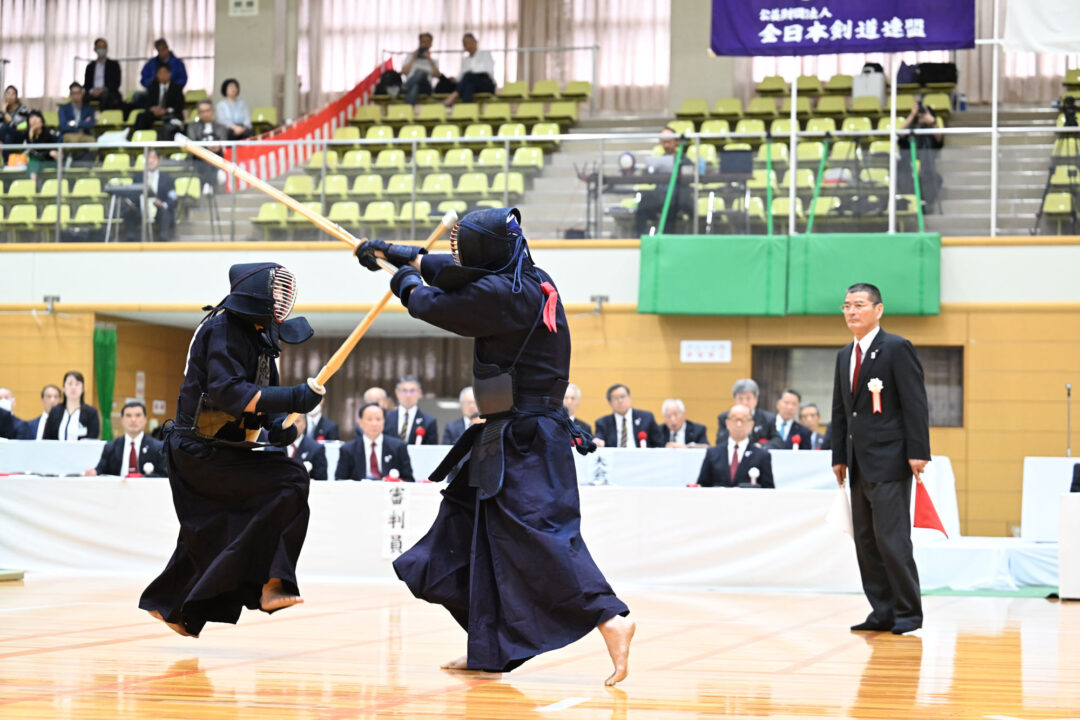
2026.8 KENDOJIDAI
Photography: Sasai Takamasa
*Unauthorized reproduction or use of any images in this article is strictly prohibited.
Still leading his generation, Nabeyama, Kyoshi 8th Dan, continues to perform at the highest level. After overcoming countless fierce battles, he finally claimed victory at the All Japan Invitational 8-Dan Kendo Championship. While pursuing the pinnacle as a competitor, he has also guided many Kendo practitioners to national titles as a coach. Where does that remarkable strength come from?
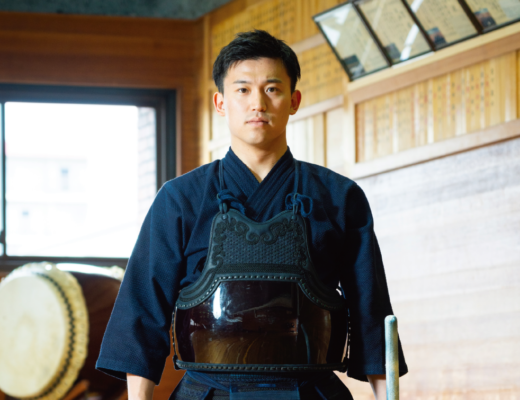
Nabeyama Takahiro
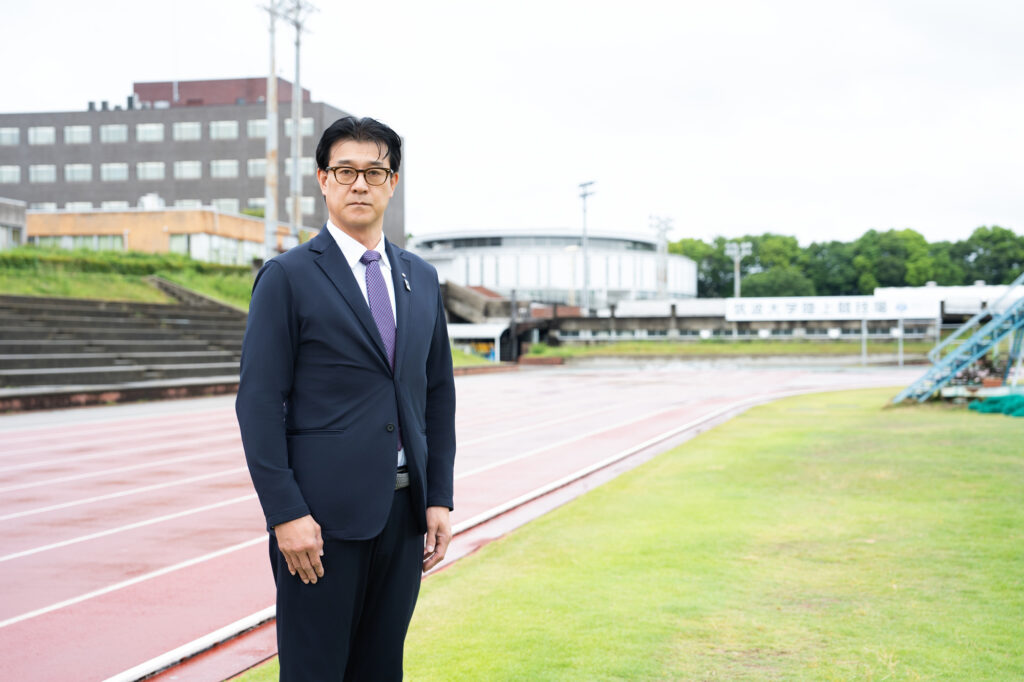
His First Individual Title in 39 Years, Since the Hokkaido Inter-High School Championships
As previously reported, Nabeyama Takahiro, Kyoshi 8th Dan, representing Ibaraki Prefecture and serving as an Associate Professor at the University of Tsukuba, claimed his first title at the 24th All Japan Invitational 8-Dan Kendo Championship. He became only the fourth schoolteacher to win the tournament, following Yamanaka Shigeki, Tani Katsuhiko, and Eiga Hideyuki, and the first university faculty member to achieve the feat.
“Among the graduates of the University of Tsukuba, Tani Katsuhiko Sensei, was the first to win this championship, while Oka Kenjiro Sensei, Hanshi, former president of the International Budo University, won its predecessor, the Meijimura Kendo Tournament. This is my first individual title since winning the Inter-High School Championships as a third-year high school student, so I am simply delighted.”
It would be fair to say that Nabeyama, Kyoshi, made a striking entrance onto the Kendo scene at the 1986 Gyokuryuki High School Kendo Tournament. Although only a second-year student, he competed as Taisho of the powerful PL Gakuen High School team. In the final against Aso High School, he completed a dramatic comeback victory, securing PL Gakuen’s second Gyokuryuki title as a team from outside Kyushu.
Today, more schools from outside Kyushu have won the Gyokuryuki, but at the time, PL Gakuen was the only school to have crossed the Kanmon Strait and taken the title. At the Inter-High School Championships held in Hokkaido the following year, Nabeyama, Kyoshi, was regarded as one of the outstanding high school Kendoka of his generation and became the center of attention. Despite the immense pressure, he went on to win both the individual and team titles.
“People began paying close attention to me from the preliminary league, and even as a high school student, I understood that there were great expectations surrounding me. In the end, I was able to win both the individual and team competitions, and I feel that those victories opened up many possibilities in my subsequent Kendo career.”
After graduating from PL Gakuen High School, he entered the University of Tsukuba. Upon completing his graduate studies, he joined his alma mater as a faculty member. Throughout his career, he has remained one of the leading figures of his generation, representing Japan twice at the World Kendo Championships and competing ten times at the All Japan Kendo Championship.
After attaining 8-Dan, he continued to achieve success, including winning the National Sports Festival representing his home prefecture of Ibaraki and capturing the team title at the All Japan Teachers’ Kendo Championship. In 2026, he was appointed Special Ambassador for the Gyokuryuki High School Kendo Tournament.
“It is a tremendous honor to support the Gyokuryuki Tournament, which has had such a profound impact on my Kendo career. I hope to further raise its profile so that it will become a tournament recognized and admired by Kendo practitioners around the world.”
Seven Ippon in the 8-Dan Tournament
Seizing Victory with Early Attacks
He made his first appearance in the 8-Dan tournament at the 19th edition in 2021. He advanced to the final, where he was defeated by Eiga Hideyuki, Kyoshi, now Hanshi, a teacher from Hokkaido, but still achieved an impressive runner-up finish.
“The previous year’s 8-Dan tournament had been cancelled due to COVID-19, and I entered the competition after spending almost an entire year with very little opportunity for Keiko. I was also suffering from a knee injury and could barely perform Sonkyo, so I even considered withdrawing. However, the All Japan Kendo Championship, which had been postponed from November until March, inspired me to compete after seeing the outstanding performances of our current students and graduates. Matsuzaki Kenshiro won the tournament, Murakami Raita finished second, and Hoshiko Keita and Hayashida Kyohei placed third.”
In his three previous appearances in the 8-Dan tournament, Nabeyama consistently achieved strong results, finishing runner-up, third, and in the best eight. In recent years, competitors have generally no longer been selected after making five appearances. This meant that he had only two more opportunities to reach the top.
“I began Kendo in the second grade of elementary school and have spent most of my Kendo career focused on competition. After bringing my participation in the All Japan Championship to a close, my opportunities to compete in individual tournaments decreased dramatically. Before long, the 8-Dan tournament had become my final individual competition, and I naturally began to feel that I wanted to compete without leaving any regrets.”
At the 24th tournament, Nabeyama faced Baba Kenji, Kyoshi, of Okayama in the first round.
“This time, my intention was not to win by grinding out long matches. I wanted to settle each bout within the five-minute regulation time. My knee had not fully recovered, and forcing my attacks could have led to another injury, so my focus was simply on giving everything I had.
In the first round, I scored a Debana-Men against Baba Sensei in Encho, but at one point he anticipated my Men attack and struck my Do. The ability of 8-Dan Sensei to read their opponents is extraordinary. It reminded me that I couldn’t afford to attack carelessly.”
In the second round, Nabeyama defeated Iwakiri Kimiharu, Kyoshi, of Chiba, followed by Tsutsumi Koji, Kyoshi, of Oita in the third round to advance to the quarterfinals. His body responded instinctively.
“For this tournament, I narrowed my focus to one theme: attacking at the Debana. If you hesitate or let your spirit retreat, a Debana technique becomes nothing more than waiting for your opponent to move before striking, and it won’t succeed. The essential requirement for a successful Debana technique is to apply pressure, draw your opponent out, and strike at that instant. That’s something I always tell my students as well.”
The rest of this article is only available for Kendo Jidai International subscribers!