2026.6 KENDOJIDAI
Photography: Nishiguchi Kunihiko
*Unauthorized reproduction or use of any images in this article is strictly prohibited.
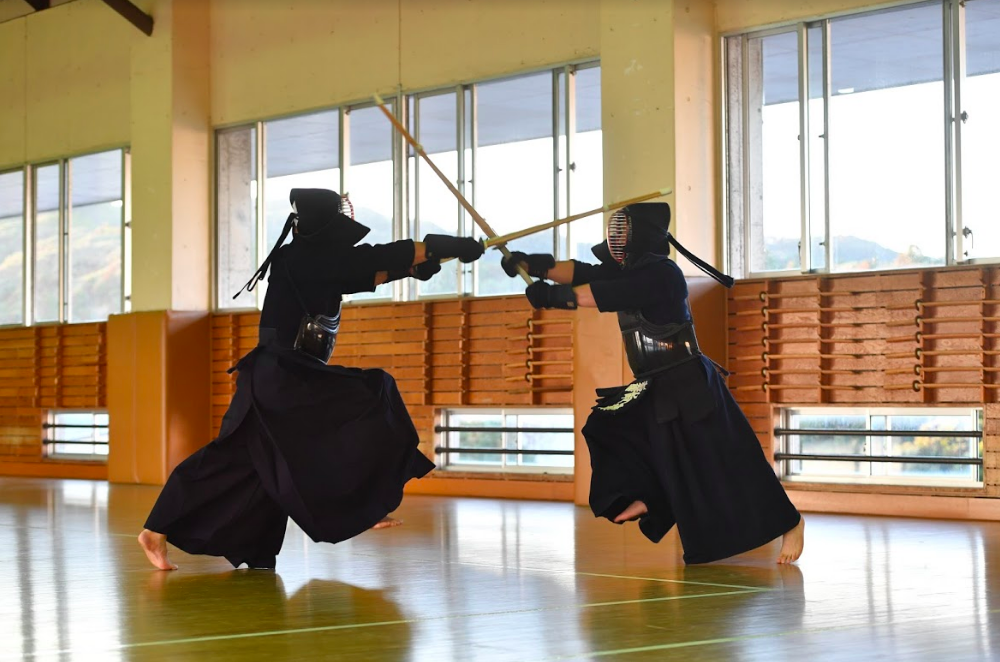
International Budo University, which trains future kendo instructors, places great emphasis on mastering correct kamae as the foundation for pursuing kendo in the proper way.
To fully demonstrate one’s abilities in high-pressure situations such as competitions, where tension reaches its peak, it is essential to engage in keiko with senior instructors and more advanced practitioners. Through such training, practitioners internalize opportunities for striking and Maai, allowing them to respond naturally and effectively in actual matches.
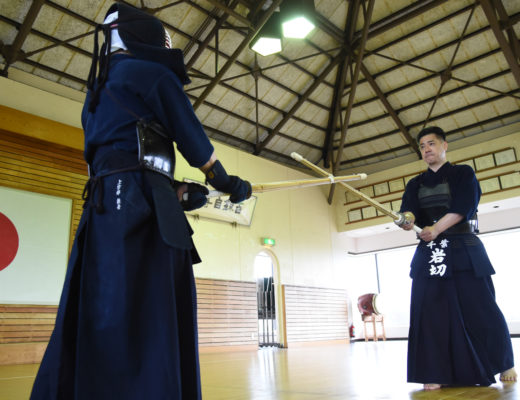
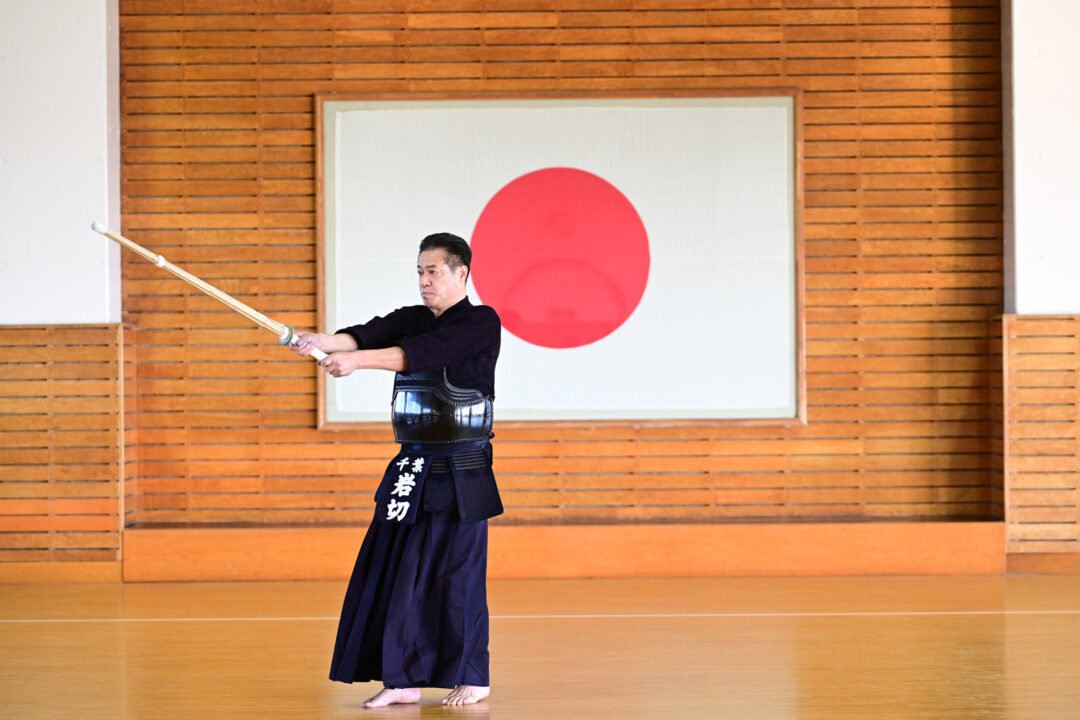
Iwakiri Kimiharu, Kyoshi 8th Dan
Born in Miyazaki Prefecture in 1966, Iwakiri Kimiharu graduated from Takachiho High School before enrolling at International Budo University. Upon graduation, he joined the university faculty. His major competitive achievements include appearances at the All Japan Invitational 8th Dan Kendo Championship, the All Japan East–West Kendo Tournament, the National Sports Festival, the National Teachers’ Kendo Championship, and the All Japan Prefectural Kendo Championship. He currently serves as a Professor at International Budo University and Head Coach of the university’s kendo club.
Striking with the Unity of Ki, Ken, and Tai
Creating Sharpness Through Conscious Kiai
Even if a kendo practitioner possesses excellent technical skills, it is difficult to demonstrate their full ability in competition without the mental strength to bring those skills out under pressure.
I have competed in tournaments since childhood and have experienced my share of disappointments. Looking back, I believe that the key to performing at one’s best in actual competition comes down to something quite simple: how seriously and sincerely one pursues correctness in everyday keiko. As commonplace as it may sound, success ultimately depends on the extent to which one approaches regular training with genuine commitment and a constant desire to refine what is right.
By “correctness,” I mean first and foremost practicing what is taught in the textbooks, by instructors, and through one’s own study with honesty and humility. I believe that the accumulation of such efforts ultimately leads to valid strike in competition.
Competition creates a level of tension so intense that one may feel like running away from it. However, unless that pressure is overcome, victory cannot be achieved. For that reason, I believe it is essential to create, during everyday keiko, a sense of tension that closely resembles the atmosphere of actual competition. That is what preparation for competition means.
There are many ways to cultivate such tension, but one method I emphasize with my students is the importance of producing strong kiai.
Some may think, “Is that all?” Yet a spirited display of fighting spirit is one of the requirements for a valid strike, and it is widely understood that sharp kiai gives power and vitality to one’s techniques.
A valid strike in kendo requires the unity of ki, ken, and tai. However, it is not uncommon to see practitioners in keiko strike without proper vocalization. Perhaps it is a recent trend, but some even vocalize only after the strike has been completed. With such habits, it is impossible to deliver a strike in competition that is universally recognized as a valid datotsu.
For this reason, it is essential to develop proper kiai from the very beginning—even during suburi—so that the vocalization fulfills the requirements of a valid strike. The same applies to uchikomi and kirikaeshi: practitioners should project their voice fully and consistently throughout training.
This may sound simple and straightforward, but if one performs an entire keiko session without letting concentration lapse even once, maintaining proper kiai in every movement, I believe it becomes clear just how physically and mentally demanding such practice truly is.
Keiko with Senior Practitioners Is Essential
Competition Requires the Strength to Overcome Pressure
There is no doubt that the path to becoming stronger in kendo lies in the repeated practice of the fundamentals. However, fundamentals alone do not automatically translate into success in actual combat.
In basic training, the partner does not move, but in jigeiko, shiai, and dan examinations, the opponent is naturally trying to strike you as well and will employ a variety of tactics. For this reason, it is crucial to bridge the gap between fundamental training and practical application.
In my view, the keiko that builds this bridge is keiko with senior instructors and more advanced practitioners.
Through such training, one learns to apply the skills acquired through basic practice while under pressure. It is through this process that those skills evolve into practical abilities and genuine fighting strength. Unless this step is taken, fundamental training remains nothing more than training for its own sake, without developing into the capacity required in real situations.
Even at our university, the students who regularly and actively challenge us instructors in keiko tend to show the greatest growth over the course of their four years. This is precisely why meaningful development cannot be expected without accumulating experience in keiko with highly skilled teachers and senior practitioners.
I first picked up a shinai at Nobeoka Shudokan in Nobeoka City, Miyazaki Prefecture. The dojo was led by Kai Tomiyoshi Sensei, the father of Kai Shuji Sensei, who currently serves as Head Coach of the kendo club at Nichisho Gakuen High School.
Kai Sensei would put on bogu and train with the children at every practice session. He had them strike actual target areas—Men, Kote, and Do—allowing them to learn Maai, opportunities for attack, and other essential elements through direct experience. In this way, they developed what is often referred to as uchi-aji—a genuine feel for striking.
Keiko with senior practitioners is mentally demanding and often difficult. However, by repeatedly challenging oneself without retreating—entering boldly through the opponent’s kensen and committing fully to each attack—one gradually becomes accustomed to operating under pressure. As a result, when training with opponents of a similar level, that sense of strain diminishes, and one becomes able to execute straightforward techniques naturally the moment an opportunity presents itself.
Today, I am fortunate to have opportunities to train with students as the head coach of a university kendo club. In doing so, I strive to pass on to the next generation what I learned from Kai Sensei, from jigeiko with Yoshimoto Masami Sensei during my years at Takachiho High School, and from the instruction I received after entering International Budo University, particularly from Komorizono Masao Sensei, the university’s first Chief Professor, as well as the other members of the teaching staff.
In the following sections, I would like to introduce some of the practices that I personally employ to create a sense of tension and intensity in keiko.
Keeping the Navel Facing Forward and the Left Side of the Body Stable
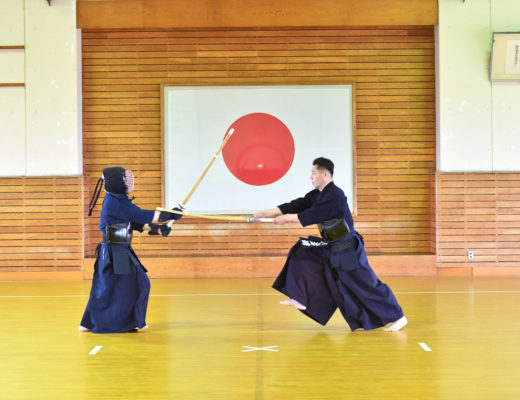
One of the first things taught when beginning kendo is how to assume a proper kamae. This includes physical fundamentals such as how to hold the shinai and how to position the feet.
In my view, the essence of kamae is, first and foremost, not allowing one’s center to collapse.
When people say that a practitioner has a “solid kamae,” they are generally referring to a posture in which the left side of the body—especially the left hand and its position—remains stable and does not break down.
By maintaining this kamae as consistently as possible when facing an opponent, one is able to execute techniques with greater accuracy.
One of the most common flaws in kamae is allowing the navel to turn sideways. As expressed in the teaching of Furi Gokō (“without departing from the five directions”), when both the tip of the shinai and the navel remain directed toward the opponent, the body does not open up and the hips remain properly engaged. I believe this leads directly to correct strikes that break through the opponent’s center.
When practicing alone in front of a mirror, most practitioners will likely find that their navel remains facing forward. In actual combat, however, as one engages in seme and becomes increasingly eager to strike, it is common for the hips to retreat and gradually open up. The stance widens, and without realizing it, the practitioner begins to lean forward.
In competition, where tension is at its highest, I believe the challenge is whether one can maintain a stable left-hand position and proper readiness, and then execute techniques from that stable foundation.
Raise the Shinai Straight and Bring It Down Straight
When facing an opponent in actual combat, tension often causes the balance between the hands gripping the shinai to break down, making it difficult to raise the shinai straight and bring it down on a straight line. This is something every practitioner has likely experienced.
Conversely, when a truly excellent valid strike is executed, effective seme is already in place and the technique is delivered without unnecessary tension. For that very reason, it is important to make suburi a consistent part of daily training.
When standing opposite an opponent, the desire to strike often grows stronger, causing tension to build in the upper body. Strong fighting spirit is essential, but excessive muscular tension makes smooth and efficient movement difficult.
In suburi, one should assume kamae with strength centered in the lower abdomen and execute the swing in a single, uninterrupted motion. This develops the ability to produce valid strikes in actual combat. Once a practitioner can strike men in one continuous action, unnecessary openings are no longer revealed to the opponent, and opportunities for attack can be seized instantly.
The key to one-motion suburi is to begin by applying proper seme with the right foot. Without moving the left foot, advance the pressure through the right foot while raising the shinai. Then, while remaining conscious of drawing the left foot forward, bring the shinai down decisively in a single motion.
In Seme and Defense, Value the Feeling of Controlling the Opponent with the kensen
The rest of this article is only available for Kendo Jidai International subscribers!